
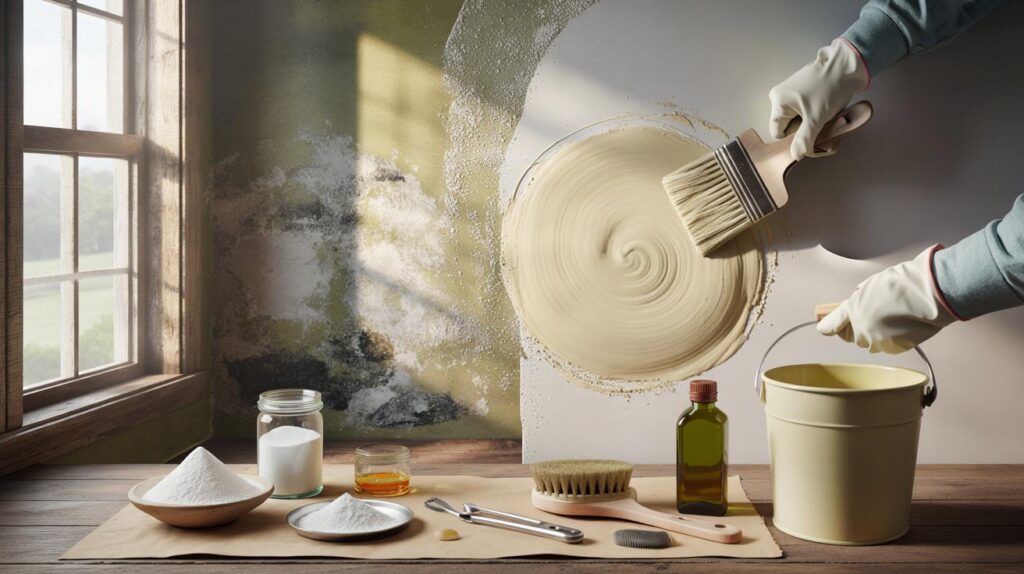
Cold months return, windows mist up, and that stale smell creeps back. Homeowners are turning to a breathable, old-world fix.
Instead of sealing damp behind plastic paints and pricey gadgets, a lime-based blend is back on the radar. It aims to let masonry exhale, cut that musty whiff, and show early gains in roughly two days.
A century-old method returns
Traditional builders favoured breathable finishes for a reason. Solid brick and stone draw moisture in and out through their faces. When you coat those faces with impermeable films, you trap vapour, encourage salt blooms, and feed mould on the surface layer. A simple mineral mix reverses that logic by encouraging controlled drying rather than blocking water outright.
The approach pairs slaked lime with a light oil and a small antifungal booster. Lime’s high pH discourages mould growth. Fine sand gives body without clogging pores. A modest dose of borate or a suitable substitute adds a defensive nudge. The result behaves like a thin, creamy, brush-on render that keys into the wall while staying vapour-open.
Applied in small patches with a stiff brush, the blend begins to feel dry to the touch within about 48 hours, while the musty odour fades as the wall starts to breathe again.
The four-ingredient mix and the simple approach
What you need
- Slaked lime (hydrated lime, not quicklime): about 2 kg for a small room wall
- Fine silica sand (up to 0.5 mm grain): about 3 kg to keep the mix open-textured
- Borax powder or “borax substitute” (sodium sesquicarbonate): roughly 250 g as an antifungal aid
- Olive oil (first cold press) 500 ml, or boiled linseed oil 300 ml if you prefer faster set
- Stiff masonry brush, wire brush, dust mask, gloves, protective glasses, and a 10‑litre bucket
How to apply in small sections
Lime is alkaline and can burn skin and eyes. Wear gloves and eye protection, keep children and pets away, and wash splashes with plenty of clean water.
Best timing and drying
Pick a dry spell in spring or early autumn if you can. Open trickle vents, prop doors, and run window fans on low. The surface firms up within two days. The stale smell eases within a week. With steady ventilation, new dark marks stop reappearing over the following month.
| Item | Typical quantity (5 m²) | Estimated cost (UK) | Notes |
|---|---|---|---|
| Slaked lime | 5 kg | £6–£10 | High pH discourages mould; use fresh, dry bag |
| Fine silica sand | 7.5 kg | £3–£6 | Keep grain under 0.5 mm for breathability |
| Borax or substitute | 600 g | £4–£8 | “Borax substitute” is widely sold in the UK |
| Olive oil or boiled linseed | 1–1.2 litres (olive) or 700 ml (linseed) | £6–£12 | Linseed sets quicker; olive stays more workable |
| Typical drying to touch: 48 hours with ventilation; full breathing effect builds over several weeks. | |||
Will it fix your damp?
Match the fix to the problem. This breathable coat helps where solid walls need to release trapped moisture: older brick, stone, lime mortar, and mixed masonry. It won’t solve a leaking pipe, a broken gutter, or ground levels bridging the damp course. It will not work over impermeable plastic paints or tanking slurries unless you strip them first.
- Condensation: common in bedrooms and kitchens. Improve airflow and add the lime blend where paint has bloomed with mould.
- Penetrating damp: check gutters, pointing, and sills. Repair outside, then use the mix to aid drying inside.
- Rising damp: this can carry salts. A breathable coat helps manage evaporation, but address ground levels and salts before cosmetic work.
If you trap moisture behind acrylic films, salts and mould return. A vapour-open finish gives that moisture a safe exit path.
Call a qualified surveyor if you see any of these red flags:
- Bulging plaster, crumbling mortar, or structural cracks
- Persistent wet patches after dry weather and ventilation
- White, furry salt crystals reforming quickly
- Timber decay, soft skirting boards, or beetle activity
- Unknown plumbing routes or recent leaks
Care, longevity and touch-ups
The finish weathers gently. Expect to refresh every seven to ten years, or sooner on windward walls. Before you tackle a full face, test a hand-sized patch behind a piece of furniture to check adhesion and shade. When cured, you can limewash over it to even the tone while keeping the wall breathable.
For routine care, wipe light marks with a barely damp cloth. Avoid detergents that leave films. If a scuff exposes sandy grains, brush on a spoonful of fresh mix and feather it out.
Money, air quality and sensible substitutions
A single small-batch application on a feature wall often costs between £10 and £20 in materials, far less than specialist coatings. It uses hand tools, no mains power, and it reduces reliance on energy-hungry dehumidifiers. You still need airflow, but the finish supports it by encouraging gentle evaporation across a larger surface.
Can’t find borax? Shops often sell “borax substitute” based on sodium sesquicarbonate. It lacks some of borax’s punch but still helps. The lime’s alkalinity already does most of the antifungal work. A few drops of tea tree oil per kilogram of mix add a pleasant scent and a small antimicrobial lift, though it’s optional.
Mind compatibility. Don’t smear this mix over gypsum skim, vinyl silk paint, or cement tanking. Strip back to a sound, porous face first. Keep the blend away from aluminium fittings, and mask adjacent timber if you plan to oil-wax later.
A weekend plan you can actually follow
Friday evening: clear the wall, lay dust sheets, and open vents. Saturday morning: prep with the wire brush and vacuum. Late morning: mix and treat the first 4 m² in tidy patches. Afternoon: tackle another 3–4 m² if you feel fresh. Sunday: light airing and no heavy heating. By Monday, the wall feels dry to the touch and the musty note has eased. Over the next weeks, moisture levels steady as the wall breathes.
If you want numbers, assume roughly 1 kg of wet mix per square metre on a light coat. A 12 m² wall needs about 12 kg of mix, which fits into two or three buckets. Keep batches small so the oil doesn’t separate, and stir often.



£12 and olive oil on walls? Sounds like a salad dressing. How does this not stain skirting or leave an oily sheen? Doesn’t it atract dust, too? And is borax petsafe once cured?
I tried a small patch on a cold stone wall this weekend—by Monday it was dry to the touch and the musty whiff had eased. Materials ran me ~£13.70. Definately helped, but ventilation was key.