
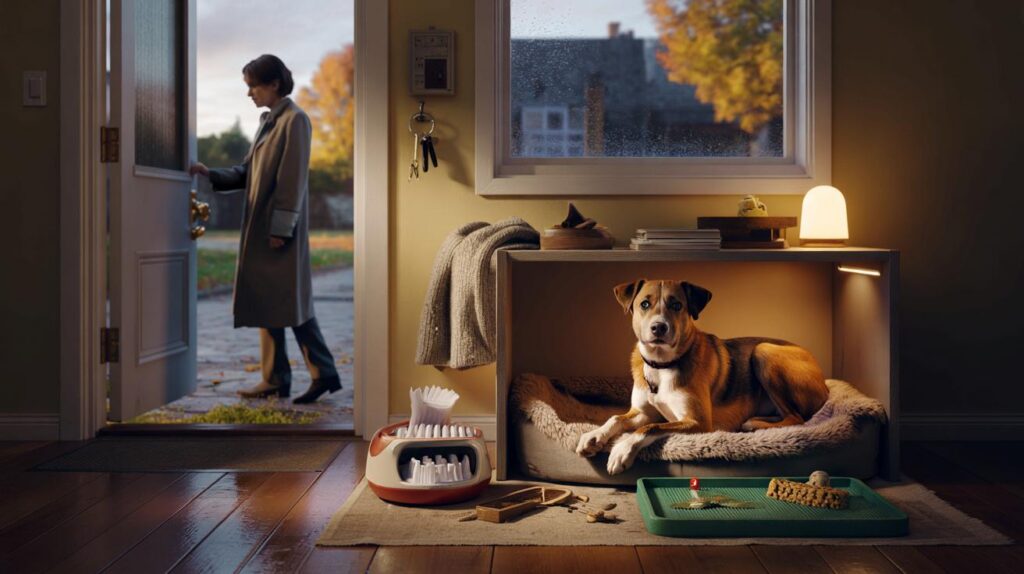
Short days and longer commutes have crept in. For many owners, the hallway goodbye now feels heavier than before.
The change of season can magnify a dog’s uncertainty at door time. A handful of practical, repeatable steps steadies the day and turns solo hours into calm ones.
Why separation spikes now
Autumn rearranges household rhythm. Walks shorten. People come and go at new times. Light fades earlier, which dulls stimulation and pushes some dogs towards restlessness. Add wetter pavements and hurried outings, and many pets get less sniffing, less problem-solving and less exercise. That cocktail nudges separation stress.
Predictability beats guilt. A clear pattern gives your dog a safe script for each departure and return.
Set the scene before you go
Dogs read the run-up to the door closing. Keep that pre-departure window steady and brief. Aim for regular times for feeding, toileting and a short, purposeful walk. Finish with something soothing your dog can do alone, then leave without fuss.
Rituals that take under 5 minutes
- Two-minute sniffy stroll or garden scent scatter to lower arousal.
- Place keys in the same spot, switch on low-volume radio, dim a lamp.
- Offer a safe chew or a puzzle already prepared in the fridge.
- Say “back soon” once, neutral tone, then go. No last-minute cuddles.
Scent matters. A soft item that smells of you — an old jumper or pillowcase — anchors your dog in familiar comfort. Position it near, but not inside, their resting area so they can choose.
Leave quietly; return quietly. Reward calm, not cling.
Give the brain a job while you’re out
Boredom feeds anxiety. Structured occupation helps. Use food-dispensing toys, snuffle mats and safe, long-lasting chews to convert waiting time into work time. Rotate options so novelty stays gentle but consistent.
Pick activities by setup, cost and duration
| Activity | Setup time | Typical cost | Occupied minutes |
|---|---|---|---|
| Stuffed rubber feeder | 3–5 minutes (prep the night before) | £10–£20 one-off | 15–30, frozen 30–45 |
| Snuffle mat with kibble | 2 minutes | £12–£25 | 10–20 |
| Cardboard box “forage” | 5 minutes | Free–£3 | 10–15 |
| Natural chew (size-appropriate) | 1 minute | £2–£6 per piece | 15–40 |
Space also soothes. Offer more than one resting place. Tweak textures: a firm mat, a fleece bed, a folded rug. Move the main bed away from draughts and windows that face busy streets. Provide a “den corner” with three sides and a roofed feel; plenty of dogs settle faster when partly enclosed.
Build independence without pushback
- Let your dog finish a chew or puzzle before calling them to you.
- Close an internal door for 30–60 seconds while you potter in another room.
- Add a cue like “on your mat” and reward calm stays with low-value treats.
Autonomy grows when the dog learns that good things happen while you are not the centre of the room.
Make the return unremarkable
Reunions set tomorrow’s expectations. Walk in, hang up your coat, put the kettle on. When four paws are on the floor and the tail slows, greet softly. A brief rub behind the ears or one small treat for quiet behaviour tells your dog that calm brings contact.
If you arrive to chewed post or scattered bins, tidy silently. Interactions tied to mess can turn chaos into a magnet for attention. Redirect to a quick sniff game on a towel, then later provide a suitable chew. Shape the behaviour you want by making it easy to choose.
Spot red flags early
Watch for patterns. Pacing, drooling, trembling at the door, continuous barking, indoor accidents or new destruction signal distress rather than “naughtiness”. A simple notebook or home camera can reveal whether stress peaks just after you leave or later during the day.
Short absences help the nervous system learn that time alone ends. Start with seconds, not minutes. Put on your coat, step out, count to ten, step back in. Repeat and lengthen gradually. Pair each step with something predictable: light music, a chew that appears only when you depart, the same calm word.
A 14-day confidence plan
- Days 1–3: Multiple micro-leaves of 10–60 seconds. One frozen feeder per day. Quiet returns only.
- Days 4–7: Build to 3–5 minutes behind the door. Add a snuffle mat on alternate sessions. Track your dog’s settle time.
- Days 8–10: Introduce one longer window of 10–15 minutes while you stand outside or sit in the car.
- Days 11–14: Two varied leaves daily, 5–25 minutes. Keep one easy win and one stretch target. Maintain the same pre-departure cue.
If any step triggers panic — frantic scratching, howling, panting that does not ease — drop back one stage and slow the pace. Progress beats speed.
Seasonal tweaks you can start tonight
- Add five minutes of nose work indoors: hide five pieces of food in one room, let your dog search. Sniffing lowers heart rate.
- Switch one fast walk for a slower, sniff-heavy loop. Quality beats distance when time is tight.
- Use warm, low lighting near the rest area from mid-afternoon to offset early dusk.
- Prepare three puzzle toys on Sunday night and rotate through the week to cut morning stress.
When to get extra help
If your dog cannot eat when alone, hurts themselves, or neighbours report long bouts of vocalising, bring in a qualified behaviour professional. A veterinary check can rule out pain. Anxiety often sits on top of discomfort from joints, teeth or gut, which flares in colder months.
Some households use a midday visitor twice a week. Others arrange desk days at home during early training. The goal is not constant company; it is a steady rise in your dog’s ability to relax when you are absent.
Additional ideas that broaden success
Teach a relaxation cue on a mat. Feed a scatter of tiny treats between your dog’s paws, then wait for a sigh, a hip lean or a head drop. Name that state with a soft word such as “rest”. Use it before you pick up keys. This conditions calm to the very cues that once caused worry.
Try a simple cost calculator for enrichment. Work out a weekly budget of £8–£12 for chews and fillers. Home-made options stretch that: mashed banana and yoghurt frozen in toys; damp kibble stuffed into cardboard tubes; vegetable sticks for low-calorie crunch. Rotate textures to keep interest high without chasing novelty.
Consider a parallel routine for you. Many owners carry tension from rushed exits. Lay out leads, prep toys and set timers the night before. A smooth human routine often produces a smoother canine one.



The step-by-step micro-leaves and “leave quietly; return quietly” mantra finally make sense. I’ve been guility of big reunions and chaos. Going to prep three puzzle toys Sunday and try the 14‑day plan. Love the cost breakdown too—£10 rubber feeder + freezer time is doable. One Q: for a clingy rescue who paces at the door, would you start with seconds even if he seems “fine” for 3–4 minutes, or is that too conservtive?