
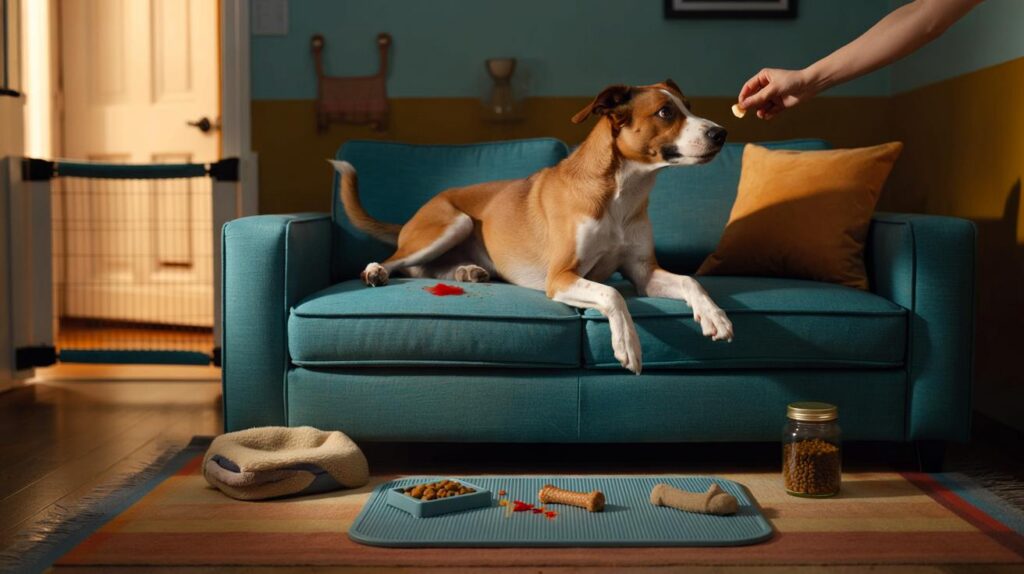
Cosy evenings, thicker blankets, longer nights. As the heating clicks on, many dogs edge closer to forbidden cushions and tempting corners.
That quiet drift indoors, paired with weaker daylight walks, often blurs boundaries. Owners sigh, dogs look puzzled, and living rooms turn into negotiation zones.
The giveaway signs your dog doesn’t grasp the rules
Sofa squats and sneaky exits
Finding a warm dent, a drift of hair or a damp nose mark on a cushion points to stealthy sofa time. If you walk in and your dog slides off slowly, avoids your gaze or offers a half-yawn, you’re seeing uncertainty. He knows there’s a line somewhere, but he can’t find it reliably.
A rule that changes with your mood teaches your dog to gamble, not to listen.
Watch the recovery after you intervene. A dog that ambles back towards the sofa within minutes likely sees the boundary as negotiable. A dog that heads to a mat on his own shows he recognises an alternative space, even if the rule needs reinforcing.
Door dashes, kitchen raids and confused looks
Bolting through the front door when it cracks open, counter-surfing the moment you turn your back, or responding to “off” in the lounge but not in the bedroom all flag patchy understanding. Context controls the behaviour because the rule lives in your tone, not in the cue.
- Delayed compliance: your dog waits to see if you really mean it today.
- Inconsistent body language: head low, ears half-back, then a quick bounce back to the banned spot.
- Room-specific obedience: perfect in front of you, gone when you leave the doorway.
- Time-based testing: rule holds at night, collapses on weekend mornings.
Why mixed messages derail your dog’s sense of safety
Intermittent reinforcement turns rules into a slot machine
Let the sofa rule slip once in a while and you create a powerful habit. Variable pay-offs make dogs try harder and longer. Your dog isn’t plotting; he is learning that persistence sometimes wins. That breeds frustration, not trust.
Consistency beats intensity: small, steady rules outlast big speeches.
Seasonal shifts make this worse. More time indoors means more chances to practise the wrong behaviour. If the boundary moves with guests, bad weather or a cosy film night, your dog learns that people, not cues, determine the rule.
| Behaviour you see | What it signals | Quick response |
|---|---|---|
| Jumping onto the sofa when you leave | Rule linked to your presence, not the space | Teach a mat cue and reward it when you stand up |
| Hovering paws on cushion edge | Testing the boundary for clarity | Guide to the mat, pay immediately for four paws on it |
| Ignoring “off” in some rooms | Context dependence; cue not generalised | Train the cue in every room and at different times |
| Rapid re-offending after correction | Intermittent wins maintain the habit | Remove access when unsupervised; rehearse the right choice |
Set up clear, kind boundaries that stick
Make the alternative more rewarding than the sofa
Dogs choose what pays best. Build a magnetic “place” by pairing a mat or bed with food, chew time and calm praise. Then ask for “on your mat” before you sit down. Pay again during adverts, not only at the start.
- Place the mat where your dog can still see you.
- Feed three to five tiny treats on the mat, one by one, as you settle.
- Hand a long-lasting chew on the mat during your film or call.
- Release with a cue before the end, so leaving the mat feels safe.
Block the wrong choice while the habit resets. Close a door, use a light barrier or flip the cushions when you go out. Manage first, train second, then fade the management as the new routine holds.
One rule, one voice: align the household
Agree the rule in plain language: sofa never, sofa only on cover, or sofa by invitation. Write it down. Share the exact cues and rewards. Ask visitors to follow the same script for a week. A stable pattern calms the dog and removes guesswork.
If you permit it sometimes, your dog hears “perhaps”. Aim for “always” or “never”, not “depends”.
Fast fixes under £10 that change the game
You don’t need pricey gadgets. Small tweaks shift habits fast when you pair them with training.
- Non-slip mat under a dog bed: boosts comfort and keeps the bed put.
- Lightweight baby gate: blocks door dashes without slamming doors.
- Cheap fleece throw: a clear “allowed” cover you can remove to say “not now”.
- Door hook or latch: creates a settle zone during deliveries.
- Treat pouch or jam jar of kibble: rewards close at hand for the right choice.
Troubleshooting and when to seek help
Age, pain and big feelings can look like “rule-breaking”
Adolescence between six and eighteen months brings risk-taking and short fuses. Senior dogs may struggle to get comfortable on hard floors and climb onto soft spots for relief. Sudden changes, new soiling or a sharp rise in clinginess can signal pain or stress. Ask your vet to rule out discomfort before you tighten boundaries.
Upgrade your cues and proof them room by room
Pair a clear marker word like “good” with a treat for two days, then use it to highlight the instant your dog chooses the mat. Train “off” by paying four paws on the floor, not by repeating the cue. Practise in the lounge, kitchen and bedroom, at breakfast, after work and late evening, until the cue survives every context.
Extra angles that help the message land
Give the day a rhythm. A simple circuit—sniffy walk, ten minutes of training, chew on the mat—soaks up energy and reduces rule-testing. Try a 3-2-1 settle: three minutes on the mat with snacks, two minutes with a chew, one minute with quiet praise. Repeat twice daily for a week.
Plan for temptation. Before guests arrive or the roast goes in, set the environment: gate the kitchen, pre-load the mat with value, and clip a lightweight lead for gentle guidance. This prevents rehearsal of the wrong move and keeps emotions steady. The advantage shows within days: fewer stand-offs, quicker settles, and a dog that finally understands what the house expects.



My dog read this and said the sofa is ‘by invitation only’ — he invited himself. Help? 😅