
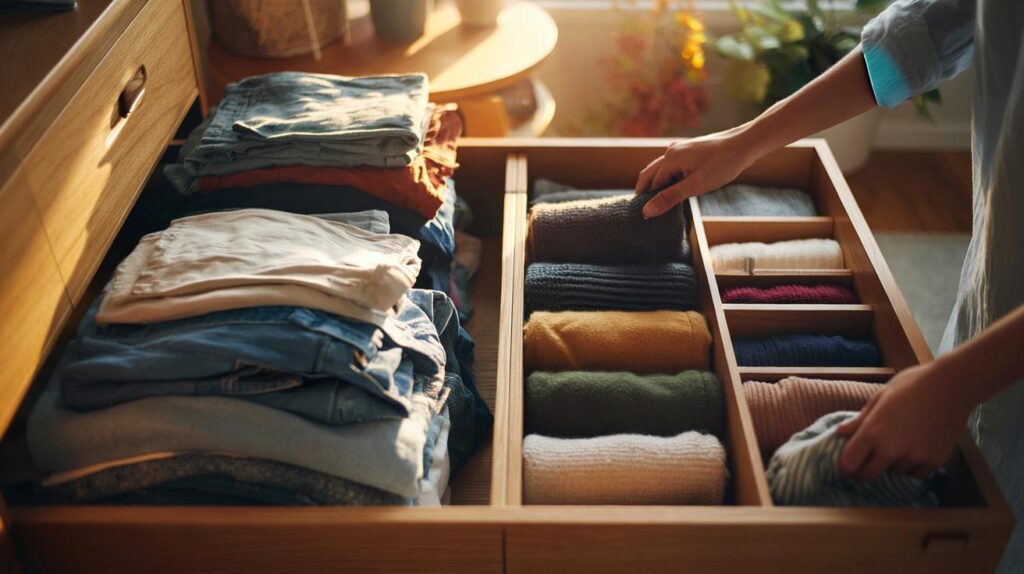
Autumn is back, wardrobes groan, mornings tighten, and households reach for quick fixes that never quite stick again at home.
Across the country, the seasonal swap has begun. Bulky knits arrive, summer bits linger, and drawers start to jam. Instead of buying more storage or dumping clothes you still wear, a small change in folding habits can hand back space, speed and calm.
The seasonal squeeze: why your drawers overflow
When we stack jumpers and tees in piles, the bottom layers carry the weight. Fabric compresses, edges kink, and every rummage collapses the stack. Visibility vanishes, so you wear the top three items on repeat and forget the rest. The result is time lost, fibres creased, and a nagging sense of clutter.
Households who switch from stacking to rolling often report a space gain of around 30–40% and a faster morning routine.
The secret sits in how you store surface area. Flat stacks waste height and encourage avalanches. Cylinders use depth efficiently, hold their shape, and let you file items like books. You can scan every option at a glance without disturbing the row.
The space trick everyone can try
What rolling actually does
Rolling compacts fabric evenly into a stable cylinder. The roll fills awkward corners, reduces dead air between garments and avoids the pressure points that cause sharp creases. Store rolls vertically in drawers or horizontally in boxes; both methods keep lines tidy and choices visible.
Think of your drawer as a bookshelf: each rolled garment stands spine-out, so nothing hides and nothing topples.
Step‑by‑step method
- Lay the garment flat and smooth with your hands to release surface wrinkles.
- Fold sleeves or legs inward to create a clean rectangle, then, if needed, fold lengthways once.
- Roll from the hem to the neckline with firm, even tension. Avoid over‑tight rolling that strains seams.
- Stand rolls upright in the drawer, edge facing up, so labels or colours are visible at a glance.
- Group by type and thickness for consistent rows that slot snugly into the space.
Crease control: why rolls look fresher
Creases form where fabric bends sharply and then bears weight. Stacks create right angles at the fold and compress layers from above. Rolls spread pressure around a curve, so fibres relax instead of collapsing. That means fewer harsh fold lines on cotton tees, fleeces and denim, and less time spent with the iron.
For wool and cashmere, roll loosely to prevent stretching, and store in breathable boxes to reduce snagging. For silky blouses and tailored shirts, a traditional fold or hanger still wins because cut and drape matter more than compactness.
Roll snugly, not tightly. Aim for a firm cylinder that holds its shape without tugging the fabric.
Proof in numbers: a quick drawer simulation
Take a standard bedroom drawer: 60 cm wide, 50 cm deep, 15 cm high. That’s 45 litres of volume. Stacking often wastes 10–15 litres as gaps open around uneven piles and the top layer remains unusable once the drawer jams. By switching to rolls, you reclaim much of that lost capacity.
| Method | Usable space | Visibility | Crease risk | Speed to retrieve |
|---|---|---|---|---|
| Stacking flat | Low to medium | Poor | High at folds | Slow, piles collapse |
| Classic fold (file‑style) | Medium | Good | Medium | Moderate |
| Rolling | Medium to high (up to ~40%) | Excellent | Low for casual fabrics | Fast, one‑grab access |
Translate that into garments: if your drawer currently holds 20 T‑shirts at 2–3 cm thickness each, rolling can raise capacity to around 28–30 tees by reducing wasted air and edge gaps. The gain grows with mixed wardrobes that include socks, gym tops and pyjama bottoms, as small rolls tuck neatly into corners.
What to roll, what to fold, what to hang
Best candidates for rolling
- T‑shirts, polos and vests.
- Denim, joggers and casual trousers.
- Knitwear with stable yarns, such as cotton blends and fleece.
- Pyjamas, base layers and sportswear.
- Scarves, leggings and children’s clothes.
Better folded or hung
- Tailored shirts, blazers and structured skirts.
- Silk, satin and delicate viscose that bruise easily.
- Heavily embellished items or anything with beading.
- Thick hand‑knits that stretch under their own weight.
Small homes, busy families, tight mornings
Rolling shines where space and time pinch. In shared rooms, each child can get a row per drawer. In flats with narrow wardrobes, rolls sit in boxes that pull out like drawers. In a suitcase, the same approach stops mid‑trip chaos and puts outfits within reach without digging to the bottom.
One routine, three wins: clearer drawers, quicker choices, and fewer ironing sessions through the week.
Common mistakes and how to avoid them
- Rolling too tightly: this strains seams and can mark delicate fibres. Keep tension even and moderate.
- Mixing bulky and thin items in the same row: the line slumps. Group by thickness for a stable grid.
- Overfilling the drawer: leave a finger’s width at the top so rolls don’t snag when you close it.
- Ignoring humidity: damp rooms lead to musty fabric. Add cedar blocks or a small moisture absorber.
- Skipping a monthly reset: a five‑minute tidy keeps the system honest and stops silent creep.
Add‑ons that boost the gain
- Simple dividers: cardboard, shoe boxes or off‑the‑shelf organisers hold rows upright and stop drift.
- Labels: size or type labels on box fronts speed up family dressing and laundry put‑away.
- Seasonal rotation: store out‑of‑season bulk in breathable bags under the bed to free prime space.
- Colour coding: sort by darks, lights and colours to streamline laundry flow and reduce dye mishaps.
Time and energy: the hidden savings
Fewer creases translate into fewer ironing hours and lower electricity use. If a household cuts two weekly ironing sessions of 20 minutes, that’s nearly 35 hours saved over a year, plus a tangible trim on the energy bill. Quicker morning choices also reduce stress, which tends to curb impulse buys driven by frustration.
For a quick check at home, time your current routine from opening the drawer to picking an outfit, then try a rolled drawer for a week and time it again. Most people shave several minutes off school or work mornings, and those minutes add up across a busy month.
A practical plan you can start tonight
- Pick one drawer only. Empty it, wipe it, and measure the inside height to plan roll size.
- Sort by keep‑in‑season and off‑season. Bag off‑season items separately for another day.
- Roll 10 garments, stand them spine‑out, and adjust spacing with a spare shoe box as a divider.
- Live with it for seven days. If a row slumps, tighten grouping or reduce the drawer count by two pieces.
If you want to go further, pair rolling with a capsule approach for high‑wear categories. Keep 10 everyday tees, five gym tops and three long sleeves in rotation, store duplicates in labelled boxes, and replenish as pieces wear out. This narrows choice without feeling strict and keeps the drawer layout stable.



Just tried rolling tees; went from 22 to 30 in my 60×50 drawer—no jam when closing. The bookshelf analogy finally clicked, and I can see every color at a glance. Morning grab time: under 20 secs, no joke.
40% sounds optimisitc—are those numbers measured or just anecdotal? My cotton shirts still crease when rolled; could fabric weight or over‑tight rolling be the culrpit? Any data beyond a quick drawer simulation?