
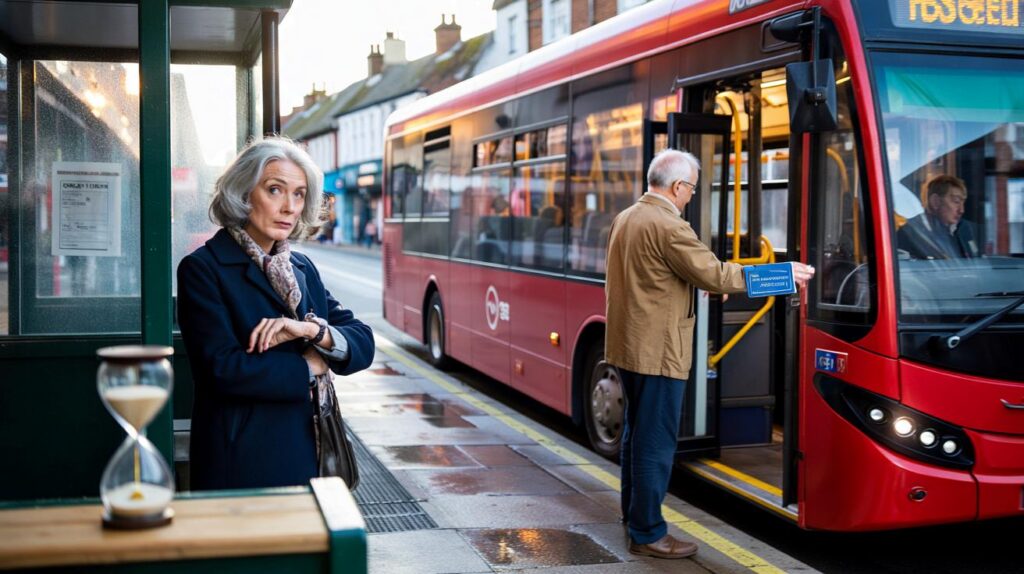
Millions counting on cheaper journeys face a fresh timetable change, with knock-on effects for wallets, communities and local routes.
From April 2026, ministers will align England’s concessionary bus pass with the rising State Pension age, resetting expectations about who travels free and when.
What changes and when it happens
The Department for Transport has confirmed that, from next April, many people in England will need to wait an extra year for a free bus pass. Eligibility will track the State Pension age as it moves from 66 to 67, a shift scheduled to complete by 2028 under the Pensions Act 2014.
From April 2026, the qualifying age in England begins its rise from 66 to 67, with full changeover by 2028.
The policy links the right to a concessionary bus pass to the same timetable as the State Pension. That means the pass arrives later for those approaching retirement, mirroring the national retirement-age timetable.
A phased timetable tied to birth dates
The acceleration of the State Pension age was legislated in 2014. People born between 6 March 1961 and 5 April 1977 will reach State Pension age at 67, and their bus pass entitlement will shift accordingly. Those already holding a pass keep it. Those who turn 66 after the change begins will wait until their 67th birthday.
How the rules differ across the UK
England is out of step with the other nations. Scotland, Wales and Northern Ireland offer free bus travel from age 60. Campaigners argue this creates a postcode effect for older residents south of the border.
| Nation | Standard age eligibility | Notes |
|---|---|---|
| England | State Pension age (rising to 67 by 2028) | Local councils can add extra concessions using local funding |
| Scotland | 60 | National scheme |
| Wales | 60 | National scheme |
| Northern Ireland | 60 | 60+ SmartPass and an older person’s pass |
Who in England can still qualify earlier
Local authorities may choose to lower the eligibility age using their own budgets. London’s 60+ Oyster card and Merseyside’s local concessions are examples of councils funding more generous provisions.
Councils can top up the statutory offer: some areas keep free bus travel from 60 by using local resources.
Availability and rules vary by area. Residents must apply to the council where they live, not the council where they travel.
What the DfT says and the money behind it
The English National Concessionary Travel Scheme costs around £700 million a year. The government recently announced £1 billion for buses, with roughly £712 million routed to local authorities to improve services. Town halls may use those funds for service reliability, lower fares, or to extend local concessions.
Officials say the age change protects the scheme’s long-term finances while aligning it with retirement-age policy. Transport bodies will watch reimbursement costs, fare revenues and passenger numbers as the age shifts upward.
When and how you can use the pass
Rules on when you can travel for free remain unchanged. The pass covers off-peak local bus journeys across England.
Free travel runs from 9.30am to 11pm on weekdays, and all day at weekends and on bank holidays.
- Your pass is valid on most local bus services in England, not long-distance coaches or tourist routes.
- Disability-based concessions are not tied to age; separate eligibility criteria apply.
- You apply through your local council, which issues the card and sets any extra local benefits.
Campaigns and the politics
A petition calling for free bus travel for all over-60s in England has passed 100,000 signatures and awaits a parliamentary debate. Supporters argue that bringing England into line with the devolved nations would boost mobility, health and inclusion for people who drive less as they age.
The Department for Transport points to devolved arrangements and says councils already have powers to add discretionary concessions. Ministers also emphasise the need to balance fairness, costs and service quality.
What it means for you
The immediate impact is calendar-based. If you turn 66 after April 2026, you may need to wait until 67 for your pass unless your council funds earlier access.
- Born 5 March 1961 or earlier: your current position remains unchanged.
- Born 6 March 1961 to 5 April 1977: expect the free pass at 67, in line with your State Pension age.
- Living in a generous local scheme: you might still qualify from 60, subject to local rules and budgets.
- Holding a disability pass: your entitlement is based on disability criteria, not age, and continues as normal.
Two real-world examples
Case 1: A resident born in July 1961 in Kent turns 66 in 2027. Under the new timetable, their bus pass arrives at 67 in 2028 unless Kent funds an earlier local concession.
Case 2: A resident born in October 1964 in London turns 60 in 2024. They can use the city-funded 60+ card until reaching State Pension age, after which the national pass takes over.
Impact on buses and budgets
Raising the age may defer some concessionary travel and increase fare-paying trips among 66-year-olds. Operators could see short-term revenue support from those additional fares, while councils may face pressure to expand local concessions to soften the change.
If more people pay for journeys at 66, services might gain resilience on marginal routes. Yet the risk is that some will cut back on travel, which could reduce footfall for high streets and out-of-town clinics. The £712 million allocated to local authorities can target reliability, frequency and multi-operator tickets, which benefit all passengers, including those waiting for their pass.
How to check and apply
You apply through your local council. You will usually need proof of age or disability, a photo, and proof of address. Processing can take several weeks, so apply ahead of your qualifying birthday. Digital tools on council sites often allow status updates and renewals.
If you live close to a boundary, remember that eligibility and extra perks differ by council. Always check the rules where you are registered to vote and pay council tax.
Ways to bridge the gap until you qualify
- Ask your council about interim discounts such as older person’s railcards, combined bus-and-rail deals, or capped daily bus fares.
- Look for operator-specific saver tickets that mirror off-peak bus pass hours.
- Plan medical or shopping trips during off-peak times to benefit from lower fares, multi-journey tickets, or caps.
- Check community transport schemes that offer low-cost door-to-door services for people with mobility needs.
Key facts to keep in mind
England keeps the national off-peak scheme, but shifts the age to match the pension timetable: 66 towards 67, completing by 2028.
The change does not cancel existing passes. It does not alter disability-based eligibility. Councils retain the power to be more generous locally if they can fund it. Those nearing 66 should check their birth-date window, their council’s policy, and the earliest application date to avoid a gap in travel support.



England moving to 67 while Scotland, Wales and NI stay at 60 feels like a postcode lottery. If local councills “top up” from their own budgets, won’t richer areas keep earlier access while poorer ones can’t? Also, pushing people to pay at 66 could cut essential trips—clinic visits, volunteering, caring—exactly when people start to scale back work. Where’s the impact assesment on rural routes and small towns?