
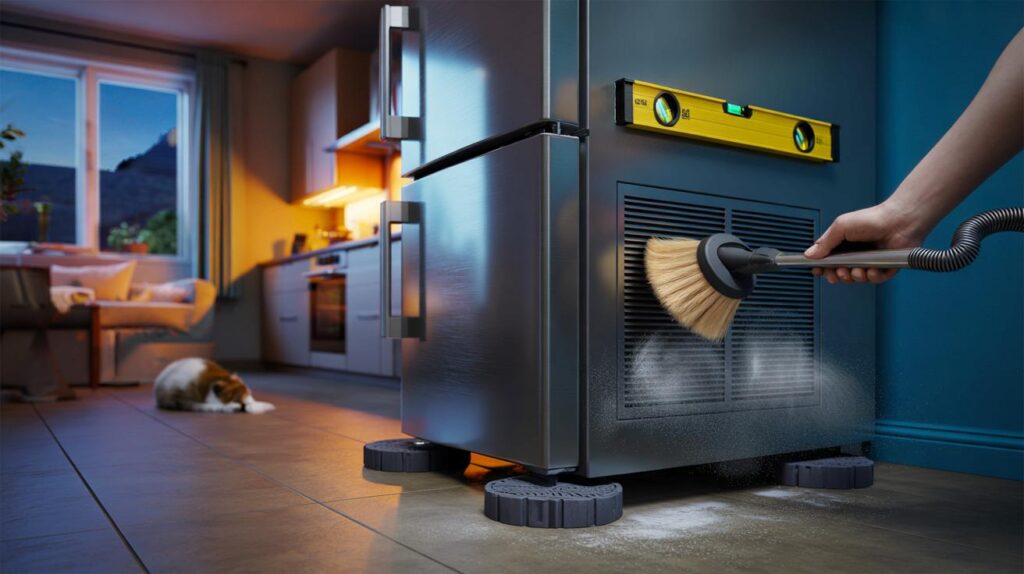
That relentless hum can drain your focus and cash. The cure often sits behind the fridge door, not in a new appliance.
Open-plan living puts the fridge in the thick of daily life. When the sound swells, the kitchen feels tense and your bill creeps up. A few targeted tweaks can calm the racket, shorten compressor run-time and trim electricity use. You won’t need a toolbox the size of a van, just a method and ten spare minutes.
Why your fridge gets loud
Most noisy fridges point to simple mechanics, not a terminal fault. A unit that sits out of level vibrates, and cabinetry can act like a drum. Close bottle necks clink together, shelves buzz, and anything pressed against the back panel resonates. Dust chokes the rear grille and the fan, so the system works harder and the tone deepens.
Clearance matters. Sound bounces off hard surfaces, and cramped gaps trap heat. Pull the cabinet out and leave at least 5 cm around the sides and back. That extra space frees airflow and breaks the echo path into walls and worktops.
Aim for at least 5 cm of space around the fridge and clean the rear grille twice a year. Many households hear an immediate drop.
Noise also changes with cycles. After a big shop or a warm door left open, the compressor runs longer. You may hear gurgles from refrigerant, soft clicks from relays, or gentle crackles as plastics expand and contract. These pass. Persistent rattles, harsh scraping, or a whine that builds deserve attention.
As a guide, many “quiet” models sit near 35 dB at one metre in a still room. Your goal isn’t the catalogue number; it’s a clear step down at home after you adjust and clean.
Instant quiet: practical steps that save energy too
- Level the cabinet: use a spirit level and adjust the feet until the door closes on its own from halfway open.
- Make space: pull the fridge 5–7 cm from the wall; keep the top free and vents unobstructed.
- Secure the inside: separate glass bottles, seat shelves fully, and stop containers from touching the back panel.
- Clean the rear: unplug, brush the grille and fan, and vacuum gently. Repeat every six months, and before winter.
- Defrost: clear frost thicker than 5 mm. Lab tests show ice build-up can push freezer consumption up by 10–30%.
- Set sensible temperatures: 4°C in the fridge, −18°C in the freezer. Colder settings extend run-time and noise.
- Check door seals: close a paper strip in the door; if it slides out freely, replace the gasket.
- Dampen vibrations: fit rubber anti-vibration pads under the feet; they isolate the cabinet from rigid floors.
- Tighten gently: look for loose screws or brackets around the compressor shroud and fan guard; nip them without over-torquing.
Target 4°C in the fridge and −18°C in the freezer. Each extra degree colder can raise electricity use by roughly 5–10%.
Don’t overload the cabinet. Cool air needs pathways. Leave gaps between containers so the fan doesn’t drone as it forces air past blockages. After a big load, expect a temporary hum; it should settle once temperatures stabilise.
What that noise means
Match the sound to a likely cause and act early.
| Sound | Probable cause | Action |
|---|---|---|
| Gurgling or sloshing | Refrigerant flowing after a cycle | Normal; check again after 10–15 minutes |
| Soft crackles | Materials expanding or contracting | Normal; review shelf seating if frequent |
| Rapid clicking | Compressor relay cycling, power issues | Unplug; call a technician if it persists |
| Persistent rattle | Loose panel, bottle contact, grille buzzing | Tighten screws, separate items, add pads |
| High-pitched whirr | Fan blade touching debris or ice | Defrost fully; clean fan and clear obstructions |
| Harsh buzz with hot sides | Overworked compressor, poor ventilation | Increase clearance; service if heat feels excessive |
Bring overall noise close to 35 dB at one metre. That’s library-level sound and a relief in open-plan rooms.
When to stop and call a professional
Cut power and seek help if you notice any of the following: a burning smell, visible arcing, rapid clicking that goes on for minutes, a compressor that runs constantly without cooling, fresh seals that still leak, or heat on the side panels that feels uncomfortable to touch. A qualified technician can test relays, fans and compressor mounts, and prevent a small fault becoming a costly failure.
What you could save, in pounds and decibels
A modern A-rated fridge-freezer might use 150–220 kWh per year; an older unit can exceed 300 kWh. With a typical unit price of 24p per kWh, each 10 kWh trimmed equals about £2.40.
- Coil and fan cleaning: 5–10% less consumption on some units, worth roughly £3–£7 a year on a 150 kWh fridge.
- Regular defrosting: 10–30% on a frost-laden freezer; that’s £5–£16 if your freezer uses 200 kWh annually.
- Temperature sanity check: easing from 2°C to 4°C often shaves 5% or more without food safety risk.
- Anti-vibration pads: £8–£15 upfront; they cut structure-borne noise and protect neighbours in flats.
Noise perception is logarithmic. A 3 dB drop is noticeable; 10 dB sounds roughly half as loud. Decoupling feet, better spacing and a clean fan can easily yield a 3–6 dB reduction in a kitchen with hard surfaces.
Open-plan survival: placement and routine that work
Position with purpose
Keep the fridge away from corners and rigid end panels that trap sound. Avoid tight alcoves. If it must sit under a counter, line the cabinet sides with thin closed-cell foam to stop panel buzz. Do not block ventilation paths.
Set a maintenance calendar
- Every month: paper-strip test on door gaskets; quick check for rattling shelves.
- Spring and autumn: unplug, dust the rear grille and fan; wipe the drain channel inside.
- When frost reaches 5 mm: full defrost of the freezer compartment.
- After a move or deep clean: re-level and re-space to 5–7 cm from the wall.
Hands-on checks that make you confident
Use a free sound meter app to take a one-metre reading before and after your tweaks. Note the loudest part of a 10-minute cycle. Track the improvement rather than chasing a catalogue figure. A smart plug with kWh logging can reveal long compressor cycles after you adjust temperatures; shorter cycles usually mean less noise and lower cost.
Try the door test: open the door 45 degrees and release. A correctly tilted, levelled fridge should close itself gently. That small tilt prevents half-shut doors, stale air and the droning that follows as the motor fights warm leaks.
Vibration physics sits on two ideas: mass and decoupling. Heavier worktops can carry hum across a room. Rubber pads under feet, a thin cork mat between appliance and skirting, and felt dots behind rattly back panels break the path. You get less buzz without touching the sealed system.
Food safety and energy balance
Keep milk and ready-to-eat foods at 4°C. Use a fridge thermometer to verify the middle shelf, not the door. A warmer setting saves energy but respect safe ranges. Pack the freezer efficiently; a well-filled freezer holds cold better and runs quieter after the door closes. Leave space around vents so the fan doesn’t sing.
If the fridge still roars after you clean, space and level it, compare its age and label to current models. A 15-year-old unit at 300+ kWh per year can cost over £70 more annually than a modern 180 kWh cabinet at 24p per kWh. A quiet replacement adds calm and pays back over a few winters, but only choose it once simple fixes fail.



Brilliant guide! I pulled my fridge 6 cm from the wall and cleaned the rear grille; hum dropped from ~42 dB to about 36 on a phone app. Definately cheaper than a replacement—thanks!