
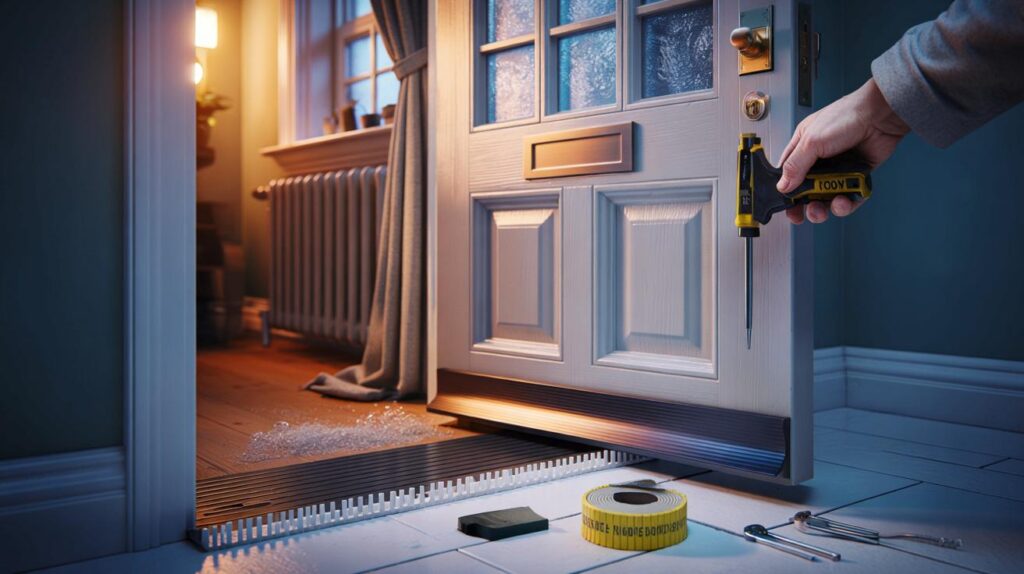
The hallway feels icy, the thermostat creeps up, yet bills balloon. The culprit hides where you least expect.
Across Britain, a small gap around the front door turns a cosy home into a wind tunnel and pushes heating spend higher. You feel it at ankle height, you hear it on gusty nights, and you pay for it every month.
Why your front door leaks heat
A front door can look solid and still leak like a sieve. Thin gaps at the threshold, along the hinge side, or around the lock pull warm air out and pull cold air in. Radiators run longer to compensate and the hallway never warms up.
Tell-tale signs show up quickly: a chill on your feet, a faint whistle, or the smell of outside air in the hall. On windy days, the draught grows stronger and the boiler cycles more often.
Research and field tests suggest uncontrolled infiltration can drive up to 20% of space-heating losses in a typical home.
That 20% does not come from one giant hole. It comes from tiny, persistent gaps. The biggest culprit often sits right under the door leaf at the threshold, followed by flattened or missing compression seals around the frame, a flappy letterbox and an unprotected keyhole.
Fast fixes you can fit today
Door sweep or drop-down seal
A door sweep (a rigid strip with a flexible blade) screws to the bottom edge and closes the floor gap. A drop-down seal sits discreetly in a routed groove and lowers when the door shuts. Both block the major highway for cold air.
Fresh compression seals
Self-adhesive foam or rubber P-seals press against the door and stop side leaks. Choose a profile that compresses 25–50% when the door closes. Too thin, and air slips past; too thick, and the latch won’t engage.
Thermal curtain behind the door
A heavy, full-height curtain on a rail across the inside of the door traps a layer of still air. It tames gusts and evens out temperature in the hall without touching the door itself.
Letterbox and keyhole control
A brush-style letterbox cowl and a simple escutcheon with a spring flap block a surprising leak path. They cost little and take minutes to fit.
- Choose a sweep that spans the full width of the door and trims cleanly to the skirting.
- Clean and dry the frame before sticking new seals to ensure they stay put.
- Hang the curtain 20–30 mm from the floor to avoid dragging and to seal better.
- Test the latch and deadbolt after sealing; adjust the strike plate if the door binds.
Most households can fit a sweep, renew seals and add a thermal curtain in under an hour with basic tools.
Step-by-step: stop draughts in 10 minutes
Pick a breezy day. Close the door and run the back of your hand slowly around the frame, threshold, letterbox and keyhole. Mark any cold spots with a bit of masking tape.
Brush and vacuum the threshold and frame. Wipe with methylated spirits where you will stick seals. Fit the sweep flush to the floor on the inside face. Stick new compression seals starting at the hinge side, then the latch side, then the head. Finally, screw on a letterbox brush and fit a keyhole cover. Test the close and latch pressure; tighten hinges if the door sags.
What it costs, how long it takes, what it saves
| Measure | Typical cost | Time to fit | Indicative annual saving |
|---|---|---|---|
| Door sweep or drop seal | £12–£45 | 10–25 min | £30–£90 |
| Compression seals (full frame) | £8–£25 | 15–30 min | £20–£60 |
| Thermal curtain and rail | £25–£80 | 15–20 min | £20–£70 |
| Letterbox brush and keyhole flap | £8–£20 | 10–15 min | £10–£30 |
Figures vary with door type, exposure to wind and how leaky the door was to start with. Still, most homes feel warmer the same day and need fewer boiler cycles.
How much could you save? a quick calculation
Take a household spending £1,560 a year on heating fuel. If uncontrolled air leakage accounts for 20% of space-heating losses and the front door is a major share of that leakage, targeted sealing might cut that portion in half.
That gives a rough saving of £1,560 × 20% × 50% = £156. In draughty, wind-exposed homes that number can be higher. If your heating spend sits nearer £3,120, halving that 20% leakage lands around £312. These are illustrations, not promises, but they explain why small gaps produce big bills.
Checks that boost performance
Look along the bottom edge from the outside at night: if you see light under the door, you have a leak path. Slide a sheet of paper between door and frame; if it moves freely when the door is shut, fit a thicker seal at that spot. If the lock needs a slam to catch, adjust the strike plate rather than thinning seals.
If your door opens onto strong prevailing winds, add a weather bar or threshold plate to divert water and air away from the gap. Around glazed panels, fit glazing tape or beading gaskets if you feel cold rings near the glass edge.
Renters and listed homes
Renters can stick foam seals, hang a curtain on a tension rod, use a weighted draught sausage and fit a reversible letterbox brush without drilling the door. Keep packaging and remove cleanly at the end of the tenancy. For listed frames, use non-invasive options and ask a joiner for drop seals that don’t alter the appearance.
Avoid common mistakes
- Do not block trickle vents; you need controlled ventilation to manage moisture and indoor air quality.
- Do not seal over damp timber; dry it first or the adhesive will fail.
- Avoid over-thick seals that cause warping or latch misalignment.
- Do not forget the threshold; a perfect frame seal still leaks if the bottom gap stays open.
When a new door makes sense
If the door leaf is twisted, the frame out-of-square or rot has taken hold, sealing becomes a sticking plaster. A well-fitted insulated door with proper compression gaskets and multi-point locking can reduce infiltration and improve security. Ask for a test-fit and insist on a continuous threshold seal. A correct installation beats a high-spec slab with sloppy gaps.
Keep it working all winter
Check seals monthly. Clean grit from the threshold so the blade doesn’t wear. Tighten hinge screws and lubricate moving parts with a light spray. If seals flatten, replace short sections rather than the whole run. After storms, re-check the letterbox and sweep for damage.
Extra ways to lock in warmth
Pair door sealing with loft hatch sealing and a simple chimney balloon in unused fireplaces to stop the stack effect from pulling warm air out through the roof. Set your thermostat to a steady, comfortable level and use time schedules so the boiler doesn’t chase a cold hallway all day. A small rug that stops short of the sweep helps seal while keeping the floor warm underfoot.
If you want numbers before you buy, run a 15-minute fan test with a smoke pencil or incense stick: count the seconds it takes smoke to pull through the gap before and after you fit each measure. Faster movement means a bigger leak; the difference gives you a real-world gauge of improvement.



Brilliant guide—clear, actionable, and cheap. I added a sweep and fresh P-seals this afternoon and the whistling stopped instantly. One snag: the latch now needs a firmer push; any quick trick to adjust the strike plate without misaligning the deadbolt? Also, for composite doors with slightly bowed leaves, is a drop seal still worth it or am I chasing a wonky frame?