
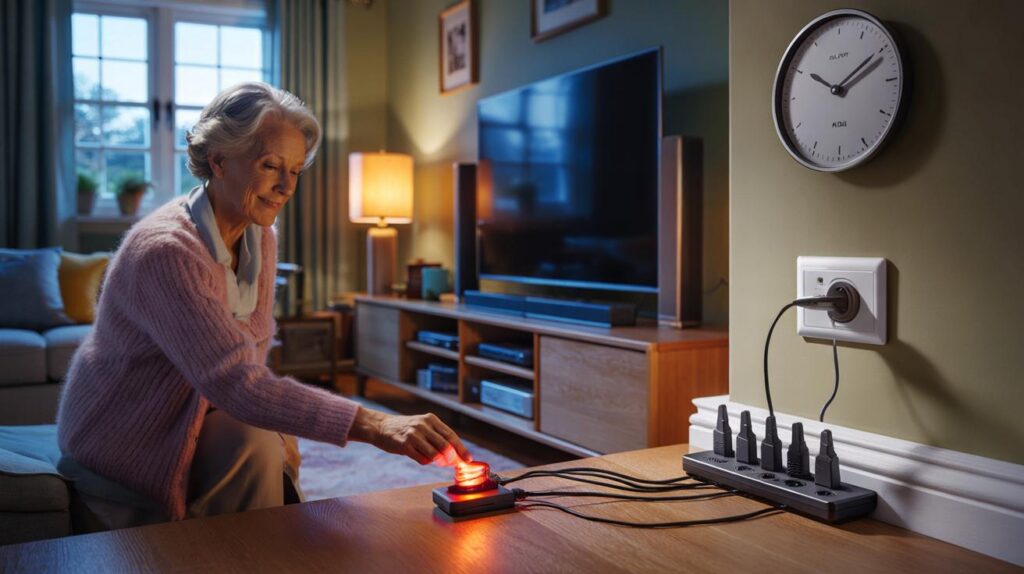
As bills creep higher, a plain, old-school routine is sweeping living rooms, kitchens and bedrooms, trimming costs without new tech.
A post-war habit is back in fashion: cut power to clusters of gadgets while you sleep, using a simple timer and a switched strip. Households report slimmer bills, calmer rooms without blinking LEDs, and no loss of comfort or convenience.
Why a nightly switch-off saves real money
Standby power leaks away cash. Set-top boxes, televisions, speakers, consoles, coffee machines, smart assistants and chargers sip electricity all night. One device might only draw a few watts, yet the pile adds up. Switch off those groups for the hours you never use them and you bank real savings without changing your routine.
Cutting standby power for 7 hours each night can trim 5–15% from plug-load costs. In homes with heavy gadget use, savings near 15% are realistic.
The idea is not new. In the 1950s, families used mechanical timers to control lamps and heaters when electricity felt precious. The modern twist is to group “always-on” gadgets on a switched power strip and let a 24‑hour timer kill the current overnight. No apps, no pairing, no subscriptions; just a reliable click at set times.
The hidden drain: standby loads and chargers
Device makers have cut standby consumption, but many bundles still draw 60–300 W combined. A soundbar that listens for a remote, a TV that wakes for HDMI, a set-top box that keeps a hard drive spinning, a games console that updates while you sleep, and an espresso machine that keeps its electronics warm: together they drink power quietly.
How a £15 mechanical timer does the heavy lifting
Plug a £15 24‑hour mechanical timer into the wall. Add a six‑socket, surge‑protected power strip with a switch. Set the timer to cut electricity from 23:00 to 06:00. That’s 7 hours of guaranteed off-time every night. Your gadgets keep their settings, and you still use them as usual during the day. If your evenings run late, shift the window to fit your life.
What you need to copy the trick today
- One six‑socket power strip with an illuminated switch (surge‑protected, 13 A rated)
- One 24‑hour plug‑in mechanical timer (about £15)
- Labels to tag each socket so you know what’s what
- A small notebook or calendar to track when you actually use each device
- A tape measure to keep cables within about 1.5 metres of the strip
- No timer to hand? Set two phone alarms as reminders to switch off and on
Step-by-step plan for a typical home
Step 1: List your “energy vampires”: TV, set‑top box, console, soundbar, smart speaker, coffee machine, printers, chargers and any lamps with chunky power supplies. Avoid fridges, freezers and medical kit; they stay on.
Step 2: Group those devices physically. Bring them within 1–1.5 metres of a switched strip using low‑profile extensions. Label each plug so you reconnect correctly after a move or clean.
Step 3: Track real use for a week. Note when the TV turns on, when coffee gets made, when consoles get used. People often overestimate usage; your notes reveal the slack hours.
Step 4: Programme a 23:00–06:00 off window on the timer for living areas. In offices, choose 20:00–07:00 if no late work happens. Keep routers separate if you need overnight connectivity for alarms or work.
Step 5: Make a morning habit. The strip’s light shows power is back. If a device needs instant boot, give it a minute; most modern gear wakes quickly.
Step 6: Tidy and test. Route cables safely under skirting. Keep the strip accessible but discreet. Check the strip and timer ratings match the total load, and never daisy‑chain strips.
A quick savings picture
| Standby load (W) | Nightly off-hours | Monthly kWh saved | Monthly £ saved (30p/kWh) | Share of £120 bill |
|---|---|---|---|---|
| 60 | 7 | 12.6 | £3.78 | 3.2% |
| 120 | 7 | 25.2 | £7.56 | 6.3% |
| 180 | 7 | 37.8 | £11.34 | 9.5% |
| 300 | 7 | 63.0 | £18.90 | 15.8% |
Many households sit between 120 W and 300 W once you count the full cluster. That puts a 5–15% cut on the table with a single timer and a tidy cable plan.
Results people report
Households that adopt a 23:00–06:00 shut‑off often see bill reductions near £15–£20 per month at current unit rates, roughly 10–16% of their electricity spend if plug loads make up a large share. One typical setup — TV, box, console, soundbar, coffee machine and two chargers — removed about 63 kWh per month, equating to around £19 and over £200 a year. The side effects feel pleasant: no standby LEDs pulsing in the lounge, fewer warm power bricks, and less cable clutter.
A £15 timer and a switched strip can pay for themselves within the first month, then keep saving for years.
Pro tips to keep comfort intact
Seasonal tweaks
Shift the off window by an hour in winter if evenings run later. Delay the cut‑off on cold nights so you can enjoy a final brew or film. In summer, extend the off window for rooms you rarely use late. For dehumidifiers, run them in the early evening and early morning when air is cooler, then let the timer rest them overnight.
Safety and placement
- Check the strip and timer are 13 A rated and carry a proper UK plug and fuse.
- Do not run high‑load heaters, kettles or tumble dryers through a cheap timer. Control their standby only, not their active cycles.
- Keep fridges, freezers, boilers, alarm systems and medical devices on permanent power.
- If you rely on the internet overnight, keep the router on its own socket.
- Mount strips where you can reach the switch, but hide cabling along skirting for a clean look.
Stack more wins without gadgets
Seal draughts around window frames and letterboxes; small gaps force boilers and electric heaters to work longer. Fit thick curtains and close them at dusk. Clean the fridge’s rear coils to cut compressor runtime. Use appliance eco modes, set TVs to auto sleep, and enable computer hibernation after 20 minutes. Cluster chargers at one station so they don’t sit live across the house.
Manage humidity to reduce heating demand. Aim for 40–60% relative humidity. Use extractor fans after cooking and showers, fix leaks promptly, and ventilate briefly with a sharp window open, then close. Drier air warms faster, which means shorter heating runs and lower costs.
Try a quick calculation for your home
Add up your likely standby. Count each device on the strip and assign a typical figure: 10 W for a set‑top box, 8 W for a TV, 5–10 W for a console idle, 3–5 W per charger, 5 W for a soundbar idle, 2–5 W for a printer asleep, 3–7 W for smart speakers. Eight items can easily reach 120 W.
Use this rule of thumb: monthly kWh saved ≈ standby watts × 0.21 (for 7 hours × 30 days). Multiply by your unit rate. Example: 120 W × 0.21 = 25.2 kWh. At 30p/kWh that’s about £7.56 a month. If your bundle nears 300 W, you’re looking at about £19 a month back in your pocket.
If you want precision, borrow a plug‑in energy monitor to measure each cluster for a day. Swap the timer window until convenience meets savings, and log the result on your next bill to see the change in black and white.



Just set a £12 mechanical timer to cut 23:00–06:00 last week — bill down £16 already and the living room is darker and calmer. Zero faff, exactly as promised. Gran would be proud 🙂