
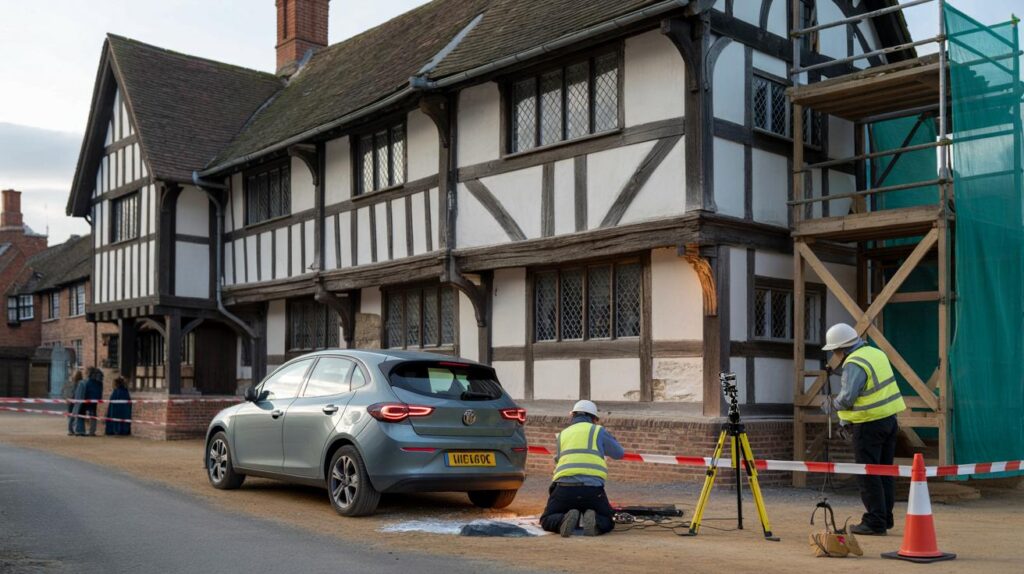
Morning footfall slowed on a quiet Stratford street, where centuries-old timber meets modern life and cameras. Staff moved fast.
Visitors watched from behind cordons as conservators checked a beloved Tudor landmark, its frame already scaffolded for planned works. A routine slip behind the wheel turned a fragile façade into today’s concern.
What happened on Friday
A vehicle reversed into Hall’s Croft, a Grade I-listed house in Stratford-upon-Avon once lived in by Susanna Shakespeare and her physician husband, John Hall. The incident happened on Friday morning. The Shakespeare Birthplace Trust, which cares for the property, described the collision as accidental. Nobody suffered injuries. Staff secured the scene and kept people away from the frontage while specialists assessed the impact.
The building remains safe to approach from designated areas. No injuries were reported, and the team stabilised the site quickly.
Police presence was minimal, reflecting the low-speed nature of the impact, yet even modest force can unsettle historic timber, limework and glazing. The trust had already scheduled substantial conservation works at the property before the incident. Those plans now include an additional inspection phase to check for hidden movement, water ingress paths and stress to joints.
A fragile house with a long memory
Hall’s Croft stands as one of Stratford’s most striking timber-framed houses. The principal exterior dates to 1613. It belonged to the town’s professional class for much of its history and even served as a small school in the mid-19th century. The Shakespeare Birthplace Trust bought the dwelling in 1949, then opened it to the public in 1951 after heavy repairs and alterations suited to museum use. Tour guides often point to the medical instruments associated with John Hall and the domestic world of his celebrated wife, Susanna.
Shakespeare’s family story runs through this plot. The Bard himself was born in 1564 in the town, and his words continue to fill theatres around the globe. That reach helps explain why a single cracked brace or sprung panel here draws national attention.
This is a nationally protected, Grade I building — the top tier of listing reserved for sites of exceptional interest.
Immediate response and next steps
Trust staff closed off the affected area and called in conservation engineers, joiners and a structural surveyor. They plan to document the impact, photograph joints and test levels across the frontage to check for racking. If the frame has shifted, teams will prop, brace and gently realign the members before any cosmetic work takes place.
- Make-safe: cordons, propping, tarpaulins if needed to keep water out.
- Survey: timber moisture readings, crack monitoring, and laser levels.
- Stabilise: temporary bracing, gentle jacking, and tie repairs.
- Repair: oak scarf joints, pegged connections, lime mortar reinstatement.
- Review: traffic protection and access changes for the frontage.
The trust has said it will fold this collision into its ongoing conservation programme for Hall’s Croft, which already targeted the building’s envelope, drainage and structural timbers. Insurance and legal processes will run in parallel, but the team intends to keep disruption for neighbours and visitors to a minimum.
Why repairs will be complex and costly
Listed building rules require like-for-like materials and reversible methods. That raises both timelines and prices. Finding seasoned oak to match early 17th-century fabric takes time. Lime mortars must cure slowly. Paint analysis can reveal historic colour schemes that need careful reinstatement. Each step requires specialist craftspeople.
Rising conservation costs and a shortage of skilled craftspeople now squeeze timetables and budgets across the heritage sector.
Across the country, owners of listed buildings report longer waits for accredited carpenters, masons and glaziers. Apprentices come through, yet demand outpaces supply. On a heavy timber frame, even a small misalignment can push moisture into joints and invite decay, so teams proceed methodically. That patience protects the building’s breathability and preserves original material, which sits at the heart of Grade I care.
Key facts at a glance
| Location | Old Town, Stratford-upon-Avon |
| Listing | Grade I (exceptional interest) |
| Primary phase | 1613 timber-framed exterior |
| Historic residents | Susanna Shakespeare and Dr John Hall |
| Use over time | Professional residence; small school in mid-1800s |
| Acquired by trust | 1949; opened to public in 1951 |
| Friday incident | Low-speed reversing collision; no injuries |
| Current status | Area made safe; expert assessment under way |
How the trust plans to protect the site
The Shakespeare Birthplace Trust cares for several family homes tied to the playwright. Its teams run exhibitions and manage thousands of visitors each year. After Friday’s collision, they will likely review traffic management near the frontage. Options include discreet bollards, planting, tighter parking controls or adjusted delivery routes. Any change must respect sightlines and archaeology under the pavement.
The trust has asked supporters to help fund the extra work at Hall’s Croft. Donations often underwrite the unglamorous elements: moisture management, joinery workshops, scaffold hire and analysis. Small gifts add up. A single oak repair can take days of skilled time, and lime-based finishes require repeat visits as coats cure.
Why this matters to you
Grade I sites make up a small slice of England’s listed stock. They hold stories we share — not only Shakespeare’s family life, but how a market town grew, taught its children and treated the sick. When a car nudges such a building, it reminds us that protection depends on habits as much as on law: slow speeds, careful parking, and respect for tight streets.
For local residents, a short-term inconvenience can unlock long-term gain. Repairs often reveal details hidden behind panelling or later plaster. Conservators may learn more about original joinery or paint layers and improve drainage that protects the house for decades. Visitors benefit from clearer interpretation and safer routes.
Practical guidance for heritage sites near traffic
- Audit vehicle movements at opening and closing times, when delivery vans and tour coaches cluster.
- Install unobtrusive physical buffers, such as low kerbs or timber planters, where bollards would jar.
- Use retractable barriers on maintenance days, keeping heavy tools and materials clear of façades.
- Train stewards to spot early signs of structural movement: sticky doors, fresh cracks, twitching glazing.
- Agree a local protocol with insurers and engineers so emergency inspections start within hours.
What repair work may involve
Specialists will likely test the affected studs and rails for compression set and micro-fractures. If a scarf joint needs renewal, they will cut out decayed or crushed sections and insert seasoned oak, pegged in the traditional fashion. Where panels loosened, lime daub or lime plaster will be reworked to keep the wall breathable. Any displaced lead flashing will be dressed back. Finally, conservators will adjust guttering and ground falls to prevent splashback against timber.
Costs vary widely. Minor reinstatement can sit in the low thousands. If monitoring reveals frame movement or rot pathways, figures climb, particularly when scaffold and traffic management run for months. Grants and community giving often bridge the gap between insurance and best-practice conservation.
If you want to help
Support can arrive in different forms. Local businesses often sponsor a day of scaffold hire or provide staff time for crowd management. Residents can volunteer as room stewards once the house reopens, which frees funds for specialist trades. Visitors can time trips outside peak hours, easing pressure on narrow streets and helping teams keep the site calm while repairs proceed.
Small, steady contributions — money, time, patience — keep fragile places standing and open.
For those curious about craft, many heritage workshops welcome trainees. A weekend taster in lime plaster or timber repair does more than build a skill. It grows the pool of people ready to care for buildings like Hall’s Croft when the unexpected happens.



Relieved the Shakespeare Birthplace Trust moved fast and kept people safe. Will the engineers publish a brief on racking checks (laser levels, crack monitoring) and any propping needed before oak scarf repairs? Transparency would help locals understand closures and the conservation timeline.