
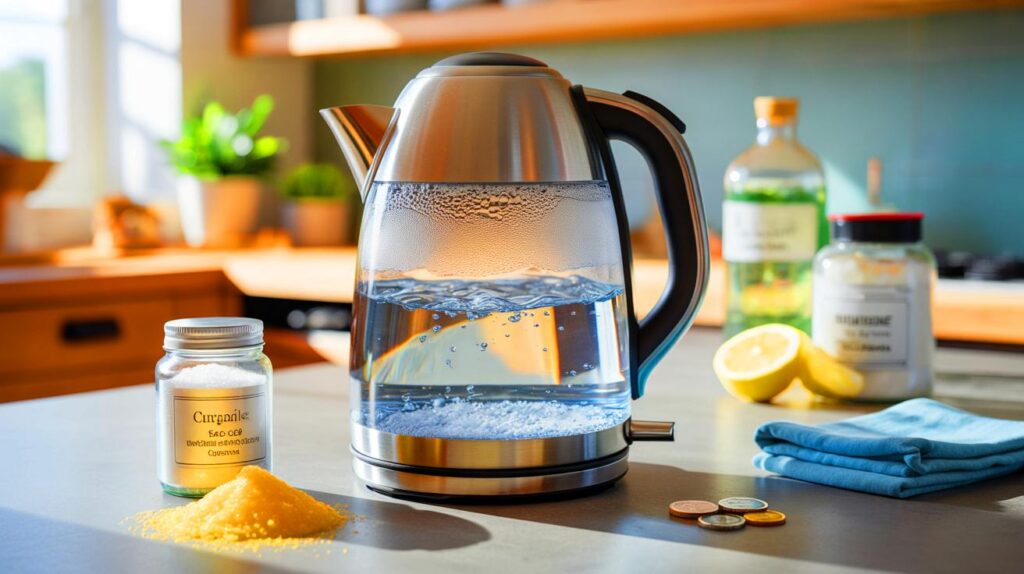
Across hard‑water homes, kettles look tired, tea tastes dull and morning routines slow down. Energy bills creep up too.
Scale clings to hot metal, turns clear water cloudy and makes a simple boil drag on. People from Kent to Cumbria report chalky rims, gritty flakes and longer boil times. A quiet fix sits in the cupboard, and it costs pennies.
Why limescale builds up so fast
Hard water carries calcium and magnesium salts. Heat pushes those dissolved minerals out of solution, so they settle as a crust inside your kettle. Regions with limestone or chalk aquifers send more of these minerals through the tap, so build‑up speeds up and cleanups take longer.
A scaled heating element transfers heat less efficiently. The kettle runs longer to reach the same temperature. That wastes power, nudges up costs and blunts flavour. A thin layer already makes a difference; a thick rind turns every brew into a slow boil.
Left unchecked, limescale can push kettle energy use up by a meaningful margin and shorten the appliance’s life.
The cold citric acid method people swear by
Citric acid removes limescale without leaving a lingering odour. It is food‑safe when used correctly and works while you get on with your day.
Use it cold: 2 tablespoons citric acid in the kettle, fill with water, wait 2–3 hours, then rinse well.
Do not heat the mix. Heating can form stubborn calcium citrate deposits. A cold soak dissolves the scale gently, and the inside feels smooth again after a thorough rinse.
Step by step in three minutes
- Unplug the kettle and let it cool.
- Add 2 tbsp citric acid crystals.
- Top up with cold water to cover the scaled area.
- Leave for 2 to 3 hours. Check progress after 90 minutes.
- Pour away the solution. Rinse with fresh cold water three times.
- Boil one kettle of plain water, discard, and your next brew tastes clean.
Never heat citric acid in the kettle. A cold soak clears scale; heat can set a new crust.
Other cupboard options: vinegar, bicarbonate, lemon
Different kitchens, different supplies. These household staples also shift scale when used with care.
- White vinegar: fill with one‑third vinegar and two‑thirds water. Bring to the boil once, stand for 45 minutes, pour away and rinse well. Boil clean water once and discard. Keep the room ventilated; vinegar vapour can irritate.
- Bicarbonate of soda: add 2 tbsp, fill with water and follow the same boil‑and‑stand routine as vinegar. Rinse thoroughly before use.
- Lemon juice: use the juice of 1–2 lemons. Either soak cold and rinse, or bring to the boil once and rinse. Odour fades faster than vinegar.
Quick comparison
| Method | Measure | Heat | Wait time | Odour | Good for | Caution |
|---|---|---|---|---|---|---|
| Citric acid | 2 tbsp | No | 2–3 hours | None | Quick prep, no smell | Do not heat; rinse three times |
| White vinegar | 1/3 vinegar, 2/3 water | Yes | ~45 minutes | Strong | Tough crusts | Ventilation needed; boil clean water after |
| Bicarbonate | 2 tbsp | Yes | ~45 minutes | Low | Mild scale | Rinse well to avoid residue |
| Lemon juice | 1–2 lemons | Optional | 30–90 minutes | Fresh | Light odour, natural option | Still rinse thoroughly |
What about the filter and spout
Many kettles have a mesh filter that traps flakes. It scales up fast and needs special care.
- If removable, soak it separately. Use hot water with white vinegar or bicarbonate, or cold water with citric acid or lemon juice.
- If fixed, spread a paste of bicarbonate (3 tbsp) and water (1 tbsp). Leave for 30–40 minutes and rinse until clear.
Dry the filter before refitting. Check the spout for chalky edges and wipe them with a cloth dipped in your chosen solution.
How often to descale
- Very hard water and daily use: once or twice a month.
- Softer water or filtered water: one to two times a year.
Emptying the kettle after use slows build‑up. Leaving warm water inside encourages fresh crystals to settle on the metal.
Cut build‑up between cleans
- Switch to filtered water via a jug, a charcoal stick or a tap‑mounted cartridge.
- Consider an under‑sink reverse‑osmosis unit if scale ruins multiple appliances.
- Drop a clean oyster shell or a smooth pebble into the kettle; scale tends to coat it first.
- Wipe the interior dry with a soft cloth after the last boil of the day.
Energy and money: small maintenance, real savings
Scale forces longer boils. A typical 1‑litre boil uses about 0.11 kWh. Two boils a day total roughly 80 kWh a year. If scale adds around 12% to that, you waste about 9.6 kWh annually. At 30p per kWh, that is close to £3. Boil four times a day and the waste can approach £6. The figures rise with larger fills or very hard water.
Rinse and descale on a schedule. It boosts speed, cuts noise and trims a few pounds from yearly bills.
Safety notes you should not skip
- Unplug before treatment. Never submerge the base or electrical parts.
- Avoid heating citric acid in the kettle. Keep the soak cold.
- Rinse until the water runs clear and odour‑free. Boil one kettle of clean water and discard.
- Ventilate when using vinegar. Keep faces away from steam.
- Do not mix acids with bleach or chlorine products.
- Check the manual if your kettle has aluminium parts or special coatings.
Tea taste and appliance lifespan
Scale traps residues and off‑flavours. After descaling, tea tastes brighter and coffee feels cleaner on the palate. The element also clicks off faster and stays quieter. Regular care keeps seals and thermostats under less strain, which helps the kettle last longer and prevents sudden failures.
Helpful extras for curious readers
Want to gauge your risk? Water‑hardness strips show the mineral level in a minute. Keep one by the sink and note the result before setting your cleaning schedule. If the colour points to very hard water, plan more frequent cold citric acid soaks and empty the kettle after each use.
Try a simple home test: time your kettle from switch‑on to auto‑off with a 1‑litre fill. After a thorough descale, repeat under the same conditions. A faster boil confirms better heat transfer. Log the times and set a reminder to descale when the boil slows by 20–30 seconds.



Did the cold soak exactly as written—2 tbsp citric acid, topped up, left for 2 hours, rinsed three times. Limescale slid off and my boil time dropped by ~30 seconds. Tea tastes brighter too 🙂 Thanks!