
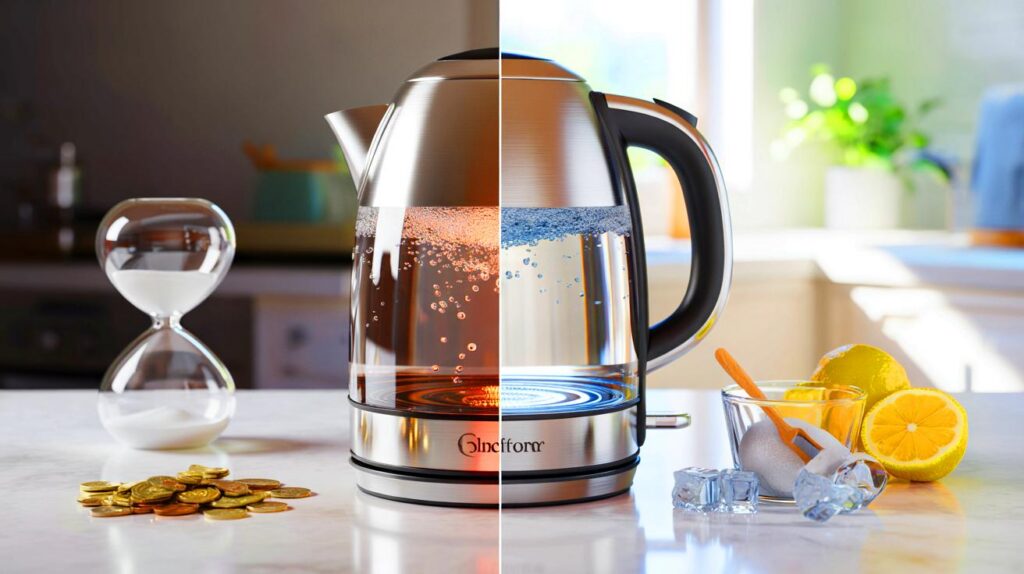
The humble morning brew hides a costly secret in millions of kitchens, and the signs are staring back from the spout.
Across hard‑water postcodes, chalky buildup creeps over heating elements, dulls shine, and steals heat. That white crust is limescale, and it slows every boil while nudging your electricity bill higher. The good news: a low-odour, cold‑soak routine reverses the damage with little effort and no harsh fumes.
Why limescale hits british kettles hard
Most UK homes draw hard water rich in calcium and magnesium. When water heats, dissolved minerals turn into solid deposits that cling to metal and plastic. The higher the hardness, the faster the crust forms.
In parts of the south and east, hardness can exceed 300 mg/L as CaCO3. That level coats a kettle in weeks, not months. The layer insulates the element, so energy goes into warming the crust first, not the water.
Your bill on the line
A clean 3 kW kettle needs roughly 0.11 kWh to bring 1 litre from tap temperature to the boil. Four full boils a day add up to about 175 kWh a year. At 27p per kWh, that is about £47. Heavy tea drinkers doubling that usage can spend near £94.
Now add scale. Tests from appliance engineers show noticeable deposits can push boil times up by 10% to 45%, depending on thickness and surface coverage. That extra time is extra electricity. If you boil frequently, the penalty mounts.
Scale on the element can make a daily kettle habit cost an extra £9 to £39 a year, depending on how often you boil and how crusty the element gets.
The low‑odour fix that works while you wait
Citric acid—sold as a food‑safe descaler—unbinds minerals fast without leaving vinegar fumes in your kitchen. The trick is to keep it cold.
Use 2 tablespoons of citric acid in the kettle, top with cold water, and leave it still for 2 to 3 hours. Do not heat it. Rinse three times.
After the soak, most deposits slide off at a splash. Stubborn patches wipe away with a soft sponge. Refill with fresh water and boil once, then discard that water to clear any remaining tang. Next tea tastes clean.
Why you should not heat citric acid
Boiling a citric solution can form calcium citrate, a tougher deposit that clings hard and clouds the interior. Keeping the soak cold avoids that reaction. The same rule applies if you swap in fresh lemon juice.
Other pantry methods, with real‑world trade‑offs
Different cupboards, different options. Each route below removes limescale, but not all leave a neutral odour.
| Method | Measure | Heat? | Contact time | Odour | Notes |
|---|---|---|---|---|---|
| Citric acid | 2 tbsp per kettle | No | 2–3 hours | Very low | Fast, gentle on seals; keep cold |
| White vinegar | 1/3 vinegar, 2/3 water | Yes | 45 minutes rest after boil | Strong | Ventilate; boil clear water once after |
| Bicarbonate of soda | 2 tbsp, top with water | Yes | 45 minutes rest | Low | Milder action; rinse well before use |
| Lemon juice | Juice of 1–2 lemons | Cold or hot | 30–120 minutes | Fresh citrus | Cold soak gives the cleanest finish |
Filter care matters
Many kettles have a fine mesh that catches flakes. If it lifts out, soak it separately: hot water with vinegar or bicarbonate, or cold water with citric acid or lemon. If it is fixed, spread a paste of three tablespoons bicarbonate with one tablespoon water, leave for 30–40 minutes, and rinse well.
Simple routine, fewer flakes, lower bills
- Frequency: descale once or twice a month in very hard water areas, and once or twice a year in soft water homes.
- Rinse rule: after any acid or alkaline treatment, rinse thoroughly and run a single boil of clear water.
- Water choice: jug filters, charcoal sticks, or under‑sink osmosis systems reduce hardness and slow new deposits.
- Attract the crust: drop a clean oyster shell or a stainless steel descaling ball inside; scale prefers rough surfaces.
- Volume discipline: only boil what you need; trimming 250 ml per boil cuts energy use and scale growth.
Short boils, soft water and cold‑soak descaling form a trio that keeps the element shiny and the taste clean.
How much could you personally save?
Pick your pattern. If you boil 1 litre six times a day, you use about 240 kWh a year, or roughly £65 at the current cap. A 25% slowdown from scale turns that into £81, a difference near £16. At eight boils a day, the same slowdown can add £21. Heavy users, and those with thick scale, can shave £30 or more by cleaning and right‑sizing each fill.
Time is money here. If a daily clean kettle reaches the boil in 3 minutes, a scaled element might push you past 4 minutes. Multiply that across the week and your morning routine drifts.
Safety notes you will want to keep
- Never mix vinegar or citric acid with bleach or bleach‑based cleaners. Dangerous gases can form.
- Unplug and cool before handling the filter or the interior.
- Avoid abrasive pads on coated heating plates; scratches invite faster scale growth.
- If your manual forbids acidic cleaners, follow the manufacturer’s guidance to protect the warranty.
Extra ways to hold back the crust
Track your hardness
Test strips cost pennies and give a quick hardness reading. If you see results above 250 mg/L as CaCO3, switch to filtered water for tea and coffee. Tastes improve and descended scale slows.
Set a reminder
Stick a small label under the kettle with your last descale date. Repeat before performance slips. Consistency beats crisis cleans that need heavy scrubbing.
Think beyond the kettle
Hard water hits shower heads, irons, coffee machines and hot‑water cylinders. The same citric‑acid approach—cold soak where feasible, rinse well—applies to many small appliances. For plumbed systems, a whole‑house softener or a scale inhibitor cartridge can cut maintenance across taps and heating circuits.
If you want a quick yardstick, aim for three habits: measure your fill, wipe the interior dry after the final boil of the day, and run a cold citric soak every few weeks. Those small moves keep heat transfer efficient, protect seals and gaskets, and bring back the bright, clean taste that should greet every brew.



Brilliant explainer. The cold citric soak (2 tbsp, 2–3 hours, no heat) worked a treat—no vinegar pong and the element came up shiny. The calcium citrate warning explains why my last “boil with lemon” made things worse. Definately saving this for routine maintenance.
Interesting numbers, but is the 0.11 kWh per litre based on a 20°C start tempertaure and a 3 kW element at full efficiency? In winter my tap runs closer to 10°C; does that push the baseline bill higher and reduce the apparent 10–45% slowdown?