
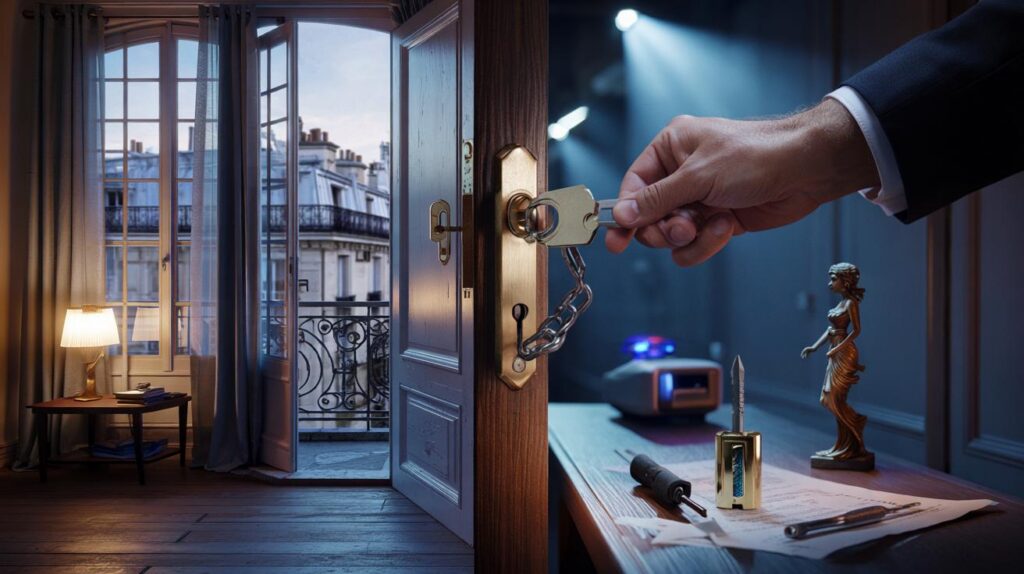
Back from a weekend away, you spot a window left ajar and papers nudged out of line. The spare key lingers in mind.
You pay rent for a home, not a revolving door. When an owner holds a duplicate key, the boundaries can blur fast. French law is far from vague on this point, and the consequences for getting it wrong are anything but soft. Here is how the rules really work, the narrow emergency exceptions, and the practical steps that keep your private life truly private.
What the law really says about spare keys
Once a residential lease is signed in France, the property becomes your domicile. That single word anchors everything that follows. The landlord retains ownership, but your right to quiet enjoyment and privacy is protected by criminal law. Keeping a duplicate key is lawful. Using it without your express permission is not.
No consent, no entry — except for a genuine emergency that endangers people or property.
Permission is not a one-off blanket. The owner must ask each time and state why and when they seek to enter — whether for repairs, a meter reading, or viewings. A text or email that clearly sets out the request and your reply can be enough. Silence does not equal permission.
Consent must be specific and recent
Courts expect precision. “We spoke about it weeks ago” rarely passes muster. Agreeing to an electrician on Tuesday afternoon does not unlock the door for a plumber on Friday morning. Timings matter. Purpose matters. Your comfort and availability matter.
When can a landlord enter without consent
French law makes space for real emergencies. The list is short, and convenience does not feature on it.
| Scenario | Notice required | Your consent needed | Lawful without you | Best practice |
|---|---|---|---|---|
| Major water leak flooding neighbours | No | No | Yes | Enter to stop the leak; inform you immediately |
| Fire, gas leak, imminent danger | No | No | Yes | Attend with emergency services where possible |
| Routine repairs or inspection | Yes (agree a slot) | Yes | No | Propose times, obtain written agreement |
| Meter reading or contractor estimate | Yes | Yes | No | Book an appointment, confirm in writing |
| Buyer/tenant viewings | Yes | Yes | No | Arrange reasonable, agreed windows |
“Urgency” must be real and verifiable — a burst pipe, the smell of gas, water pouring through a ceiling. Chilly weather, a contractor’s tight diary, or “I was nearby” do not cross the threshold.
Grey areas that trap tenants
Some situations sit awkwardly between courtesy and intrusion. A landlord might claim a quick check before a cold snap, or a meter visit when you did not respond at once. Courts look at evidence, not convenience.
- Non-response to a message does not authorise entry.
- “Reasonable notice” typically means at least 24 hours and a mutually agreed time slot.
- Viewings require dialogue and proportionate scheduling, not unilateral decisions.
- Contractor availability never trumps your right to say when access is possible.
- Repeated unannounced visits can amount to harassment as well as trespass.
Keeping a duplicate key is not a passport. It is a responsibility — and using it wrongly turns it into a liability.
What to do if it happens
If you suspect the landlord used the duplicate key without permission, act methodically. Quick, tidy steps build a strong record and often stop the behaviour at once.
- Write immediately, by registered letter with acknowledgement of receipt, stating dates, facts and your demand to stop unauthorised entry.
- Collect proof: photos of moved items or ajar windows, timestamps, messages, neighbours’ accounts.
- Propose practical access windows for legitimate works to show you are reasonable.
- Change the lock cylinder at your expense if you feel unsafe; keep the old cylinder to refit at the end of the tenancy if requested.
- Report repeat intrusions to the police for violation of domicile, and consider legal action for damages.
In France, violation of domicile is a criminal offence punishable by up to one year in prison and a €15,000 fine. That is the ceiling. Judges also award civil damages for distress, lost time, and any material loss.
What your letter should say
- The date(s) and circumstance(s) of suspected entry, without embellishment.
- A reminder that access requires your prior consent for each visit, except in genuine emergencies.
- Your proposed dates and times for any pending repairs or readings.
- Your intention to change the lock cylinder for safety, at your cost, with original parts refitted at check-out on request.
- That further unauthorised access will lead to a police complaint and a claim for damages.
Can you change the locks
Yes. Tenants in France may change the cylinder at their own cost for security. The landlord cannot refuse, and you do not have to hand over a new key. You must, though, return the property as you found it: keep the original cylinder and refit it when you leave if the owner asks.
Typical costs run from €120 to €250 for a standard cylinder and call-out, more for anti-snap or high-security models. Keep invoices. If a break-in forced the change, your insurer may cover the bill, subject to the policy excess.
If the dispute escalates
Police take a dim view of keys used without consent. Even a single entry can trigger a warning; repeated incidents raise the stakes quickly. In parallel, a civil claim can seek compensation for anxiety, lost work time, and any extra costs, such as hotel nights or an emergency locksmith.
Judges weigh three things closely: frequency, evidence of your refusal or absence of consent, and whether a true emergency existed. Calm records win cases. Emotional but vague accounts do not.
Smart habits that protect your peace
- Agree a written protocol for access at the start of the tenancy: preferred days, hours, and a minimum notice period.
- Use simple door hardware such as a chain or secondary latch when you are at home.
- Set up a hallway camera facing your own door only (no common areas) if building rules allow; store footage locally.
- Ask a neighbour to call you if anyone attends in your absence.
- Keep communications in writing; confirm phone calls by follow-up email or text.
Key points you can rely on
The owner may hold a spare key, but your consent is the gatekeeper. Emergencies are rare and strictly defined. When boundaries are crossed, a firm letter, clean evidence, and practical access offers usually reset the relationship. If not, the law is on your side — with real teeth, including up to one year in prison and €15,000 in fines for violation of domicile.
One final tip: if you often travel, set “access windows” in advance for non-urgent works and insist on a written request each time. You stay in control, legitimate jobs get done, and that spare key stops feeling like a threat to your peace of mind.



Is the €15,000 fine actually enforced in practice, or is it just the theoritical ceiling courts rarely use? Any stats or case examples?