
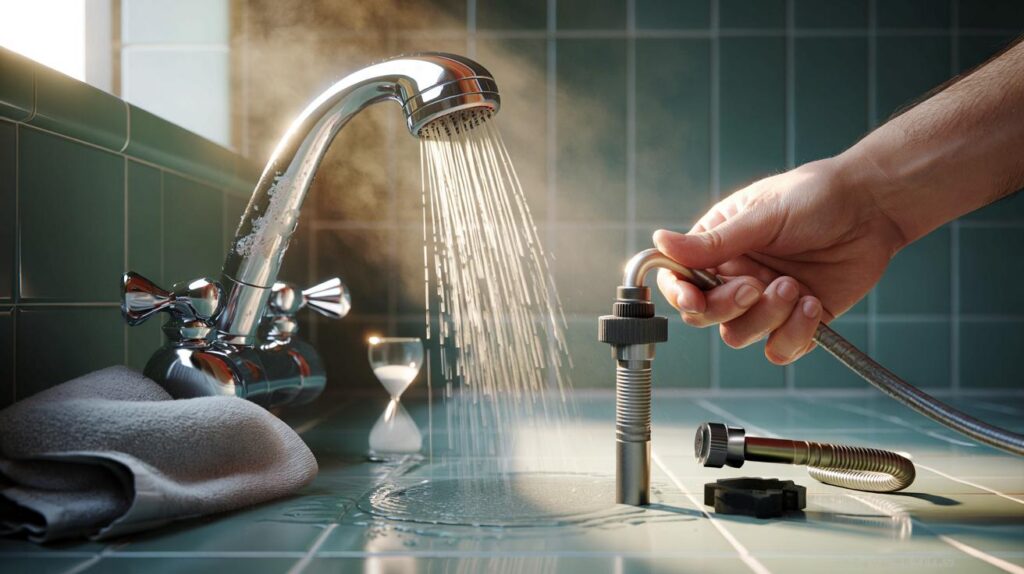
A tiny split in your shower hose looks trivial. The bill says otherwise, and the fix is faster than a kettle.
Cold weather drives longer showers and fiercer household budgets, yet millions still ignore the hiss and spray of a split hose. Retailers report a brisk uptick in winter replacements, and plumbers agree: most swaps take minutes, not money.
Rising bills make tiny leaks big news
To many households, a punctured shower hose is just a nuisance that drenches tiles and towels. It also drains cash. A small pinhole can send a thin jet sideways every time you turn the tap, wasting hot water and pushing humidity through grout and paint. Left as-is, that drip turns into limescale, mould, and swollen plasterboard.
Household hot water costs turn a leaky hose into a hidden metre-ticking machine, especially on electric showers.
How much water and energy are you losing?
A steady spray from a split can waste tens of litres each day. Heat those litres and the cost climbs fast. Heat 50 litres from 10°C to 40°C and you use roughly 1.7 kWh of energy. On an electric shower at 25p per kWh, that is about 43p a day. Stretch that over six winter months and you creep towards £80, and that is before water and wastewater charges.
| Scenario | Daily waste | Energy cost (electric) | Six‑month impact |
|---|---|---|---|
| Fine mist from a pinhole | 20–30 litres | 17–26p | ~£31–£47 |
| Thin jet off to one side | 40–60 litres | 34–51p | ~£61–£92 |
| Split at the ferrule | 80–120 litres | 68p–£1.02 | ~£122–£183 |
Spot the failure before it soaks the room
Warning signs appear long before the hose gives up completely. Catch them early and you prevent damp patches behind tiles and under vinyl.
Signals you can’t miss
- Unexpected fine spray hitting the wall or glass while the shower runs.
- White crust around the hose ends or shower valve, pointing to limescale and micro-leaks.
- Whistling or sizzling noise as pressure finds a hairline split.
- Faint puddle where the hose loops down, even after a short shower.
- Stiff kinks and flattened coils that twist the inner tube every time you move the handset.
Why hoses fail in the first place
Metal-sheathed or plastic hoses both rely on a flexible inner tube. Hard water roughens that tube from the inside. Repeated twisting and the weight of a heavy handset add stress at the ends. A drop or a harsh chemical clean can nick the sheath. Cold rooms and steamy use produce expansion and contraction, which opens weak spots. None of this needs a toolbox to fix.
The 15‑minute swap you can do without tools
Most modern shower hoses use standard 1/2‑inch British Standard Pipe (BSP) threads at both ends. They are designed to go on by hand. No spanner, no drama.
Most UK shower hoses use 1/2‑inch BSP threads and seal with a rubber washer — hand‑tight is enough.
Gather what you actually need
- One new hose, preferably anti‑twist and the right length for your enclosure or bath.
- Two new rubber washers (usually included in the pack).
- A dry cloth or microfibre for grip and to protect chrome.
- A towel on the floor to catch drips.
Step by step, without a spanner
Shut the shower off. If you have an isolation valve, turn it to off for peace of mind. Unscrew the hose nut from the mixer or tap by hand, then the nut from the handset. If it is slippery, use the cloth for grip. Pull out and bin the old washers. Seat a new washer in each end of the new hose. Offer the hose to the mixer first; thread the nut on gently by hand until it bottoms out. Repeat at the handset end. Keep everything straight so you do not cross the threads.
Hand‑tight, then a modest nip with your fingers, is enough. Over‑tightening crushes washers and invites leaks later.
Test it and prevent the next failure
Turn the isolation valve back on or run the shower at low flow. Check for any bead of water at both ends. Run your fingers around each nut. If you feel moisture, a small extra turn by hand usually stops it. Check again at normal temperature and pressure for a minute. If you still see a drip, reseat the washer and try once more.
Make the new hose last longer
- Let the hose hang straight after use; avoid trapping it under the showerhead.
- Choose an anti‑twist model so the inner tube does not wind up every time you move.
- Rinse soap off with warm water; harsh chemicals shorten the life of the inner tube.
- Descale the showerhead monthly; lower back‑pressure reduces stress on the hose.
- Keep winter bathrooms above dew point to reduce constant wetting and drying cycles.
What you will spend, what you might save
| Item | Typical UK price | Expected life |
|---|---|---|
| Standard 1.5 m hose | £8–£15 | 2–4 years |
| Anti‑twist, anti‑limescale hose | £15–£30 | 3–6 years |
| Pack of 1/2‑inch washers | £2–£4 | Spare set |
Even at the higher end, a new hose under £30 undercuts months of wasted hot water. For households on electric showers or peak‑rate tariffs, the payback can be measured in weeks. On gas‑heated systems, the savings arrive a little slower, but you still cut damp and maintenance risks.
When a five‑minute job becomes a bigger repair
If the nut refuses to budge, limescale may have bound it tight. Warm water and patience usually help. A seized or corroded outlet on the mixer signals a different problem: you may need a new outlet adaptor or attention to the valve. Signs of leakage inside the wall, staining below the bath, or a hose that hisses even when the shower is off point to a faulty cartridge or non‑return valve. Address those before you fit the next hose, or pressure will force another failure.
Two useful add‑ons that stretch your savings
Fit a flow‑limiting handset
Swapping to an 8 L/min handset from a 12 L/min model cuts hot water use by a third without turning the shower into a dribble. Pair that with a fresh hose and you reduce both spray waste and the amount of water you heat.
Do a quick home calculation
Count your showers per day, estimate minutes per shower, and note your water heater type. Multiply minutes by your handset’s flow rate to find litres. At 10 L/min for 8 minutes, two showers use 160 litres. Trim 20% with a better handset and a sound hose, and you save 32 litres daily. On electric heat at 25p/kWh, that is roughly 27p saved each day, about £98 a year.
Small fixes compound: a sound hose, a descaled head, and a lower flow rate tame both energy and water bills.
For renters, everything above remains reversible and landlord‑friendly: keep the old hose and washers in a bag, note the thread size (almost always 1/2‑inch), and restore the original before you move. For homeowners, consider a short logbook near the boiler with hose and washer replacement dates. That habit catches creeping leaks before they stain ceilings.
One last safety note: test new connections with warm, not scalding, water, and stand aside on first flow. A mis‑seated washer can create a sharp jet. Correct it, tighten by hand, and your next shower should be about steam and silence, not spray and stress.



Swapped mine in 12 minutes, hand‑tight only, and the whistling stopped. Checked the old washers—flattened to paper. This guide definitley saved me a callout. Also loved the reminder to descale the head; back‑pressure was probably killing the hose.