
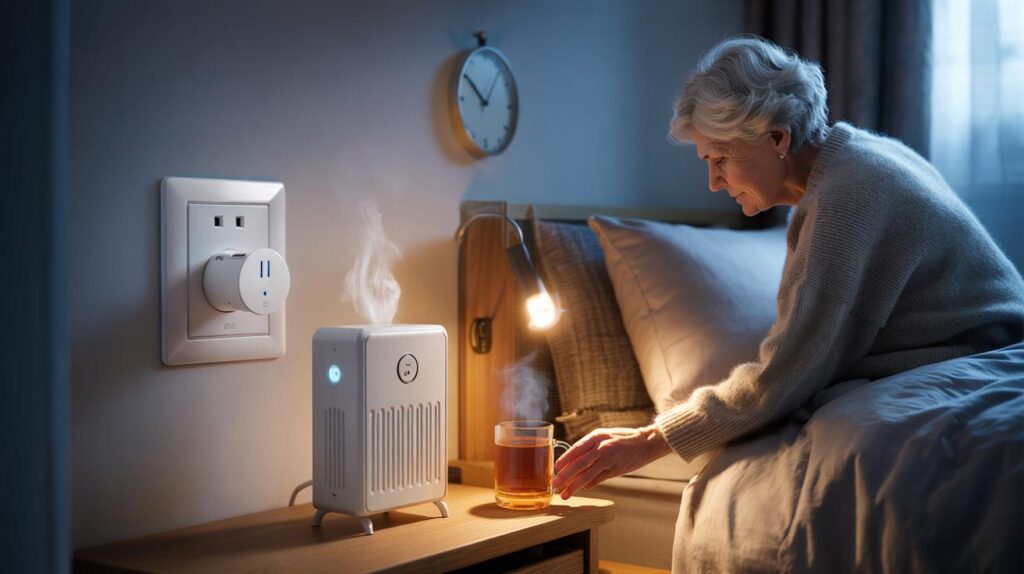
As energy costs bite, a bedtime routine marrying ritual and automation is quietly reshaping the way households warm bedrooms tonight.
Across the country, families are pairing a calming night-time tea with a timed burst of heat, using a £15–£20 smart plug to pre‑warm rooms. The approach leans on lower setpoints, shorter run‑times and a fixed schedule, with early users reporting deeper sleep and leaner bills.
Where an old habit meets a smart plug
The idea is disarmingly simple. You wind down at 21:15 with a mug of chamomile. At 21:30, a smart plug wakes a compact electric heater. The setpoint sits at 18–19°C, not the toasty levels that drive costs up. The plug switches off at 06:30. The room feels ready when you climb into bed. The heater doesn’t run all evening, and you stop fiddling with knobs at midnight.
Sync your wind‑down with a short, targeted heat window: 21:30 on, 06:30 off, setpoint 18–19°C. Less time on, less spend.
Old‑school versions use a mechanical timer. The modern twist uses a Wi‑Fi plug and an app, adding geofencing, schedules and the option to cut power remotely if you forget.
What you need and what it costs
- Wi‑Fi smart plug rated 13A, £15–£20.
- Small oil‑filled or convector heater with thermostat, 750–1500W.
- Phone app to set schedules and a reliable home Wi‑Fi connection.
- Optional: a basic mechanical timer if you want a cheaper, no‑app route.
- Night‑time comforts: chamomile tea, honey, and a quiet, dark room.
Use a properly rated plug and socket. Keep heaters clear of curtains and bedding. Place the unit on a level surface, use built‑in thermostats and tip‑over protection, and never daisy‑chain extension leads.
How to set it up in 15 minutes
Step‑by‑step
- Install the smart plug, pair it with the app, and name it “Bedroom heat”.
- Set an “on” schedule for 21:30 and an “off” schedule for 06:30.
- Dial the heater’s thermostat to 18–19°C. Use the lowest power setting that holds comfort.
- Run a one‑night test. Check the room doesn’t overshoot, and adjust the setpoint down if it does.
- Add an automation to skip heating if you’re away. Many apps offer home/away toggles.
- Pair the routine with your tea at 21:15 to anchor the habit.
| Time | Action | Target temp | Why it helps |
|---|---|---|---|
| 21:15 | Make tea, dim lights | — | Signals wind‑down, reduces late‑night device use |
| 21:30 | Smart plug turns heater on | 18–19°C | Short pre‑heat builds comfort without all‑evening run‑time |
| 23:00 | Lights out | 18–19°C | Stable, slightly cooler air supports sleep quality |
| 06:30 | Smart plug off | — | Prevents drift into costly morning hours |
Why the numbers add up
Cutting temperature by 1°C can trim heating energy use by several percentage points, and shaving two evening hours of run‑time compounds the effect. For resistive electric heat, cost tracks run‑time almost linearly: fewer hours on means fewer kilowatt‑hours consumed.
Take a 1kW heater. If it runs six hours nightly at an average unit rate of 28p/kWh, that’s about £1.68 per night. Reduce the schedule to four hours with a lower setpoint and you use roughly 4kWh, about £1.12. Over a 90‑day winter stretch, that shift alone lands near £50–£60 saved. Households reporting a 23% drop typically combine a lower setpoint, a shorter pre‑heat, and stricter off times in the early morning.
Two hours less heat each night is roughly 14kWh saved per week. At typical tariffs, that’s about £3.50–£4.00 back in your pocket.
Homes with good curtains and closed doors hold warmth longer, so you can shorten the pre‑heat to 45 minutes. Poorly insulated rooms may need the full window, but they still gain from the fixed off time and modest setpoint.
Expert tweaks that make it work year‑round
Winter refinements
- Start at 19°C, then nudge down by 0.5°C every few nights until comfort dips. Stop one notch above that point.
- Use an oil‑filled radiator for steady, quiet heat and less overshoot.
- Seal draughts around windows and use thermal curtains to stretch the heat between cycles.
Summer variant
- Swap the heater for a quiet fan at low speed, set on the same plug schedule.
- Pre‑cool by moving air, not by blasting cold. Pair with open windows during cooler late evenings.
For renters and shared houses
- Smart plugs avoid touching central‑heating controls you don’t own.
- An old tablet can become a simple home hub to manage multiple plugs with one screen.
What early adopters report
People talk about fewer wake‑ups, fewer trips to the thermostat and fewer arguments over the dial. The routine removes guesswork. The room feels consistently comfortable, and bedding does more of the work while the heater cycles less.
Safety and sensible limits
- Use only heaters that carry overheat protection and a tip‑over cut‑out.
- Keep a one‑metre clearance from textiles, beds and furniture.
- Do not cover the heater. Do not use multi‑way extension blocks.
- Test smoke alarms and consider a plug with an energy meter to spot abnormal draw.
- If you feel uneasy running a heater overnight, pre‑heat for 45–60 minutes, then switch off at lights‑out and rely on insulation and bedding.
Will it work with central heating?
Yes, if you adapt the principle. Programme the boiler to pre‑heat bedrooms from 21:30, set bedroom TRVs to 18–19°C and schedule a hard off before sunrise. You still compress run‑time into a useful window and avoid waste during late evening TV time and early morning drift.
What about tariffs and timing?
Households on time‑of‑use or multi‑rate tariffs can align the pre‑heat with cheaper periods. If your unit rate falls after 22:00, shift the on‑time accordingly and shorten the window to avoid pushing into pricier morning bands. A slightly later tea still anchors the habit.
A quick way to test your own saving
Log last week’s kWh for the bedroom heater or view the plug’s energy history. Switch to the 21:30–06:30 schedule and record the next seven nights. Compare total kWh. Factor your actual unit rate. If the room overheats, lower the setpoint by 0.5°C and retest. This simple loop finds your sweet spot in a fortnight.
Anchor a calm ritual, cut the thermostat to 18–19°C, and force a lights‑out off time: that trio drives the 23% claim.
One final practical tip: add one or two drops of lavender oil to your pillowcase before bed. It supports the same wind‑down the schedule relies on. Pair that with a warm mug at 21:15, and you build a nightly cue that keeps comfort high while the meter slows down.
If you want to widen the gains, layer small extras: a draught excluder under the door, a sealed keyhole cover, a door‑closer to keep warm air corralled, and a heavy curtain over the window. These cheap upgrades make the short pre‑heat feel richer, so your plug spends more time off without sacrificing comfort.



23% feels optimistic. Where’s the baseline? If you already run at 18–19°C, the saving shrinks, right? Please share your calc and assumptons—heater wattage, insulation grade, and actual kWh logs—so readers can reproduce the numbers.