
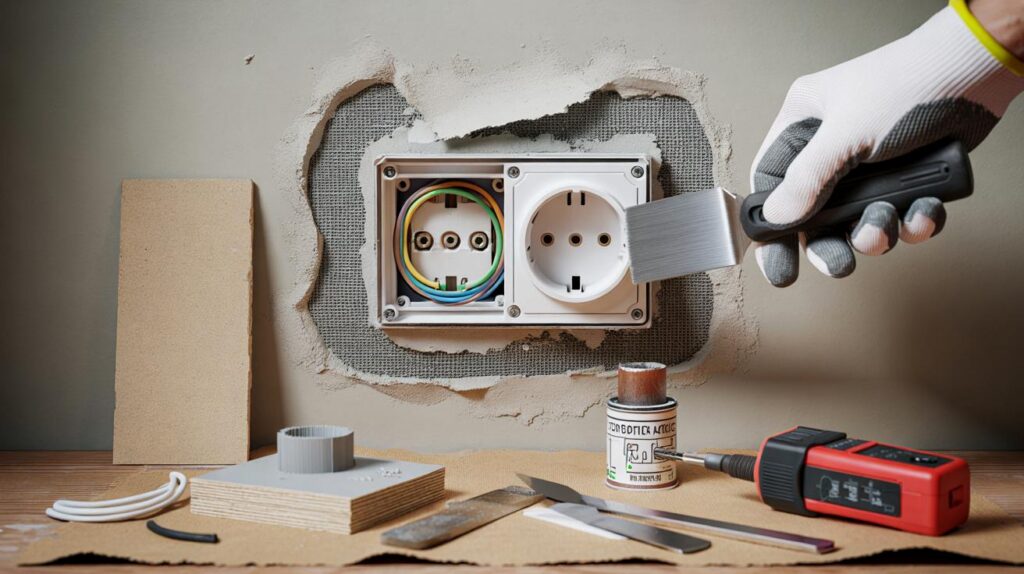
That ragged halo around your socket feels minor, yet it grows, snags sleeves and steals comfort every time you switch.
Across the UK, homeowners are noticing tired plasterboard around outlets just as heating clicks back on and interiors get scrutiny. You can stabilise the damage fast, avoid ripping out a whole wall, and keep the electrics safe while you work.
What you’re seeing and when to worry
Small chips and hairline cracks often sit in paint or filler only. Deep fissures, flaking edges and a wobbly faceplate point to crushed plasterboard around the metal back box. That’s common near busy sockets, skirting heaters and furniture scuffs.
Press gently around the opening. If the surface powders, caves or moves, plan a repair. If you spot sooty marks, melted plastic or a smell of singeing, stop and call a qualified electrician. Heat damage suggests a loose connection rather than a cosmetic fault.
Quick safety check before you touch anything
- Switch off the circuit at the consumer unit and test the socket with a non-contact tester.
- Remove the faceplate screws. Pull the plate forward gently. Support the wiring, don’t let it hang.
- Inspect insulation for nicks. Check the back box for sharp edges and loose lugs.
Kill the power at the consumer unit, verify it is dead, and keep conductors insulated while the faceplate is off.
Tools and materials that save time and dust
- Plasterboard offcut or a ready-made self-adhesive mesh patch
- Utility knife or plasterboard saw, and a metal straightedge
- Jointing compound or lightweight filler, plus paper or fibreglass joint tape
- Back-block support: timber baton, plasterboard offcut, or repair clips
- 120–180 grit sanding block, brush and vacuum
- Socket box extender ring if the board is thin or crumbled back
- Primer sealer and matching wall paint
- PPE: gloves, goggles, dust mask
Three repair routes, from 10 to 45 minutes
Pick the method that matches the damage and your patience. These timings refer to hands-on work, not drying time.
Self-adhesive mesh patch (10–20 minutes)
Best for shallow dents, flaked edges and small voids up to a palm-wide area.
- Square up the ragged edges with a knife. Dust and vacuum the recess.
- Stick the mesh patch centred on the hole, keeping it clear of the back box opening.
- Skim a thin coat of joint compound through the mesh. Feather 50–100 mm beyond the patch.
- Let it dry, sand lightly and add a second skim if needed.
Cut-and-patch with back-block (35–45 minutes)
Best for broken corners, soft plasterboard and any area where the socket “floats”. This makes a robust, long-lasting repair.
- Mark a neat rectangle around the damage, avoiding cables and the box rim.
- Cut the opening. Remove loose crumbs back to sound paper-faced board.
- Slip a back-block behind the hole. Screw through the existing board to clamp it.
- Cut a new plasterboard insert to fit snugly. Offer it in and fix to the back-block.
- Tape the seams. Apply two to three thin coats of compound, widening each pass.
Socket box extender and caulk (15 minutes)
Best when the socket sits too deep or the rim has minor gaps but the board is otherwise firm.
- Fit a plastic extender ring to bring the faceplate flush with the wall surface.
- Backfill hairline gaps with decorator’s caulk. Let it set fully before paint.
- Do not rely on caulk where the board is crushed or missing. Upgrade to a patch.
| Method | Active time | Typical cost | Durability | Skill level |
|---|---|---|---|---|
| Mesh patch | 10–20 min | £8–£15 | Medium | Beginner |
| Cut-and-patch | 35–45 min | £12–£25 | High | Intermediate |
| Box extender | 15 min | £4–£10 | Low–medium | Beginner |
Feather every coat wider than the last. Aim to lose the joint in the wall rather than build a hump.
Finishing that looks like you paid a pro
Good prep makes paint disappear into the wall. Use a damp brush to chase out dust from the repair. Prime any raw paper or filler before you paint. That prevents flashing under low-angle light.
Keep coats thin. A 150 mm knife blends small patches. Use a 250–300 mm knife for wider repairs. Sand with a firm block, not fingertips, so you keep the plane flat. Wipe, prime, then apply two finishing coats, cutting in neatly around the faceplate.
If the socket has no slack, label the conductors, disconnect with the power OFF and remove the faceplate to paint cleanly. If you are uncertain with wiring, keep it connected and mask the edges instead.
Why this damage appears in the first place
- Over-tightened faceplate screws crush the gypsum core and split the paper face.
- Loose back box lugs let the plate rock and grind the opening wider.
- Furniture bumps, vacuum strikes and flexing skirting loads the weak edge.
- Damp softens plasterboard, especially on external walls and near sinks.
Stop the next crack before it starts
- Tighten faceplate screws just snug. The plate should sit flat without bowing the wall.
- Use a box extender if the board sits back after tiling or re-skimming.
- Add a self-adhesive protector plate behind busy sockets in hallways.
- Seal external drafts and treat moisture sources. Dry board resists blows better.
- Consider intumescent putty pads on party walls for fire and acoustic gain.
If you see heat staining, tripped RCDs or crackling at the socket, stop work, isolate the circuit and call a professional.
Small details that raise the standard
Score the paper skin before you cut. That prevents tears which telegraph through paint. Bevel the edges of your patch with a shallow chamfer so the jointing compound has somewhere to sit. Swap coarse paper for a fine sanding block at the end to avoid fluffing the paper face.
Back-blocks matter. A short length of 12–18 mm plywood grabs screws better than crumbly gypsum alone. Two screws, one top and one bottom, prevent the patch from tipping as you knife on the filler.
Costs, time and when to call help
A basic repair with mesh, compound and paint refresh can land under £20 if you already own a knife and sander. A cut-and-patch with a small board offcut, fixings and compound typically sits between £12 and £25. Your active time ranges from 15 to 45 minutes, with drying overnight between coats.
Bring in an electrician if the back box is distorted, the cable insulation looks damaged, or you plan to replace the box itself. If you live in a flat with a fire-rated partition, use listed fire-stopping products around the opening rather than standard filler alone.
Extra know-how for better outcomes
Gypsum shrinks slightly as it dries. A second skim the next day levels micro-settling. Aim for a broad, shallow blend instead of chasing perfection in one heavy pass. Watch the light across the wall. Side lighting exposes ridges you cannot feel.
If you often plug and unplug heavy transformers, the leverage stresses the plate. Add a short multi-socket with a switch and fix it where the cable strain runs straight. That habit reduces future wall damage and cuts wear at the outlet.



Saved this for the next rainy Saturday—clear, no fluff. Thanks!