
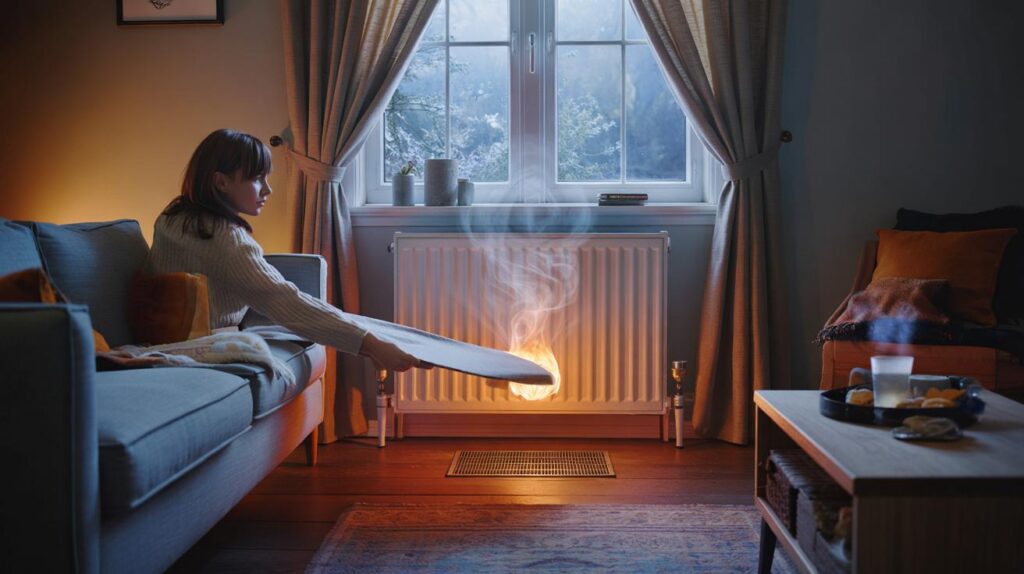
As the cold creeps back, many households feel costs rising while a small, overlooked habit sits in the living room.
Across Britain, radiators switch on, thermostats nudge up, and bills follow. Yet a misplaced sofa or heavy curtain can quietly trap heat, forcing your boiler to work harder for less comfort.
The quiet culprit lurking in your living room
Interiors often favour looks over airflow. A chunky sofa, a media unit, or floor-length curtains seem harmless. Place any of them in front of a radiator or a warm-air grille and you choke circulation. The radiator heats the fabric or wood, not the room. The thermostat senses cool air, the boiler runs longer, and your spend climbs.
How furniture and curtains stifle heat
Radiators warm rooms by convection. They heat nearby air, which rises and draws cooler air from below. Block the front or the top and you stop that cycle. The warm air pools behind the sofa or inside the curtain and never reaches the space where you sit. The result feels like weak heating, when the real problem is blocked paths for air.
Leave at least 30 cm of clear space in front of and above every radiator or warm-air outlet to restore circulation.
- Cold corners linger while the area behind furniture feels stuffy and hot.
- The thermostat sits higher for longer as the room takes ages to reach target temperature.
- You nudge the dial up one degree, adding roughly 7% to usage, yet comfort still disappoints.
- The boiler cycles more often, raising wear and maintenance risks.
Layout mistakes that quietly drain cash
Common setups that cost you money
- A deep sofa or armchair parked directly in front of a radiator.
- A media cabinet or sideboard covering a low wall convector.
- Heavy, floor-length curtains drawn across a radiator under a window.
- Clothes drying on radiators, trapping heat and raising indoor humidity.
- Books, plants, and ornaments lined up along the top grill.
- Thermostatic valves hidden behind curtains, sensing heat too early and shutting flow.
What this means for consumption and comfort
A blocked radiator delivers less heat to the room, so you compensate with time and temperature. Across a winter, simple obstructions can add 10–20% to space-heating demand. For a household spending around £1,150 on heating, 15% waste equals £172 that brings little comfort. Spread that across millions of homes and the lost energy becomes huge.
| Scenario | Likely impact | Quick fix |
|---|---|---|
| Floor-length curtains over a radiator | Warm air trapped in fabric, slow room warm-up | Tie back curtains, use shorter or lined but raised panels |
| Sofa 5 cm from a radiator | Airflow blocked, hot spot behind sofa | Pull forward to 30–50 cm, add low feet to raise base |
| Media unit covering a wall vent | Convection disrupted, uneven temperature | Shift unit or add grille clearance at the rear |
Moving furniture by a hand’s breadth can feel trivial, yet it often cuts run time and restores even warmth.
Free fixes you can do today
- Clear 30–50 cm of space in front of every radiator or warm-air outlet.
- Tie curtains to the side when heating runs; avoid pooling fabric over radiators.
- Raise soft furnishings on legs so warm air can rise underneath.
- Bleed radiators to remove air pockets; top up boiler pressure within the recommended range.
- Dust radiator fins and grills; clean convector fans to improve airflow.
- Fit reflective foil behind radiators on external walls to bounce heat back into the room.
- Check thermostatic radiator valves are upright, unobstructed, and set room by room.
- Close doors to unheated spaces to stop draughts stealing warm air.
Set-up tips for a cosy, efficient lounge
Think of radiators as air fountains. They need a clear path up the wall and into the room. A narrow shelf mounted a few centimetres above a radiator can deflect warm air outward, helpful under windows. Low-profile furniture works better than deep, fabric-heavy pieces near heat sources. If you dry clothes indoors, pick a folding rack away from radiators and keep a window trickle vent open to limit moisture build-up.
Numbers that bring the point home
What might you save this winter?
Savings vary by property, fuel type, and tariff. The examples below show how small changes add up:
- Gas-heated flat using 6,000 kWh for space heating at 7p/kWh: £420 spend. Avoiding 15% waste saves about £63.
- Semi-detached home using 9,500 kWh at 7p/kWh: £665 spend. Cutting 18% waste saves about £120.
- All-electric flat using 3,000 kWh at 22p/kWh: £660 spend. A 12% reduction saves about £79.
These figures come from simple arithmetic with typical unit rates and usage bands. Your meter, insulation level, and room sizes will change outcomes. The no-cost airflow fixes above still pay back from the first day because they reduce run time without sacrificing comfort.
When the layout is right but warmth still disappoints
Checks that reveal hidden problems
- Cold radiators at the top suggest trapped air; bleeding often restores output.
- One room cold while others roast points to a stuck or mis-set valve; balance the system.
- Frequent boiler cycling may indicate low flow temperature or oversized output; gentle adjustments can stabilise heating.
- A chilly floor and draughts hint at gaps under doors or leaky skirting; fit draught excluders and seal cracks.
Low-cost upgrades that strengthen the gains
Smart tweaks with clear benefits
- Thermostatic radiator valves let you heat lived-in rooms while dialling back spare spaces.
- Programmable controls match heat to your schedule, trimming empty-house run time.
- Reflective panels and proper curtain rails stop fabric from swallowing warm air.
- A small, quiet radiator booster fan can lift convection in tricky alcoves.
Combine these with clearances and regular maintenance and you create a tidy heat path from boiler to room. The aim is straightforward: let warm air move, let thermostats read real room conditions, and keep surfaces that hoard heat out of the way.
One last check repays the time. Stand by each radiator with the heating on. Feel for a steady upward flow and look for obstacles within a foot. Nudge a sofa forward, hitch a curtain to the side, and clear the top grille. Ten minutes of rearranging often unlocks even temperatures, quieter boiler cycles, and lower bills without spending a pound.



Just pulled my sofa 40 cm forward and tied back the curtains—room feels warmer already 🙂 If this knocks even £50 off, I’m in!
£172 saving—source?