
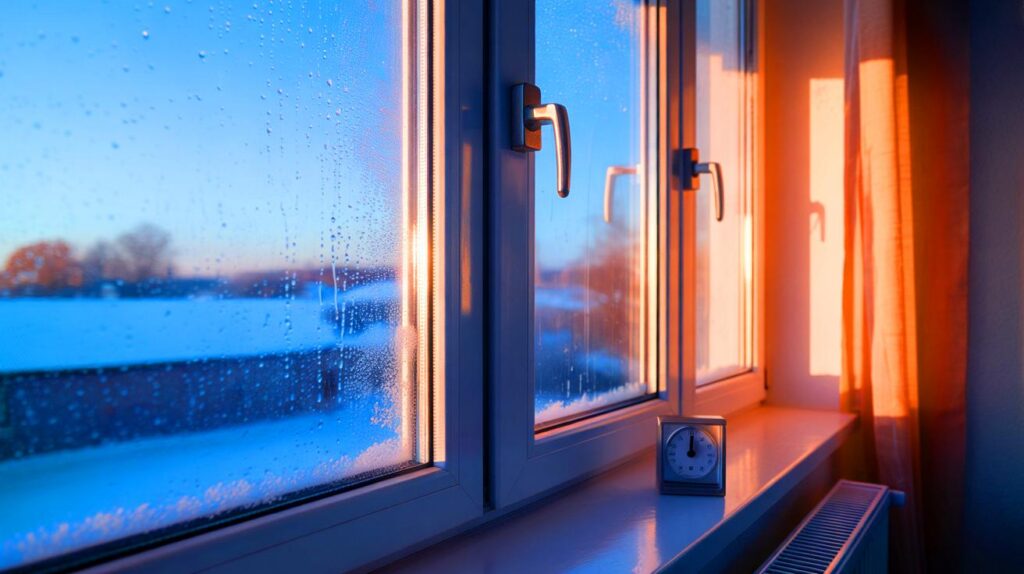
Morning panes drip, rooms smell stale, and coughs linger. Winter damp creeps in long before frost settles outside. Heating roars while comfort slips.
Moisture from people, cooking and showers piles up inside tightly sealed homes. Warm air holds that vapour until it touches a cold pane. Water beads, heat escapes, and musty odours take hold.
Why your windows fog up when the temperature drops
Warm air can carry more moisture than cold air. When indoor air hits a chilled surface, it sheds water. That change pushes liquid onto glass, frames and sills. Repeated wetting feeds dust mites and mould, then damages paint and timber.
In a typical household of four, breathing, boiling and bathing release a surprising volume of water. Laundry dried indoors adds even more. Tight new windows and blocked vents trap vapour. Heating alone cannot remove it.
A family of four can release 10–12 litres of water vapour per day indoors. That moisture must go somewhere.
The dew point, in plain numbers
At 20 °C, indoor air at 60% relative humidity hits its dew point around 12 °C. At 70%, the dew point sits closer to 14 °C. If your glass cools below those values overnight, expect condensation by breakfast. Heavier curtains pressed against panes make surfaces even colder.
Small, steady extraction prevents that tipping point. Keep the pane just above the dew point and the beads stop forming.
The 45° handle that dries glass quietly
Many modern PVC or aluminium windows include a micro‑vent setting. Set the handle around 45° so the sash sits a few millimetres off the frame. That tiny, controlled crack refreshes indoor air without a draught. Air humidity drops gradually. Glass stays clear.
Set the handle at 45° and keep a 2–3 mm gap while the heating runs. You get steady air change without chills.
Where windows lack this feature, a slim night‑vent latch or a 2–3 mm wedge achieves the same effect. Keep it engaged day and night during the heating season. Pair the trick with trickle vents fully open.
Set it and track it with a £10 gadget
Place a small hygrometer by a window and watch the number settle. Aim for 45–55% relative humidity in living rooms and bedrooms. That range balances skin comfort, respiratory health and mould control.
Aim for 45–55% relative humidity in living spaces. A simple hygrometer tells you when to tweak the gap.
- Leave 3–5 cm space between curtains and glass to avoid a cold pocket.
- Do not cover radiators beneath windows; let warm air wash the pane.
- Clear and clean trickle vents and extract grilles; dust chokes airflow.
- Use lids on pans; run the cooker hood to outside, not to recirculate.
- Avoid drying clothes indoors; if you must, ventilate and use low heat.
What to do when the number is off
| Humidity reading | Immediate action | Ongoing tweak |
|---|---|---|
| Below 45% | Reduce the micro‑vent gap slightly to keep air comfortable. | Close bedroom night vents on very windy nights. |
| 45–55% | Do nothing; you are in the comfort band. | Maintain current micro‑vent setting. |
| Above 55% | Open opposite windows for 10 minutes of cross-ventilation. | Widen the micro‑vent gap a notch. |
When quick fixes are not enough
Persistent damp points to weak ventilation or cold surfaces. Mechanical extract in wet rooms pulls moisture at the source. Continuous systems known as MEV adjust fan speed with humidity. Balanced systems known as MVHR recover heat from outgoing air to pre‑warm fresh air, cutting heat loss.
On the glazing side, double or triple glazing raises pane temperature. Warm‑edge spacers reduce cold bridging at the perimeter, where droplets often start. Perished window seals, water trapped between panes and a sour smell signal hardware that needs attention.
If condensation sits between two panes, the unit has failed. Replace the sealed unit to restore insulation and clarity.
A compact desiccant dehumidifier helps in small flats or during laundry days. Use it as a backup while you sort the root cause. Empty and clean the tank to prevent odours.
Health, heat and money: why this matters
Condensation is not just a housekeeping nuisance. Wet sills feed fungi that aggravate asthma and eczema. Spores travel on air currents and settle in wardrobes, behind sofas and on external corners. Children and older adults feel the effect first.
There is also an energy penalty. Evaporating yesterday’s puddles steals heat from the room. Every litre of water you remove with ventilation is a litre that no longer saps warmth. Lower humidity also makes 19 °C feel more comfortable than a sticky 21 °C.
A quick reality check you can do today
Run this simple routine for one week. Note the humidity morning and evening. Engage micro‑vent at 45°. Keep curtains clear of the glass. Use lids on pans and time showers. You should see the morning reading drop into the 45–55% band. The glass will tell the same story.
Security matters too. Use purpose‑designed night‑vent positions that latch. Avoid propping a sash open on the latch side in ground‑floor rooms. Check window manufacturer guidance to keep warranties intact.
If you rent or manage property
Provide or maintain trickle vents and working extract fans in kitchens and bathrooms. Fit humidity‑sensing fans where possible and test them. Schedule annual cleaning of vents and filters. Give tenants a one‑page guide that shows the 45–55% target, the 45° handle position and laundry tips.
Helpful numbers and a worked example
Set indoor temperature to 19–20 °C. If your hygrometer reads 65%, your dew point sits near 13–14 °C. A poorly insulated pane can hit 10–12 °C overnight. That gap guarantees fog. Micro‑venting nudges the humidity down a few points, pushing the dew point under the glass temperature so droplets cannot form.
In a small two‑bed flat, shaving average humidity from 65% to 50% removes roughly 2–3 litres of water from the indoor air each day. That change reduces mould risk on cold corners, trims mirror fogging in the morning and keeps bedding drier. Pair that with regular extract in the bathroom and you cut cleaning time and energy waste.



Quick question on securtiy: when the handle is parked at ~45° with the micro‑vent gap, is the sash actually latched on most PVC systems? Any standards (PAS 24, etc.) that cover this setting for ground‑floor windows, or should we avoid it overnight?
Tried the 45° handle plus a £9 hygrometer—day 1: 66%, day 3: 52%. Windows stopped crying and towels dry faster. Thanks for the heads‑up! 🙂