
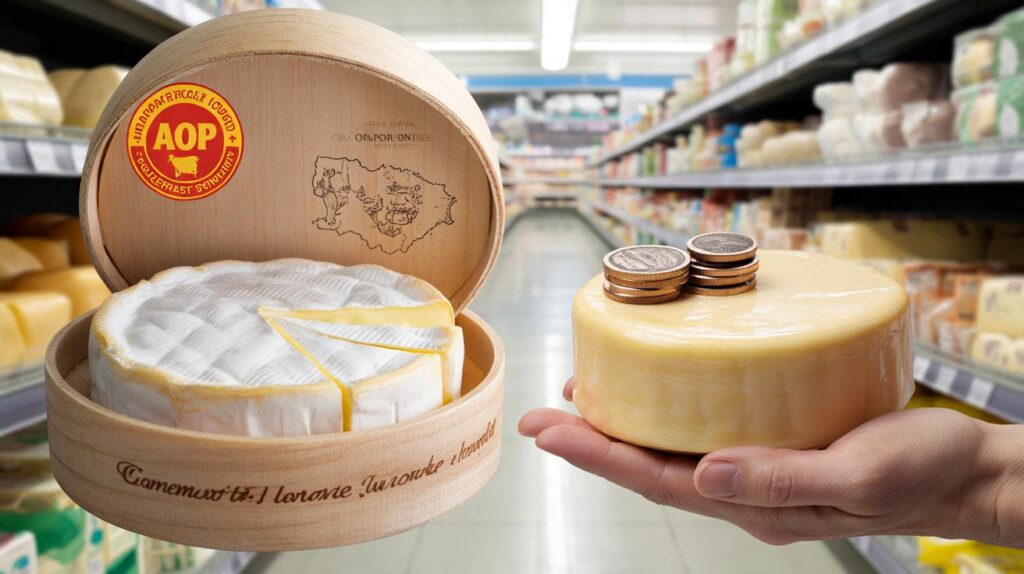
A creamy round can conceal a weak centre. Budget lookalikes imitate tradition while shaving time, flavour and craft.
Shoppers face dozens of near-identical boxes, yet only a handful deliver the rustic bite many expect. A consumer watchdog in France sets out simple checks that separate genuine Camembert de Normandie from supermarket stand-ins.
Why the name camembert no longer guarantees tradition
Since 1926, “camembert” as a name has not been protected. Any factory can sell a camembert-style cheese made far from Normandy, often with pasteurised milk, industrial acceleration and a uniform taste. The protected product you want carries the words “Camembert de Normandie AOP”. That label signals raw milk, strict farming rules for Normandy cows, ladling by hand and ageing in the region before a poplar-wood box seals the deal.
Only “Camembert de Normandie AOP” guarantees raw milk, ladle moulding, Normandy origin and regulated ageing.
Look for raw milk noted on the label, the AOP seal, and a wooden box rather than a plastic tub. AOP producers ladle the curd into moulds, which leaves delicate striations visible through the wrap. Those faint stripes are a tiny but telling signature.
The price clue you can check in 2 seconds
Price reveals a lot. A 250 g Camembert de Normandie AOP typically sits between €3 and €4.50. When you spot a 250 g camembert at under €2.50, you’re usually looking at an industrial round with curtailed ageing and leaner aromas. That doesn’t make it unsafe, but it can feel flat and rubbery next to a properly matured AOP.
If the 250 g box costs under €2.50, treat it as a red flag if you want depth of flavour and authentic craft.
Four supermarket profiles to put back on the shelf
- Missing AOP or vague wording like “made in Normandy”: if it doesn’t say “Camembert de Normandie AOP”, it isn’t the protected recipe.
- Too cheap: below €2.50 for 250 g signals standardisation, shorter ageing and limited flavour versus €3–€4.50 for AOP.
- Overbuilt rind: a very thick, chalky white coat often means imbalance and lost nuance; a fine white rind with a few rust-coloured freckles is a better sign.
- Sharp ammonia on the nose: that acrid whiff points to overmaturity or poor balance; seek a clean, rural scent that doesn’t hit harshly.
How authentic AOP is made, step by step
After unmoulding, cheesemakers salt the rounds and seed the rind with Penicillium candidum. In ageing rooms set between 10 and 18 °C, AOP camembert matures for at least 12 days on shelves, with a minimum total of 21 days before it’s boxed. Some artisans push closer to 30 days for deeper aromas, trading off a shorter shelf life.
Expect a thin white rind, a supple centre that yields gently without running, and edges that remain creamy rather than firm. If you can, press lightly through the wrap; a soft centre that springs back hints at a well-timed ripeness.
| Feature | Camembert de Normandie AOP | Standard supermarket camembert |
|---|---|---|
| Milk | Raw (not heated above 40 °C) | Usually pasteurised |
| Origin | Made, matured and boxed in Normandy | Can be produced anywhere |
| Cows and pasture | Normande breed, grazing at least six months | Not specified |
| Moulding | Ladled by hand, visible striations | Industrial filling, smooth surface |
| Ageing | Minimum 21 days | Often shorter |
| Packaging | Poplar-wood box | Mixed materials |
| Typical price (250 g) | €3.00–€4.50 | < €2.50 to ~€3.00 |
| Texture and flavour | Thin rind, creamy heart, layered aromas | Thicker rind, firmer paste, muted taste |
Quick checks in the aisle
Scan the front: find “Camembert de Normandie AOP” and the AOP logo. Check weight and price per 250 g. Flip the box and read for raw milk and the Normandy departments (Calvados, Eure, Manche, Orne, Seine-Maritime). Through the film, look for a fine rind and faint ladling stripes. If the shop allows it, a gentle press tells you if the centre still has a soft, springy core.
If you plan to eat it today or save it for later
Eating today? Choose a round that bows slightly to a light press and releases a gentle mushroom scent. Serving in three to five days? Pick one that feels a touch firmer; it will relax in the fridge and be ready by the weekend. Avoid wheels with a pungent ammonia note or edges that feel hard, as both hint at overripeness.
Nutrition, portions and who should be cautious
Cheese contributes calcium, which supports strong bones. French figures suggest around 26 kg of cheese per person each year, and roughly 500 million camemberts sold. Even so, portion size matters. Aim for 40–50 g a day when you include soft cheeses in a varied diet.
If you’re pregnant, elderly, immunocompromised or serving young children, check guidance where you live. In the UK, advice generally says to avoid mould-ripened soft cheeses made from unpasteurised milk because of listeria risk. Some pasteurised camemberts exist, but they are not “Camembert de Normandie AOP” by definition. If you need pasteurised, choose that option and accept a different flavour profile.
Serving and storage tips for better flavour
Keep camembert in its wooden box, wrapped in breathable paper rather than tight plastic, and store it in the vegetable drawer to steady humidity. Bring it to room temperature for 45–60 minutes before serving; cold fat mutes aroma. Slice a small wedge from the edge to assess the centre, then cut into slim triangles so each piece carries both rind and paste.
Planning a cheeseboard? Pair AOP camembert with crisp apples, a simple baguette and a dry cider or light Pinot Noir. Avoid heavy chutneys that can bulldoze delicate mushroom notes. For cooking, use younger, firmer wheels for baking en croûte; riper rounds work best just warmed, not cooked hard.
A practical checklist you can memorise
- Wording: look for “Camembert de Normandie AOP”.
- Price: €3–€4.50 for 250 g; under €2.50 is the warning sign.
- Make: raw milk, ladled curd, wooden box, Normandy on the label.
- Look and smell: fine white rind, subtle mushroom aroma, no harsh ammonia.
- Feel: a soft centre with spring; not rigid, not oozing excessively.
If you want to run a quick home test, buy two wheels a week apart. Keep both in similar conditions, taste blind at the same temperature and note rind thickness, aroma, centre feel and aftertaste. Most people pick the longer-aged AOP as more complex and balanced, which helps justify a higher price on the next shop.
For budget planning, calculate cost per portion: a 250 g AOP wheel at €4.20 yields about five 50 g servings at €0.84 each. Compare that with a cheaper €2.40 wheel offering similar portions at €0.48 each. If flavour, texture and satisfaction matter to you, the premium of roughly €0.36 per serving can be the better value.



This is the best cheat-sheet I’ve seen: look for “Camembert de Normandie AOP”, raw milk, a poplar-wood box, faint ladling stripes, and ignore the sub-€2.50 “bargains”. The rind notes and ammonia warning explain so many disappointments I’ve had. I also love the quick press-through-the-wrap test. Printing this for my next shop.
Is price really that reliable? I’ve had a €2.30 wheel that was creamy enough, and a €4+ one that tasted flat. Feels like batch variability and storage matter more than you admit. Also, “sharp ammonia” can be subjective—sometimes the nose calms after 20 mins. Not saying you’re wrong, just a bit definately absolutist.