
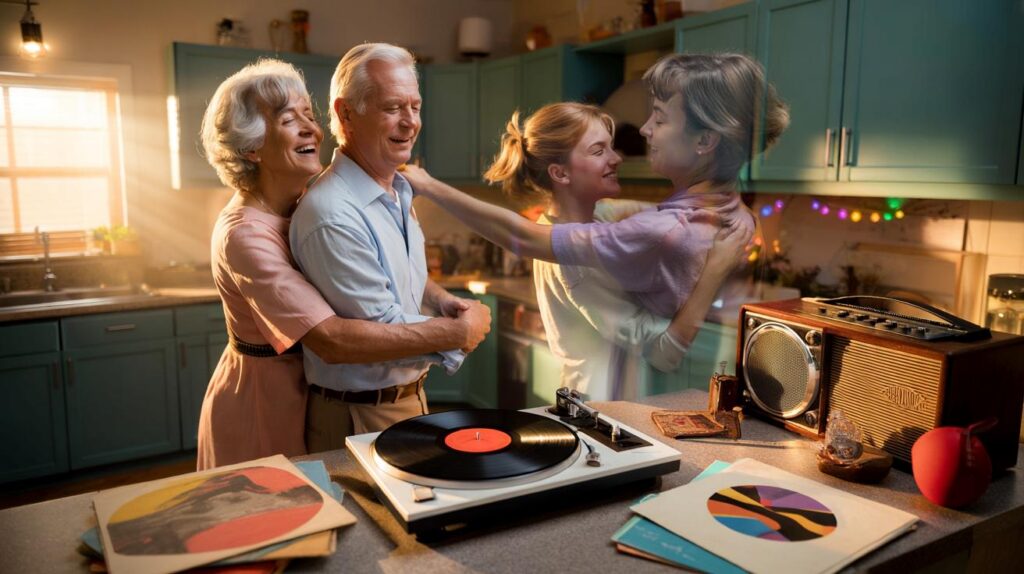
Eight tracks from the 60s and 70s still stop conversations and start memories, turning grey mornings into technicolour youth again.
You can spot the effect in a village hall or a family kitchen. A familiar intro lands, posture lifts, and lyrics tumble out with no lyric sheet in sight. For a few minutes, bills, diagnoses, and to-do lists fade. Music does not just recall those years. It restores them.
Why old songs feel new again
Psychologists call it the reminiscence bump. Memories formed between roughly 15 and 25 hold unusual strength. That window matches peak music discovery for Baby Boomers, so tracks from the late 60s and early 70s keep a privileged place.
Neuroscience adds a layer. Well-known music engages areas linked to autobiographical memory and emotion, lighting up the medial prefrontal cortex and rewarding circuits. That is why the right intro can feel like stepping into a preserved room in the mind.
Between ages 15–25, songs stick hardest. For many Boomers, that maps precisely to 1965–1976, the era that shaped them.
These tracks also came from a time when fewer stations played to larger audiences. Shared listening forged shared memories. The result is a catalogue that still binds people in rooms, not just listeners in headphones.
Eight songs that press rewind
- “The Sound of Silence” (Simon & Garfunkel, 1965): a gentle lament that gave teenagers permission to admit doubt and sit with it.
- “Good Vibrations” (The Beach Boys, 1966): sunlit optimism in three and a half minutes, bottled before the era darkened.
- “White Rabbit” (Jefferson Airplane, 1967): literate rebellion with a beat, blending bookish curiosity and counterculture bravado.
- “Let It Be” (The Beatles, 1970): a lesson in acceptance that turned growing up into grace rather than surrender.
- “American Pie” (Don McLean, 1971): a long goodbye to heroes and illusions, sung word-perfect by people who lived the references.
- “Hotel California” (Eagles, 1976): a glossy parable about success that begins as a dream and hardens into duty.
- “Stairway to Heaven” (Led Zeppelin, 1971): an eight-minute ascent that paced school discos, house parties, and first kisses.
- “Bridge Over Troubled Water” (Simon & Garfunkel, 1970): comfort made audible, promising presence when the revolution quietened.
A quick guide to the memories they unlock
| Song | Year | Memory spark | Typical moment recalled |
|---|---|---|---|
| The Sound of Silence | 1965 | Private reflection | Late-night radios, quiet bus rides, diary pages |
| Good Vibrations | 1966 | Carefree summer | Beach days, first cars, windows down |
| White Rabbit | 1967 | Curious defiance | Student flats, postered walls, big ideas |
| Let It Be | 1970 | Quiet resolve | Family crossroads, hospital corridors, farewells |
| American Pie | 1971 | Collective loss | Pub singalongs, last orders, long drives |
| Hotel California | 1976 | Success and strain | Night shifts, commutes, mortgage paperwork |
| Stairway to Heaven | 1971 | Open horizons | School dances, first bands, borrowed amps |
| Bridge Over Troubled Water | 1970 | Steadfast care | Holding hands, family tables, keeping watch |
What this says about a generation
The journey across these tracks mirrors a life arc. Early wonder gives way to questioning, then to responsibility, and finally to the call to support others. The lyrics never changed. The listeners did. A song that once soundtracked a march now fits a vigil. The same chorus can mean courage at 20 and consolation at 70.
These were among the last songs almost everyone knew before listening splintered into endless niches and private playlists.
Shared culture magnified the imprint. A single hit could pass from car radio to school hall to wedding band. That reach built a common story, and the songs still retell it when the needle drops.
Where nostalgia meets the present
Vinyl records have returned to high street shelves, and families are dusting off turntables alongside smart speakers. Grandchildren queue streams; grandparents cue sides. The medium shifts, the effect stays. A well-chosen track can calm a chaotic morning or carry a long afternoon.
Care homes now use personal playlists to spark conversation, lift mood, and reconnect people living with dementia to names and places. The right music gives staff and relatives a bridge when words falter. That approach borrows from research, but anyone can use it at home with patience and notes.
How to build a personal memory playlist
- Pick 10–15 tracks from ages 15–25. Add one or two from family events outside that window.
- Note where you first heard each song. Location cues deepen recall when the track plays.
- Sequence for energy: start warm, rise in the middle, land softly.
- Test at different times of day. Morning needs differ from evening.
- Keep a short set (20 minutes) for quick lifts and a long set (60 minutes) for steady company.
Three minutes can change the weather in a room. Treat songs like tools: choose the right one for the job.
Useful extras for sharper listening
Small adjustments raise the impact. A simple equaliser preset can soften harsh treble on older recordings and ease listening fatigue. Over-ear headphones reduce distractions during a focused session. For shared rooms, a modest Bluetooth speaker placed at ear height gives clarity without cranking volume.
Think about hearing safety. Many people have reduced sensitivity in higher frequencies by their 60s. Louder is not always clearer. Try slight bass cut and gentle mid boost before raising the dial. A comfortable level that still reveals lyrics works best for long sessions.
Ways to share the feeling
Turn a Sunday roast into a mini jukebox session. Ask each person to pick one track that shaped a decision, then play them in order. Stories tend to follow. Older relatives often reveal details that never made it into photo albums. Younger ones find openings to borrow favourites for their own playlists.
Community centres can run “time machine” hours with these eight tracks as anchors. Add local hits to taste. Encourage singing. Printed lyric sheets help, but many will not need them. A microphone is optional. The real instrument is the room.



Reading this felt like stepping back into the school gym. ‘Stairway to Heaven’ was our slow-dance finalé, and I can still smell the varnished floor. Music defintely stores rooms in the mind; one chord and the lights come back on.