
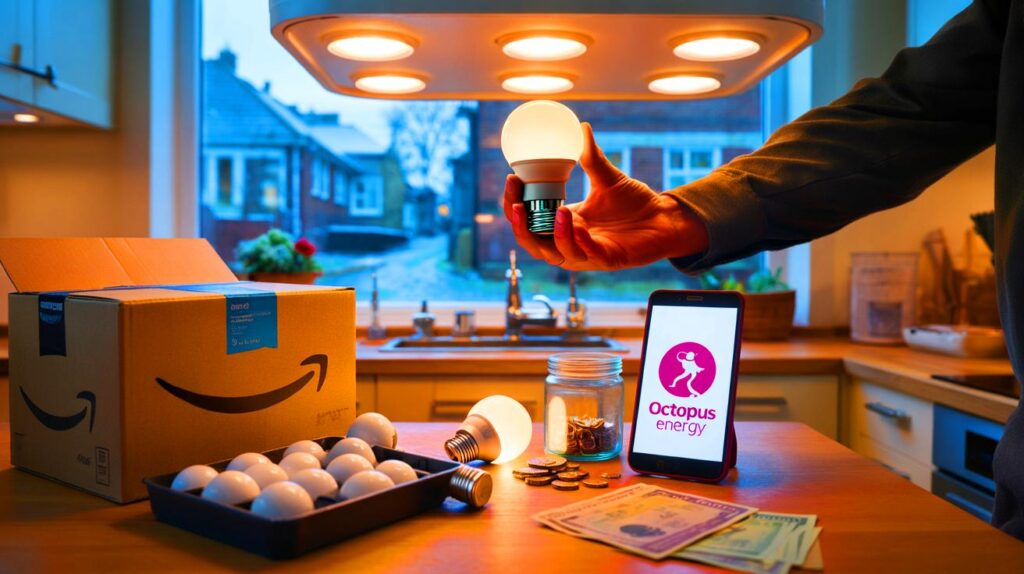
As bills bite and budgets fray, households hunt for quick wins. A small change in your lighting could punch above its weight.
With Ofgem’s cap pushing electricity costs higher, the hunt for realistic, low-effort savings is on. One tiny purchase now sits at the centre of a very big claim.
What’s behind the 87p buzz
Amazon shoppers can pick up a 24-pack of warm white 2700K LED bulbs for £20.99. That works out at just 87p per bulb. The pack is pitched with an A energy rating and designed to replace common household lamps across living rooms, kitchens and bedrooms. Buying in bulk trims the price per bulb and means spares are ready when one finally fails.
Lighting takes roughly 11% of a typical electricity bill. Swapping to LEDs cuts consumption by about 70–80% compared with old-style bulbs.
The attraction goes beyond price. LEDs reach full brightness immediately, run cool to the touch, and last significantly longer than halogen. For busy households, that means fewer ladders, fewer blown bulbs, and fewer late-night scrambles to find a spare.
What Octopus Energy says
Octopus Energy, now the UK’s largest supplier by customer accounts, has urged households to prioritise LEDs in its energy-saving guidance. Its advice suggests a household could trim £72 or more from annual costs by moving to efficient lighting and using it wisely.
Octopus Energy’s guidance: “Be bright with your lights. You could save £72+. LEDs use 70–80% less electricity.”
That support is for the switch to LEDs as a principle, rather than any single brand. The 87p Amazon pack simply lines up with that strategy: replace inefficient bulbs cheaply, and do it everywhere at once.
The numbers that matter
How much could you save at home? It depends on how many bulbs you swap, how long they’re on, and your unit rate. Here’s a simple example using 2 hours of use per day and a 28p/kWh electricity price:
| Item | Power per bulb | Annual energy per bulb | Annual cost per bulb | 12 bulbs annual cost |
|---|---|---|---|---|
| Halogen (typical) | 60 W | 43.8 kWh | £12.26 | £147.12 |
| LED replacement | 8 W | 5.8 kWh | £1.64 | £19.68 |
| Savings | — | 38.0 kWh | £10.62 per bulb | £127.44 per year |
That sits in the same territory as guidance from the Energy Saving Trust, which estimates £5–£13 saved per bulb each year, depending on usage and tariffs.
An 87p bulb that saves roughly a tenner a year pays for itself in about a month of normal use.
What to check before you click buy
- Cap and fitting: make sure the bulb matches your fitting (e.g., E27, B22, GU10, E14).
- Brightness in lumens: compare lumens, not watts. A quality 60W replacement often sits around 700–800 lumens.
- Colour temperature: 2700K gives a cosy, warm white; 3000–4000K is crisper for kitchens and workspaces.
- Dimming: only choose dimmable LEDs if you use dimmers, and check they’re compatible with LED drivers.
- Energy label: the A–G scale resets expectations; an A is excellent, but many good LEDs score B–D under the newer rules.
- Guarantee and lifespan: look for a rated life of 15,000–25,000 hours and a clear warranty.
Small habits that stack savings
Octopus Energy also underlines behaviour. Switching off lights when you leave a room adds up to around £20 a year in saved energy. Pair that with an LED swap and the gains compound fast. Motion sensors in landings and utility rooms cut waste in high-traffic spaces. In living areas, task lighting beats blazing every downlight.
One quick sweep of your home to replace the most-used bulbs can unlock the lion’s share of savings within days.
Payback, room by room
Target the heavy hitters first. Downlights in kitchens and bathrooms often run the longest. Hallways and porches stay on for safety and convenience. Swap these zones first, then move to bedrooms and occasional spaces. If you have 12 frequently used bulbs, the £20.99 outlay can be recovered within the season through lower consumption alone.
Compatibility and common snags
Older dimmer switches may cause flicker or a low-level glow with LEDs. A trailing-edge dimmer usually fixes this. Avoid mixing halogen and LED on the same dimmer circuit. If a fitting runs hot or sits in a sealed enclosure, check the bulb’s ventilation requirements to preserve lifespan. Always match voltage and avoid using mains-voltage LEDs where a transformer is required without confirming compatibility.
How this fits your wider energy plan
LEDs are a gateway to sensible, low-cost reductions while prices remain elevated. If you’re on a smart tariff, shift laundry and dishwashing to cheaper periods where possible. Seal draughts around doors and loft hatches. Turn down flow temperature on compatible boilers for steady heating without hot-and-cold cycling. Each move chips away at consumption with little disruption.
For those considering smart lighting, weigh the extra features against standby draw and price. Standard LEDs deliver most of the savings. Smart bulbs add timers, scenes and remote control, which can prevent accidental all-day lighting. Use schedules, not just voice control, to guarantee lights turn off when nobody’s home.
A quick self-check to estimate your savings
- Count bulbs used two hours or more daily.
- Note their wattage and match LED replacements by lumen output.
- Multiply total wattage saved by daily hours and 365 to get annual kWh reduced.
- Multiply kWh by your unit rate to find cash savings.
- Subtract the cost of new bulbs for your true first-year gain.
Rule of thumb: if you can feel the heat, you’re wasting energy. LEDs shine; halogens heat.
Prices change and specs vary, but the core message holds. Cheap LEDs, used wisely, cut usage fast, support Octopus Energy’s guidance, and relieve pressure on your monthly bill. If you start with the most-used lights, an 87p fix can deliver a winter-long win.



Grabbed the 24-pack at 87p per bulb—kitchen downlights finally sorted 🙂 Anyone tried them with older dimmers (trailing-edge vs leading-edge) to avoid flicker?