
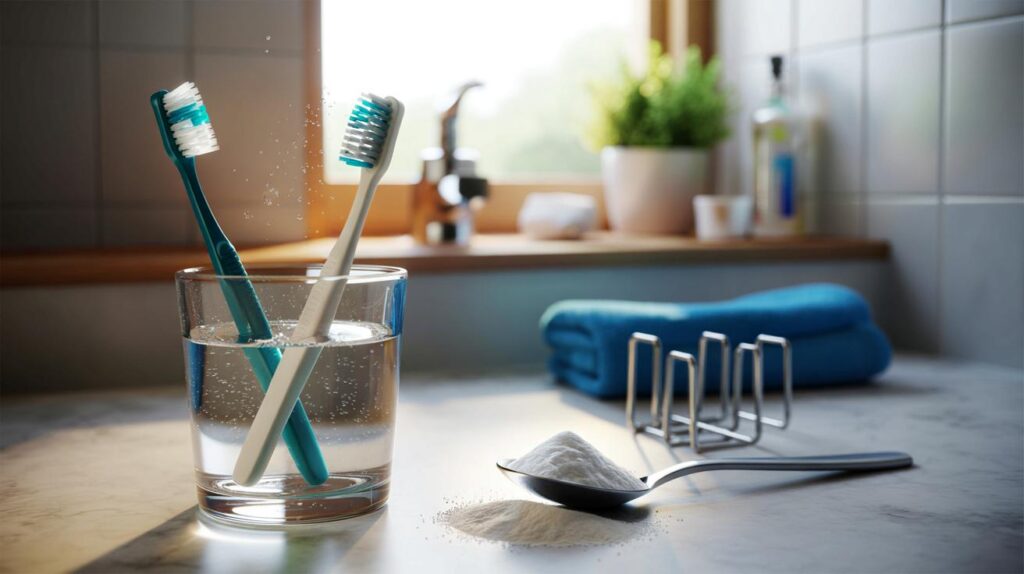
You rinse your toothbrush without thinking, then drop it back into a cup that never truly dries. The bathroom is warm, the air a little steamy, and somewhere a toilet flushes. That soft brush you trust twice a day lives in a splash zone most of us prefer not to picture. There’s a way to cut that invisible build-up without harsh sprays or mysterious liquids — just a spoon of baking soda and a few simple habits.
The mug on the windowsill held three toothbrushes, fanned like little flags. My son’s bristles were flecked with toothpaste, mine had a stray hair curling around the neck, and there was a thin tide mark inside the cup. The kettle clicked off and a flush sounded down the hall. I watched a mist of steam lift from the tap and thought: we clean our teeth, but do we clean what cleans them?
I ran a finger along the handle and felt that faint tackiness you only notice when you look for it. Not dirt in the obvious sense — the kind that smears. More like a soft film from life happening in a small room. Dental guides suggest rinsing and air-drying is usually enough, and that’s fair. Still, a weekly reset with bicarbonate of soda feels like washing the pillowcase for your mouth. One simple blend. A ten-minute pause. A small ritual before all the rushing starts.
Then I did what my gran would have done: a teaspoon of baking soda into a cup of warm water and a good stir until it went cloudy. The brushes went in head-first, not buried past the metal collar, and I left them there while I packed lunches. When I came back, the water had gone a touch milky, like it had pulled something out. I rinsed, shook them dry, and propped them upright with space to breathe. The bristles felt fresher, less tacky. Oddly satisfying. Quietly right.
Why your toothbrush needs a gentle clean
Walk into a bathroom after a shower and you can feel it: warm air, a damp mirror, droplets clinging to tiles. That moisture is comfort for your skin and for microbes. Toothbrushes are porous little things, and they love to keep hold of a day’s worth of toothpaste residue and the humidity around them. **Bicarbonate of soda won’t sterilise your toothbrush, but it helps reduce the invisible grime.** Think of it as reducing the background noise, so your mouth starts and ends the day on a lower baseline.
One small, real-life change shifts everything. Move your toothbrush 1–2 metres from the toilet and close the lid before flushing, and you cut down the chance of aerosol fallout landing on the bristles. Studies have shown bathroom droplets can travel farther than we imagine, then settle on nearby surfaces within minutes. Add a weekly baking soda soak and you nudge the odds in your favour. It’s not a hazmat protocol. It’s a quiet routine that stacks up over time.
Baking soda works in a down-to-earth way. It dissolves paste build-up, helps break down biofilm, and neutralises odour without stripping or bleaching. The slightly alkaline solution is unfriendly to many microbes, so you get a reduction in load rather than a promise of zero. That promise isn’t needed anyway; your immune system is excellent at its job. What a brush needs is the chance to dry, to shed residue, and to avoid cross-contamination. Drying beats dousing. **A clean, dry brush is simply a better starting point for a clean mouth.**
Exactly how to clean your toothbrush with baking soda
Here’s the easy method. Mix 1 teaspoon (about 5 g) of bicarbonate of soda in 250 ml of warm water until the water turns cloudy. Detach electric heads if you use them, and submerge the bristles only for 10–15 minutes. Rinse under cool running water, flick off excess, then stand the brush upright with space around it to air-dry. Do this once a week. Daily, just rinse well after brushing and let it dry uncovered. For the holder, scrub with the same solution, then rinse and dry fully.
We’ve all had that moment when you peer into the toothbrush cup and think, oh. Life got busy. Let the cup and handles have a turn in that soda mix as well, because that’s where drips collect. Don’t over-soak for an hour while you forget about them; it can weaken bristles and loosen glue on some heads. Use warm water, not scalding, so plastics keep their shape. And if you’ve got travel caps that stay damp inside, give them a rest. Let air — not fragrance — do the work. Let’s be honest: no one actually does this every single day.
Think of this routine as light maintenance, not a deep clean with lab ambitions. *A teaspoon in warm water is enough to make a difference you can feel.* If someone in the house has been poorly, replace the head rather than trying to rescue it. **Close the toilet lid before you flush.** Keep brushes an arm’s length away from the splash zone, and don’t let them touch each other in the holder.
“Clean doesn’t mean sterile; aim for fresh, dry, and low-risk.”
- Ratio to remember: 1 teaspoon baking soda to 1 cup (250 ml) warm water.
- Soak 10–15 minutes, then rinse and air-dry upright.
- Deep-clean the holder monthly with the same solution.
- Replace manual brushes or electric heads every 3 months.
- Keep at least 1–2 metres from the toilet if you can.
What this tiny habit changes
There’s something calming about rituals that don’t shout. A weekly soak, a space to dry, a lid lowered before you tap the lever — these are small signals that say your morning and evening matter. You’re cutting the low-level clutter that builds up in unseen corners, and that spills over into how those first and last minutes of the day feel. The bathroom looks a shade more intentional. The brush in your hand feels new for longer.
Share it with a flatmate, your partner, your teen who leaves their brush face-down on the shelf. Not as a lecture, just a nudge: here’s a trick that costs pennies and works. If you’re the gadget type, you can pair it with a UV caddy or a ventilated holder, but the bicarbonate routine holds its own. It’s humble, quick, and forgiving if you miss a week. That’s the beauty. You can start tonight, and you’ll taste the difference tomorrow.
| Key points | Details | Interest for reader |
|---|---|---|
| Use a baking soda soak weekly | 1 tsp in 250 ml warm water, 10–15 minutes, rinse and air-dry | Low-cost, low-effort way to cut residue and odour |
| Prioritise drying and distance | Store upright, uncapped, away from toilet splash zone with lid closed | Reduces contamination risk without buying new gear |
| Mind the holder and replacement cycle | Clean the cup monthly; change brush or head every ~3 months | Better mouthfeel, fewer frayed bristles, cleaner bathroom look |
FAQ :
- Does baking soda kill all germs on a toothbrush?It reduces build-up and lowers microbial load, but it doesn’t sterilise. For illness or frayed bristles, swap the head.
- Can I use vinegar or boiling water instead?Vinegar is acidic and smells; boiling can warp plastics. Baking soda in warm water is gentler and still effective for routine care.
- How often should I clean my toothbrush like this?Weekly is a sweet spot. Daily, rinse thoroughly and let it air-dry, uncapped.
- Is it safe for electric toothbrush heads?Yes, if you detach the head and soak only the bristles. Keep the charging base and metal contacts dry.
- What if my bathroom is tiny and I can’t move the brush far from the toilet?Close the lid before flushing, use a ventilated wall-mounted holder, and focus on drying time. The weekly soda soak helps bridge the gap.



This is the first guide that makes the ‘gross bathroom fog’ problem feel solvable. Quick Q: is the 10–15 minute soak safe for charcoal-infused bristles, or does baking soda neutralize whatever coating they have?
Any peer‑reviewed links on microbial load reduction? “Helps break down biofilm” sounds right, but without numbers it feels like vibes. Also, isn’t bicarbonate mostly a buffer, not a disinfectant? Definately open to data.