
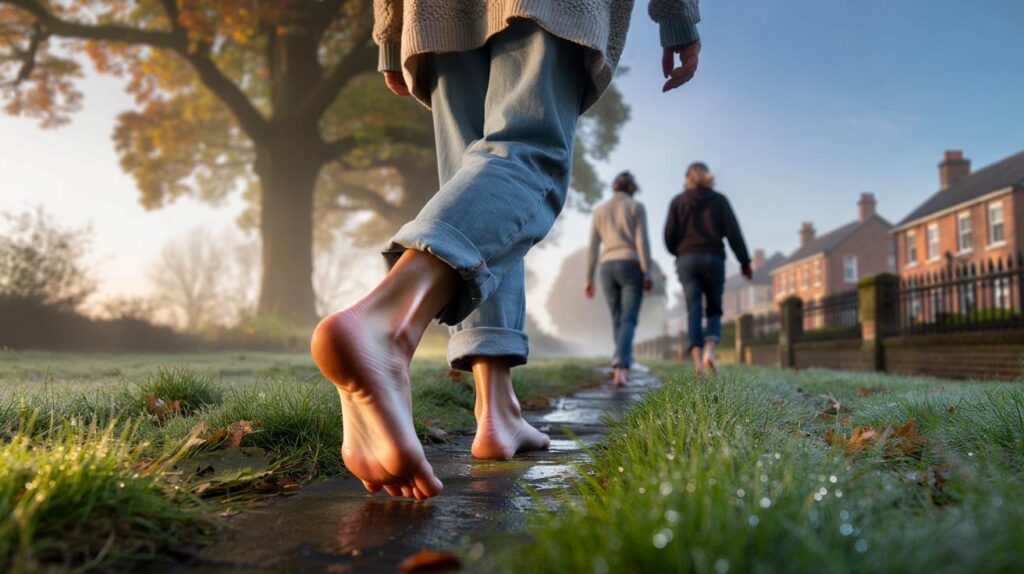
Rain on lawns, chilly pavements, and curious neighbours: a quiet ritual is nudging thousands to rethink mornings in October.
Across the UK, more people are slipping off shoes for a daily 10‑minute barefoot walk, citing calmer nerves and deeper sleep. The practice, often called grounding or earthing, blends old-fashioned common sense with a contested wellness claim. It costs nothing, needs no kit, and fits into a commute, a coffee break or a garden wander.
Why people are trying it now
Autumn magnifies small routines. Shorter days push many to look for steadier sleep, steadier mood and a reason to step outside. Barefoot time offers a sensory jolt: cool grass, uneven stone, wet leaves, and the slight risk that keeps attention sharp. That sensory input trains balance and posture. It also forces a slower pace, which many readers say calms racing thoughts before work or bed.
Wellness groups report brisk interest in “grounding sessions” at parks and coastal paths. Some National Trust properties and city commons already host family-friendly barefoot trails in summer. This year, the habit is moving into colder months, helped by hardy walkers who treat 10 minutes as a daily check-in rather than a feat.
Ten minutes on safe ground, once or twice a day, is enough to test the idea without buying anything.
The claims and the cautions
Stress, sleep and the ‘earthing’ theory
Proponents argue that direct contact with soil or grass lets the body equalise its electrical charge, easing tension. Small pilot studies have noted better sleep quality and changes in stress markers, yet the methods are limited and results mixed. Physics agrees that the Earth acts as an electrical sink. Medicine asks a different question: does that contact deliver a measurable health effect in daily life? Evidence remains tentative.
There is a less debated route to benefits. Barefoot walking stimulates thousands of sensory receptors in the sole. That input helps the brain refine balance, stride and joint alignment. Stronger intrinsic foot muscles support arches and may reduce strain higher up the chain. Slower, attentive walking also behaves like a short mindfulness drill, which often improves mood and sleep consistency.
Treat ‘earthing’ as an experiment, not a cure. Track how you feel, then keep what genuinely helps.
How to start safely in Britain’s weather
Most people can begin with short sessions on familiar ground. Start warm, choose a clean surface, and keep a towel by the door. If the ground is icy, stay indoors. If you feel pins and needles, numbness or a sudden temperature drop, stop and warm the feet.
- Pick a surface you can scan quickly: lawn, clean sand, smooth path, timber deck, or rubber mat.
- Begin with 5–10 minutes; add 2–3 minutes every few days as comfort grows.
- Walk slowly, soften the knees, and place the foot quietly to sense texture and pressure.
- Check the route for glass, thorns, dog waste and metal edges before each session.
- Dry feet after wet walks; cold, damp skin chills faster and blisters more easily.
- Skip barefoot sessions if you have open cuts, athlete’s foot, or poorly controlled diabetes.
What surfaces do and don’t do
Different terrains offer distinct sensations, grip and hygiene profiles. Conductivity matters to those testing earthing; texture matters to those building foot strength and balance.
| Surface | Sensation | Grip | Hygiene risk | Conductive |
|---|---|---|---|---|
| Wet grass | Cool, springy | Good | Moderate (soil, pets) | Yes |
| Dry lawn | Softer, warm | Good | Low to moderate | Yes |
| Beach sand | Shifting, massage-like | Variable | Low to moderate | Yes (damp more so) |
| Wooden deck | Firm, smooth | Good | Low (watch splinters) | No |
| Stone path | Textured, cool | Good | Low | No |
| Indoor tile | Hard, stable | High | Low | No |
What changes to look for after two weeks
Readers who log their experience often report steadier mood in the afternoon, warmer feet during the day, and fewer fidgets before bed. Sleep timing can shift earlier if the walk happens at the same hour, because regular light exposure and a repeatable wind‑down cue nudge the body clock. Foot tenderness tends to fade as the skin thickens and small muscles wake up. Calves may feel worked at first, then lighter.
Not every change feels pleasant. Some notice tight calves, especially after years in cushioned shoes. Others find the cold too distracting to relax outdoors. A small group feels no benefit at all. These outcomes help you decide whether to keep, adjust or drop the habit.
Who should pause or seek advice
Avoid barefoot walks on unknown ground if you have reduced foot sensation, circulation issues, or a history of foot ulcers. That includes many people with diabetes or peripheral neuropathy. Those on immune‑suppressing medicines face higher infection risk from small cuts. Allergies to grass or mould can flare on damp lawns. In tick areas, stick to paths and check ankles after.
A simple protocol you can test
Two-week self-trial for busy readers
Pick one safe surface. Walk barefoot for 10 minutes at the same time each day. Keep a short log with three ratings from 1 to 10: stress before the walk, stress after, and sleep quality that night. Add a note on temperature, surface and any discomfort. At day 14, compare day 1 and day 14 ratings. If you see a clear gain and no red flags, continue. If not, change the surface or time and repeat.
Beyond barefoot: build stronger feet and a calmer nervous system
Pair the walks with simple foot drills to speed adaptation. Three moves work well indoors: short‑foot (gently draw the ball of the foot toward the heel without curling toes), big‑toe raises, and slow calf raises. Two sets of 8–10 reps per foot three times a week fit into a kettle boil. If you transition to thinner shoes, do it gradually to avoid Achilles and plantar strain.
For cold days, an unheated conservatory or a sheltered step offers the needed contrast without numbing the toes. If you care about conductivity, a damp cotton towel on a paved patio increases skin‑to‑ground contact. If you care mainly about strength and balance, any stable surface works, including indoor tile.
What this means for your day
Barefoot time is a low-cost way to add movement, sensation and routine. It inserts a pause that many struggle to schedule. It may help you sleep sooner and stress less, and it will almost certainly wake up feet that spend long hours in shoes. The practice is small, yet repeatable, and it adapts to a flat or a garden alike.
If you want more structure, pair the walk with daylight exposure and a fixed bedtime for two weeks. That combination gives your body clock three steady cues: light, movement and timing. Add a warm rinse for the feet on cold nights, then socks, to hold heat and avoid the post‑walk chill that can delay sleep.



Trying this tomorrow—wish me luck!