
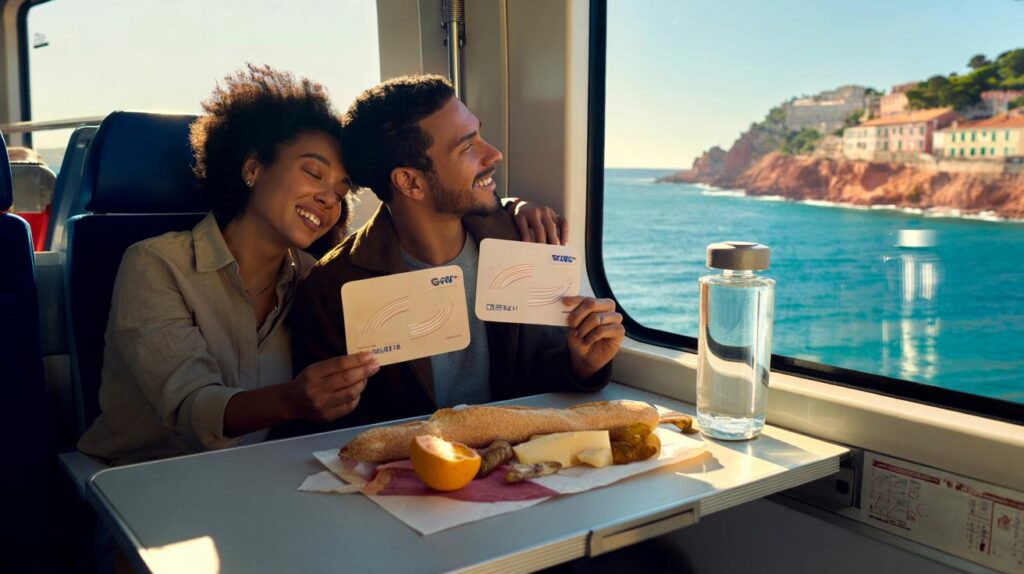
French trains have a reputation: fast, chic, a bit pricey if you play it wrong. A British couple from Manchester decided not to play it wrong. They bought rail passes, shaped a loose loop across France, and came home with a camera roll stuffed with sea light, station boards and accidental picnics in places they hadn’t planned to love. Their bill? Smaller than their smiles.
The 07:23 slid into Bayonne with that soft metallic sigh you feel through the soles. Maya pressed her forehead to the window while Tom flicked open the app, thumb hovering over the day’s pass activation like a tiny leap of faith. A woman opposite set down a half-peeled orange and passed them the other half, as if this carriage was a kitchen table and we’d all agreed to be neighbours for three hours. The guard’s cap tilted, the whistle lifted, the countryside started to unspool. They paid less than a round-trip flight.
The joy-per-pound case for rail passes
Maya and Tom’s lightbulb moment came on a sticky evening in Paris, when single fares for spontaneous TGV hops looked brutal on the screen. A **rail passes** search changed the mood: the maths, on their kind of trip, suddenly smiled. Days of travel, not single tickets. Freedom to leave when the weather turned, or when a boulangerie queue seduced one of them for far too long.
Over ten days, they stitched a path that felt deliciously excessive on paper and perfectly sane on a pass. Paris to Strasbourg for flammekueche and river light, then a meander south: Dijon, Lyon, Avignon, Nîmes, Montpellier, and a blue-skied finale along the Riviera. Buying late, those seats would have stung. With a one-country Interrail/Eurail pass, their outlay spread thin. They still paid **seat reservations** on high-speed trains, but the base cost was fixed, predictable, painless.
Rail passes work best when you let them turn movement into a habit, not an event. If you’re stringing three, four, five proper travel days, the pass pulls ahead of point-to-point fares fast. On TGV and many Intercités you’ll need a reservation, a small supplement that’s easy to miss if you’re tired or romantic or both. On TER regional trains, no reservation means you just walk on, find a window, and let the fields decide your day. You feel rich in time, not in money.
How they kept it cheap — and easy
Their system was boring in the best way. They chose an Interrail/Eurail One Country France Pass with four travel days in a month, then marked those travel-heavy days like stars on a map. Long jumps used a pass day. Short hops stacked on the same day. Town days were free days: no pass activation, no guilt, just bicycles, trams and shoes. They booked TGV reservations as soon as trains opened, then left TER rides for whim.
They travelled after 09:30 to dodge commuter crush, packed a collapsible bottle, and bought picnic bits the night before. A tiny two-port plug kept their phones and a Kindle alive on every platform. Let’s be honest: nobody does that every day. When plans shifted, they leaned on station staff, who often found quiet corners of the timetable they’d have missed. They learned to love Gare signs, those big departures boards, like a game that always pays out.
One rule kept them sane: never plan connections tighter than 12 minutes unless the stations share a roof. Delays don’t ruin a pass day if you let space breathe between your trains. They made one splurge on first class for a long stretch to Nice, using a small upgrade fee, and learned that comfort is worth more when you chose it, not when you were forced into it by price.
“The pass wasn’t just cheaper,” Tom told me. “It made us brave. We could change our minds and not feel silly or skint.”
- Book TGV/Intercités reservations early; TER rides need none.
- Stack short hops on one pass day for extra value.
- Aim for the sea-facing side between Marseille and Menton.
- Use SNCF Connect for live platforms; screenshot your day’s trains.
- Carry a paper backup of your itinerary. Batteries die at 2% and 20:02.
What the trains gave them, beyond the deal
Trains slowed their brains to the pace of landscapes. Strasbourg’s timber frames gave way to Burgundy vines so neatly lined it looked like handwriting, then ochre towns where shutters winked under the noon sun. We’ve all had that moment when a trip stops being logistics and starts being a story. For them, it was a TER rolling past flamingo-pink lagoons near Sète, a carriage gone quiet, a French teen gently singing a song that everybody pretended not to know. The pass made that possible because it removed the fear of “wasting” a day. When you aren’t meter-running your travel, you pick the left window seat, you look out longer, you start to notice the old station clocks and the stray cats by the buffer stops. That’s when France gets under your skin and refuses to leave.
On costs, they were honest with themselves. Four-day pass for France from about €120–€180 each, plus reservations on high-speed runs, usually €10–€20 a shot if booked early. A late “full-fat” fare on Paris–Lyon can nudge €90 alone, so the pass felt like a cheat code on any day they did a long leg plus a side trip. On food, they swapped restaurant lunches for station picnics: baguette, ham, cornichons, a pear. They ditched taxis whenever a tram or a city bike map appeared. The only regret was a missed sunset at Marseille’s Vallon des Auffes because Tom fell in love with a pastry case in Noailles. Price of happiness, he shrugged.
Use a pass with a rhythm. Don’t activate a day at 08:00 for a 17:12 departure just because your thumb is itchy; the clock starts when you say it does. Confirm that a TGV you fancy still has pass-holder seats left before you plan a whole day around it. Keep ridiculous connections as a spectator sport on the station board, not in your itinerary. If a train is late, you haven’t “wasted” a ticket. You’ve spent a day in motion. It counts. They avoided passing trends and flashy hacks. They just learned the pattern of French rails, then played in tune. **Interrail/Eurail** is a product, yes. But what it bought them was a feeling.
Not every moment was postcard-perfect. One morning in Avignon, they misread the platform and waved their own train goodbye, laughing, mortified. A station agent rebooked their reservations in two clicks. Another day, a strike thinned the timetable and the couple took an unplanned bus to Arles, which turned into a memory of Van Gogh blues and a terrace coffee they still mention. Soyons honnêtes : personne ne fait vraiment ça tous les jours. Yet when the train curves along the Esterel coast, the cliffs red as old brick, you forgive the odd hiccup. If it sounds like a romantic, impractical fantasy, it isn’t. It’s a method with room for romance. And that’s why it works.
They learned to respect towns as much as lines on maps. Lyon deserved two nights for bouchons and the traboules, Montpellier needed a lazy tram to the beach, Strasbourg coaxed them into an early walk for river fog. On pass-free days, they walked until their socks complained. On pass days, they chased serendipity: an extra hour in Nîmes because the arena looked gold at 4pm, a side trip to Menton just to see lemons painted on tiles. They never once felt trapped by their own plan. That might be the rarest luxury on a modern holiday.
On a practical note, their kit list was plain: cabin bags only, one packing cube each, light layers, a tiny picnic knife wrapped with a cork so it wasn’t confiscated. The pass lived on Maya’s phone with a printout in Tom’s pocket. If one died, the other survived. They checked platforms on SNCF Connect, then watched the locals’ feet; when everyone started to drift, so did they. You don’t need perfect French. A “Bonjour,” a smile and the carriage number on your tongue goes far. They spoke proper Spanish in a Basque bar by accident. Nobody minded.
By the time they reached Nice, the pass had turned from a money-saver into a permission slip. Permission to sit still in a moving country. Permission to say yes to a town you can’t pronounce. Permission to go back when a place clings to you like sea salt on your skin. If you’ve ever wanted to feel like the map bends slightly to your will, this is the trick. It isn’t a secret. It’s a decision. And then a train.
| Key points | Details | Interest for reader |
|---|---|---|
| Choose pass days deliberately | Use pass for long jumps, stack short hops on the same day, keep rest days free | Maximises value without feeling rushed |
| Book reservations early | TGV/Intercités need paid seats; TER rides don’t | Protects your plan and avoids pass-holder seat sell-outs |
| Travel light and leave buffer | Cabin bags only, 12–20 minute minimum connections, screenshots of tickets | Lowers stress and keeps options open when plans change |
FAQ :
- Which pass did they use?They picked an Interrail/Eurail One Country France Pass with four travel days in a month.
- How much did it cost overall?Passes start around €120–€180 per adult for 3–4 days, plus €10–€20 per TGV reservation if booked early.
- Do you always need a seat reservation in France?TGV and many Intercités require one; TER regional trains do not, so you can just board.
- Can you ride first class with a pass?Yes if your pass is first class, or you can sometimes pay a small upgrade fee on specific trains.
- What if a train is delayed or cancelled?Staff can reroute you; your pass day remains valid for other services, which keeps the trip flexible.



Utterly charming and genuinely useful. The image of sharing an orange on the 07:23 made me grin, and the “pass as permission slip” idea is gold. We did a mini-loop last spring and totally agree: stack short hops, reserve the big ones early. Thanks! 🙂
Question for the maths: did your total include every TGV reservation, the Nice first‑class upgrade, and the odd strike day detour? I’ve been burnt by pass‑holder seat quotas before, and last‑minute reservations can be €20+ a pop. For two people over 10 days the savings feel… possible, but not guaranteed. Any raw numbers or reciepts you can share? Also, regional TERs are great until they’re packed—were you ever left standing with luggage? Not trying to nitpick, just cautious after a pricy “cheap” rail pass trip.