
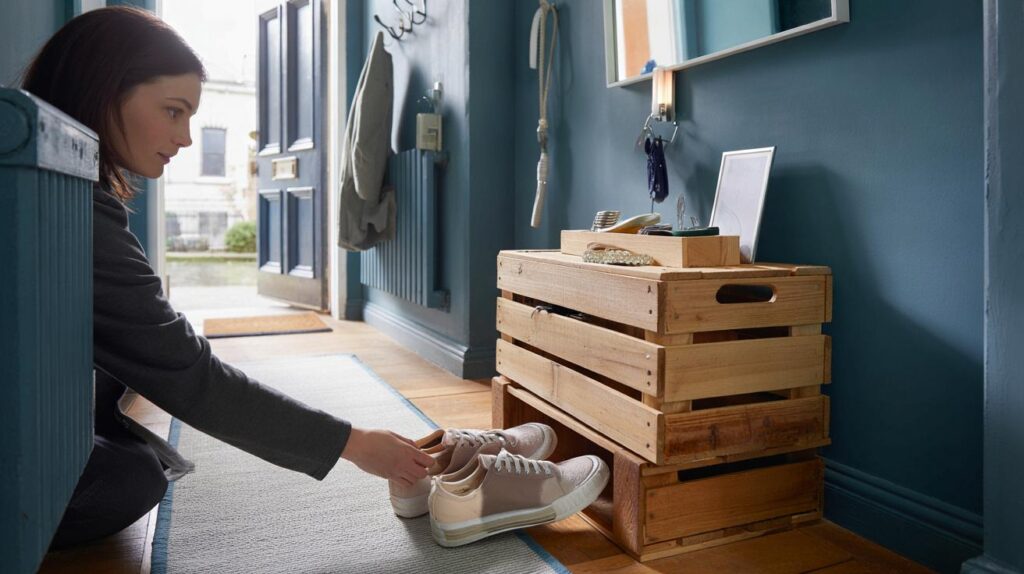
A tiny London hallway. A pile of trainers, boots and heels that never quite found a home. One young woman looked at the mess, looked at four old crates, and saw a fix that felt like style rather than compromise.
Rain knocked the letterbox like a loose cymbal the morning she decided to do it. Her hallway is the sort you tiptoe through sideways, coat hem kissing the skirting, an obstacle course of laces and wet soles. She stood there with a coffee and a sigh, then dragged in the crates she’d rescued from behind a greengrocer’s on the high street.
The wood smelled faintly of apples and dust. She brushed them down, lined them up, and the bones of a new routine clicked into place. No flat-pack, no delivery window, no endless screws. Just old timber getting a second life, and a narrow passage beginning to feel generous.
She didn’t buy. She made.
The hallway that stopped tripping her up
Stacking crates on their sides changed the whole rhythm of the space. Shoes slid into square cubbies instead of sprawling into a mushy heap, and the floor finally showed its face. Each crate became a beat: pair, pair, pair, pause. She left a gap at the bottom for muddy boots, light up top for canvas plimsolls, and a shallow tray on the very top for keys and post.
The vibe wasn’t rustic clutter. It read as deliberate, even a little gallery-like, because the boxes matched in tone. And the eye loves repetition. She could glance down the row and see who was missing a mate, which pair needed drying, what could go to charity. It wasn’t just storage. It was rhythm with a job to do.
She found the crates by chance: four fruit boxes, sturdy, with slatted sides and finger cut-outs. The greengrocer wanted rid and waved her on for the price of a fancy latte. In terrace houses up and down Britain, hallways hover around a metre wide, so every centimetre counts. Turning the crates side-on shaved precious floor space. The trick was to think vertical, not horizontal, and let the walls do more work than the skirting ever could.
She measured the wall from radiator to doorframe and had just enough room for a three-crate stack and a single beside it. The result freed a clear walkway—no more sideways shuffle, no more apologising to guests. The cost? Under £20 including sandpaper and a small tin of varnish she already had half-used in the shed. The joy? Immediate.
Why does this simple move feel so right? For one, crates are shallow—usually 25 to 30 cm deep—so they don’t bully the corridor. Air moves through the slats, which matters for damp shoes and British weather. Your eye reads the timber as warm, not bulky, and the texture looks designed even when it’s plainly not. And there’s a psychological shift when shoes have visible “homes”: tidying becomes as quick as dropping keys on a dish.
We’ve all had that moment when you’re late, can’t find the other boot, and swear you’ll sort it tonight. This makes “sorting it” three seconds long. You’re training the habit just by making it easier than kicking shoes off wherever they land. Low friction. High payoff.
https://youtu.be/RY3TLgwmMCw
Build it like she did
She started by scrubbing the crates with a stiff brush and warm soapy water, then leaving them to dry in the sun for the afternoon. Next came a light sand with 120-grit to soften edges so they wouldn’t snag tights or skin. One thin coat of matte varnish helped fend off splashes and mud, while keeping the wood’s lived-in look. No gloss, no glare.
Then the layout: she turned each crate on its side, stacked two, and slid one beside the pair. Pilot holes through the crate sides with short wood screws kept the stack tight. Felt pads under the bottom corners protected the floorboards. A small L-bracket at the top into a wall plug stopped the whole thing ever tipping, which mattered more than looks. She kept the top crate free for bits: a dog lead, a travel card, stray coins. That little tray became peace of mind.
Common mistakes? Over-sanding until the wood looks new again—don’t. The patina is the point. Forgetting to check for wobble if your floor dips—slip a thin wedge or a folded card shim under a corner and it disappears. Cramming too many tall boots into a short crate—give them the bottom row or turn a crate upright for extra height.
It’s worth testing with your actual shoes before you commit screws. Line up a couple of pairs, see how they slide, see what feels natural after a week. Let’s be honest: no one really does that every day. Design for the lazy version of you, not the aspirational one.
There’s a quiet thrill in making something with your own hands and then using it, every single morning. That’s what she kept coming back to. Not just saving money, or saving space, but the tiny ritual of placing shoes where they belong. It sounds soft. It’s not. It’s discipline disguised as charm.
“I wanted something that looked intentional without being precious,” she told me. “If it gets a scuff, fine. If it gets better with time, even better.”
- Cost guide: reclaimed crates often go for £0–£10; sanding sheet £1; small varnish tin £7–£12.
- Time needed: 90 minutes for prep and assembly, plus drying time between coats.
- Safety note: anchor tall stacks to the wall, especially in homes with kids or pets.
Small fix, bigger shift
What looks like storage is also a quiet manifesto: use what you have, elevate it, and stop waiting for the perfect buy. A hallway is a threshold; design it and mornings change tempo. Shoes go in, bag on the hook, keys in the tray, door clicks. Your brain breathes before you’ve even hit the pavement.
Crates have a story in the wood. Marks from harvests. Nail holes from bygone shops. Bringing that into a rented flat or a starter home softens the boxy newness and layers in texture. The look plays well with black metal hooks, a simple runner, or a mirror that steals light from the doorway. It also dodges landfill and long lead times, which feels quietly modern.
Space saving isn’t magic; it’s choosing vertical over horizontal, shared surfaces over single-use, small rituals over grand plans. She made a shoe rack and got a calmer start to the day. The rest happened on its own. Zero new timber, maximum effect.
| Key points | Details | Interest for reader |
|---|---|---|
| Reclaimed crates as chic storage | Stacked sideways, lightly sanded, matte varnish, anchored with L-brackets | Affordable, stylish, and easy to copy at home |
| Space won back in a narrow hallway | Shallow depth keeps walkway clear; top tray holds keys and post | Practical tips for tight British terraces and rented flats |
| Low-cost, low-waste DIY | Under £20 for materials; no flat-pack needed; fast to build | Sustainable, budget-friendly solution that looks intentional |
FAQ :
- Where can I find old crates that are safe to use indoors?Try greengrocers, farm shops, Facebook Marketplace, or car-boot sales. Look for dry timber with no strong odour or signs of rot.
- How do I clean and prepare crates without losing their patina?Use warm soapy water and a stiff brush, let them dry fully, then lightly sand edges only. Finish with a thin coat of matte varnish or wax.
- Will the crates hold heavy boots and heels?Yes, if they’re solid wood and stacked securely. Put heavier items on the bottom row and anchor tall stacks to a wall plug.
- What if my hallway is even narrower?Use slimmer wine boxes or cut a crate down to 20 cm depth. One high column often beats a wide, low unit.
- Can I personalise the look?Absolutely. Stain for a darker tone, add castors to one crate as a rolling boot bin, or stencil labels for seasons or names.



Love how you turned fruit crates into a gallery-like shoe wall. The “pair, pair, pair, pause” rhythm line sold me. Quick Q: did the matte varnish cut the apple smell, or do you still get a hint in rainy wheather?
I’m a bit cautious about reclaimed wood—any concern about mites, mold, or old spill residues in greengrocer crates? How did you verify they were safe beyond a scrub and a sniff test?