
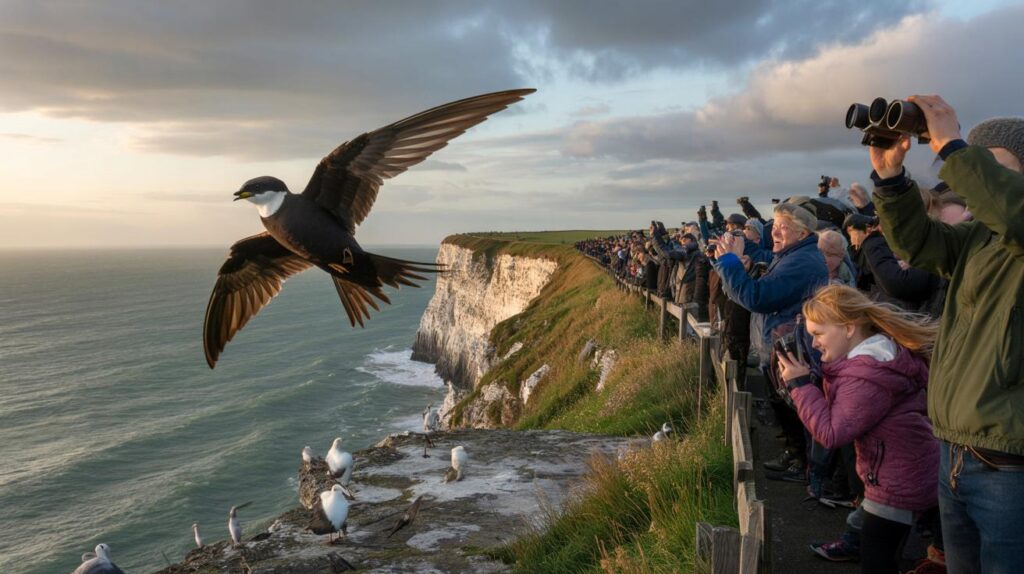
Binoculars were raised, phones buzzed, and coastal car parks filled as an unexpected visitor lit up Yorkshire skies for hours.
By late afternoon, whispers on birding forums had turned into tailbacks on rural lanes, with families and twitchers chasing a fleeting silhouette.
A bolt across Yorkshire skies
An exceptionally scarce white-throated needletail — a heavyweight among swifts — sent shockwaves through two East Yorkshire hotspots, drawing a fast-growing crowd. First noticed at Yorkshire Water’s Tophill Low Nature Reserve, the bird later tore past the sea cliffs at RSPB Bempton near Bridlington, prompting a surge of people eager for a once-in-a-generation view.
First confirmed sighting in England since 1991; only the second on record in Yorkshire after a 1985 appearance.
The chain of events began when visitors Mandy Gregory and Ray Maddison photographed a striking, scythe-winged swift over Tophill Low on Wednesday afternoon. Their images quickly set reserve staff buzzing. Word spread within minutes, and cars began to stack up in the small car parks. About 50 people arrived within the first hour, with many more on the way by early evening.
Why this bird matters
The white-throated needletail, also known as the needle-tailed swift (Hirundapus caudacutus), breeds in parts of Asia and migrates towards Australasia. It is noted for tremendous speed in level flight, long sabre-shaped wings, and a distinctive white throat patch. The species is a rare vagrant to Europe, and visits to the UK are exceptional.
Local staff describe it as probably the reserve’s second-rarest bird in six decades, eclipsed only by an Amur falcon in 2008.
Tophill Low has a track record of attracting unusual visitors. Regular residents include barn owls, kingfishers and bitterns, while last year a pair of blue-winged teal from North America turned up. Even with that pedigree, a needletail sits in a different category of rarity, which explains the speed and scale of the public response.
From reservoir to sea cliffs
After its initial dash over the reservoir lagoons, the bird was glimpsed again along the coast at Bempton Cliffs on Wednesday evening. There, word-of-mouth reached walkers, families and seasoned birders alike. The cliff-top paths filled quickly as people trained scopes and phones on the sky above the gannet colonies.
Hundreds assembled at Bempton within hours, scanning the horizon for a dark, bullet-shaped swift carving tight arcs over the sea.
Conditions were helpful. The evening brought bright gaps between showers, giving enough contrast for people to pick out a fast, dark bird powering through the wind. The needletail’s direct, muscular style stands out from the fluttery jinks of swallows and the regular scything of common swifts.
What people actually saw
| Date and time | Location | Estimated crowd | Notable details |
|---|---|---|---|
| Wednesday afternoon | Tophill Low Nature Reserve | About 50 in the first hour | Initially photographed by two visitors; rapid alert via staff and social media |
| Wednesday evening | RSPB Bempton Cliffs, Bridlington | Several hundred by nightfall | Multiple brief passes over the cliff-top and sea; views were fast and intermittent |
How to recognise a needletail at speed
Identification is challenging when the bird is a dot against cloud. These cues help sharpen the view:
- Shape: thick-bodied, “bullet-like” torso with very long, sabre-shaped wings.
- Colour: dark brown to blackish overall; clear white throat patch, often flashing during banking turns.
- Flight style: powerful, direct, scything arcs with sudden bursts; minimal fluttering.
- Tail: short and square with tiny needle-like spines that are rarely visible but contribute to the name.
- Comparison: stockier than a common swift; wings look broader at the base; swallows show long streamers and more buoyant flicks.
Why now, and why here
Stray arrivals of Asian swifts in Britain often follow unsettled spring patterns. Broad bands of easterly winds and low pressure can divert migrating birds far to the west. Yorkshire sits on a prominent corridor where inland reservoirs meet a wind-battered coast, offering relief, insects, and lift. That combination turns places like Tophill Low and Bempton into magnets during weather shifts.
Observers reported insect hatches over the water and cliff-top updrafts, both attractive to a high-speed aerial feeder. The bird repeatedly used these zones for quick feeding passes, then vanished into distance as wind fronts moved through.
What this means for birders and families
The arrival created a national stir because of the historical gap. For many, it is a once-only chance to put a tick beside a species they may never encounter again in England. The crowd also reflected a wider trend: more families and younger watchers are taking up birding, drawn by viral sightings and accessible sites with facilities.
Staff at both locations balanced demand with safeguarding wildlife and people. Tophill Low operates as a working reservoir with sensitive areas. Bempton’s cliff paths carry risks in gusty weather. Stewards guided visitors towards safer viewpoints and asked for patience during the busiest windows.
Viewing without causing harm
- Keep to marked paths and barriers, especially near cliff edges or reedbeds.
- Use car parks and avoid blocking farm gates or access roads.
- Share space courteously; short stays at the best viewpoints help everyone.
- Bring binoculars rather than crowding closer; the bird moves fast and covers distance.
- Check reserve updates before travelling; access can change with conditions.
Rarity in context
Only two English records are on file since the late 20th century: 1991 and this week. Yorkshire had just one earlier mention in 1985 near Ferrybridge. Scotland has logged occasional appearances, underlining how unevenly these events occur across Britain. That patchiness fuels the sense of jeopardy and urgency that swept through the birding community on Wednesday.
Tophill Low’s modern roll-call adds to the story. An Amur falcon put the site on national maps in 2008. Blue-winged teal were noted last year. Otters, kingfishers and barn owls keep regular visitors returning. Even so, a needletail dwarfs routine excitement because of the long intervals between English encounters.
What to watch for over the next 48 hours
Vagrant swifts rarely linger. They feed on aerial insects while ranging widely with the wind. The needletail may cut back inland if showers build and hatches emerge over large water bodies. It could also ride the coast north or vanish overnight. Early mornings and late afternoons offer the best light for picking out fast aerial shapes.
Bring a notebook and capture short, precise descriptions: direction of travel, height, wing shape, and any flash of white at the throat. A few seconds of clear video, even on a phone through binoculars, can help confirm what your eyes caught.
Extra context for curious readers
White-throated needletails rank among the quickest birds in level flight, built for long-distance foraging with deep-chested power. Their needle-like tail spines are modified feather shafts that may stabilise the bird during tight turns. The species spends most of its life on the wing, feeding, drinking and even sleeping aloft.
Weather models suggest that spring vagrancy correlates with blocking highs over Eurasia and repeated lows across the North Atlantic. When those patterns lock in, reservoirs and sea cliffs in northern England see sudden spikes in unusual swifts, terns and skuas. A simple field exercise for families is to scan above large water bodies after showers, when insects rise and aerial hunters arrive to feed.
If you are planning a visit, pack layers for wind, a hat for glare, and patience for brief fly-bys. The reward is real: a chance to witness a bird that England last recorded in 1991, sprinting across a Yorkshire sky that, for a few hours, belonged to it alone.



I can’t believe a white‑throated needletail in England again after 1991! We dashed to Bempton and caught a 3‑second fly‑by — thick-bodied, scything wings, flash of white at the throat. Absolute rocket. Thanks to the stewards for keeping folks safe 🙂