
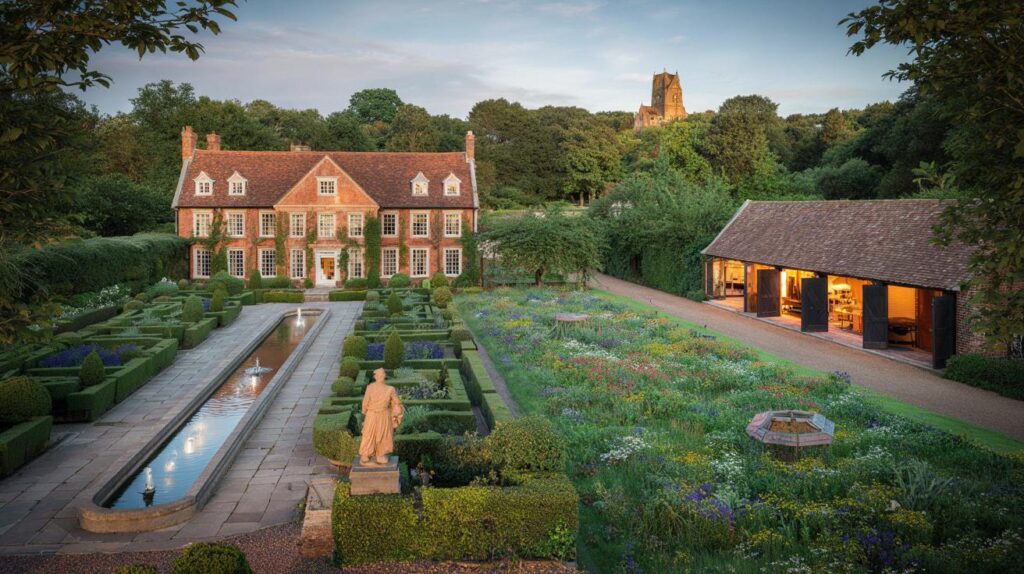
Four acres of meticulous planting, a 42ft party barn and a Hogwarts-esque library await in a Georgian Hampshire idyll.
Now the man who made gardens feel personal to millions has set his Holybourne base on the market, inviting buyers into a rare blend of history, craft and comfort.
A home with centuries under its roof
Grade II-listed Manor Farm House sits beside the Church of the Holy Rood in Holybourne, near Alton, with Saxon roots and a conservation area setting. The earlier portion dates to around 1690; elegant 18th-century additions present a handsome five-bay Georgian façade in rich red brick under clay tiles. Inside, space flows across approximately 4,768 sq ft with a grand drawing room, a separate sitting room and a bright kitchen–breakfast room anchored by an Aga and bespoke cabinetry. Five first-floor bedrooms include a principal suite with serene garden views. Attic rooms offer scope for more accommodation, subject to consent.
Guide price: £3.95 million through Savills, Farnham. Grade II-listed. Approximately four acres of grounds.
Practical upgrades sit quietly behind period detail. The owners reinstated proper floorboards where chipboard once lurked and added underfloor heating on the ground floor and in bathrooms, bringing steady warmth to the old bones of the house without jarring its character.
Gardens that show a lifetime’s craft
Alan Titchmarsh set out to make one last garden when he and his wife bought the property in 2002; in truth, the result looks like several gardens in pleasing conversation. The “gardened garden” nearest the house frames a broad Yorkstone terrace and formal borders, with clipped topiary, richly planted beds and a calm rill drawing the eye. Water features and fountains punctuate the scheme, while tree-lined paths open onto lawns and a charming octagonal summerhouse.
Four acres of fully organic planting, from Yorkstone formality to a hand-sown wildflower meadow, show decades of know-how.
A towering terracotta figure of Humphry Repton by Whichford Pottery’s Jim Keeling presides over the terrace — a wink to the history-minded planting approach — and will remain with the house. Beyond the formal spine, a two-acre wildflower meadow, established on former arable land acquired later, bursts with seasonal colour. The meadow was sown by hand from a bucket, a romantic detail that speaks to the owner’s hands-on ethos.
Spaces made for people
A detached stone-and-brick range shelters a 42ft party barn/theatre for big gatherings. Beside it, a generous library with a tucked-away eaves office conjures a touch of Hogwarts. The outbuildings, restored and extended with care, turn a picturesque farmyard into a working, welcoming part of daily life.
- Approx. 4,768 sq ft main house over three levels
- Five bedrooms; two bath/shower rooms; scope in the attic (subject to consent)
- Aga kitchen with breakfast area and garden outlook
- 42ft party barn/theatre; large library; eaves writing room
- Yorkstone terrace, formal rill, fountains, topiary, mature trees
- Two-acre wildflower meadow added to the original plot
Where village history meets daily convenience
Holybourne’s name hints at sacred water and long memory; streams rise near a village pond and feed a tributary of the River Wey. The church next door carries Norman origins, with a 12th-century nave and tower, a 13th-century chancel and a distinctive broach spire shingled in oak. Despite the heritage weight, everyday life remains easy: Alton’s station puts London Waterloo roughly 70–80 minutes away on South Western Railway, and village lanes keep the setting quiet.
The market moment: what the numbers mean for buyers
Country houses with grown-in gardens remain scarce, and four acres laid out by Britain’s best-known gardener adds a premium that spreadsheets struggle to price. For budgeting, residential stamp duty at £3.95 million (main residence) currently comes to roughly £385,250 under the present bands. Buyers adding this as a second home face a 3% surcharge across the bands on top. Running costs for a listed Georgian house also deserve a line in the spreadsheet: insurance for period fabric, regular tree work, and seasonal garden care can be significant yet predictable if scheduled sensibly.
| Guide price | £3,950,000 |
| Location | Holybourne, near Alton, Hampshire |
| Listing | Grade II |
| House size | Approx. 4,768 sq ft |
| Land | Approx. 4 acres (including wildflower meadow) |
| Outbuildings | 42ft party barn/theatre; large library; office |
| Agent | Savills, Farnham |
Why it speaks to gardeners
The planting reads like a primer in proportion and restraint. Borders swell without spilling; clipped shapes give the eye somewhere to rest; water threads movement through stillness. It is also practical: organic management suits birds, pollinators and the soil itself. A well-sited seat appears just when you want it. The meadow extends the seasons and the habitat, softening the boundary between garden and countryside.
Not many gardens arrive with structure, maturity and a clear rhythm — and still leave room for a new owner’s hand.
Those who want to personalise can tweak the meadow mixes, adjust orchard understory or reshape a border palette without unpicking decades of groundwork. The plan is generous and legible, which makes change easier.
Permissions, repairs and what you can change
As a Grade II-listed house in a conservation area, substantial alterations need consent. That said, the most disruptive work has been done: services improved, floors reinstated, and key outbuildings renewed. Kitchen updates, bathroom refreshes and soft-landscaping adjustments typically proceed smoothly with the right advice. Any intent to convert attic storage or add garden structures should start with early conversations with conservation officers. A measured survey and a photographic record of existing fabric will save time.
Who this suits
Gardeners who value structure; families who host often; buyers seeking heritage without the headache of a total rebuild. Proximity to Alton helps commuters, while the barn and meadow tempt those planning courses, performances or open-garden days. The library and eaves office also serve writers, consultants and home workers who need a quiet, separate space.
Extra insight for would-be buyers
Expect peak-season gardening to need a core team or a committed schedule. A four-acre regime might include weekly mowing, fortnightly edging in spring–summer, seasonal pruning, irrigation checks for key borders, and meadow cuts after seed set. Organic methods thrive here: composting green waste, mulching at the start of spring, and allowing a little benign untidiness in wildlife corners can cut inputs and lift biodiversity.
If you plan to open occasionally under a garden scheme or host community events in the barn, check parking capacity and grass reinforcement options for wet months. Removable trackway can protect lawns during autumn shows or winter performances, and local volunteer stewards help keep village lanes calm.



£3.95m and you still have to mow a two-acre meadow? Sounds like a full-time job disguised as a dream.