
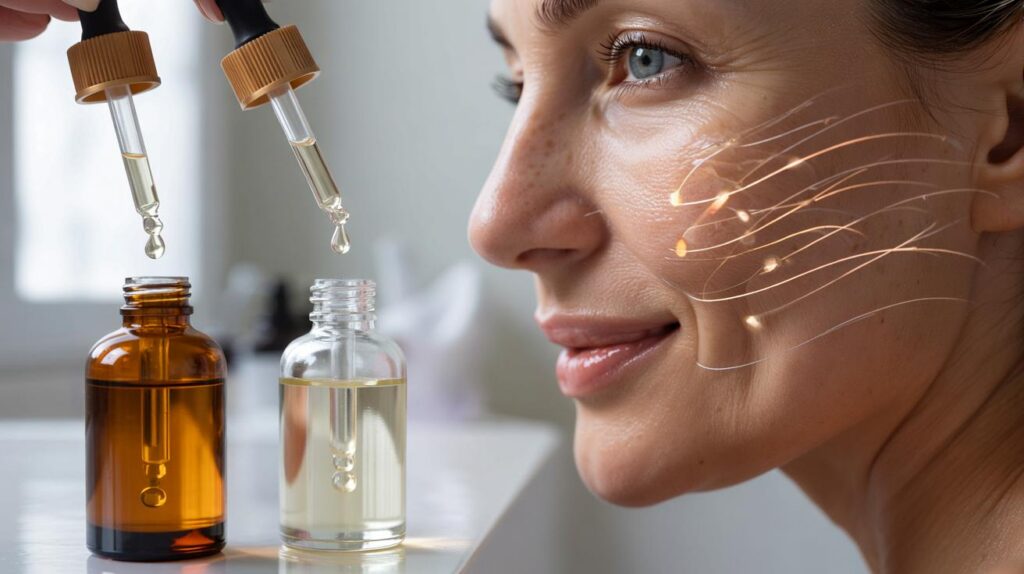
You’ve seen the price of that cult serum. You’ve also clocked your bank balance. There’s a gap big enough to park a bus in, and yet the mirror doesn’t care. Fine lines still sketch their quiet maps across the face, and collagen feels like it’s packing its bags. What if the glow you’re chasing lives in the ingredients, not the logo on the bottle?
I watched a friend dab a drop of a famous gold-capped serum on the back of her hand in a department store, like it was liquid silk. The sales light hit her skin and, for a second, I believed the hype. She slipped the bottle back and mouthed the price. We both laughed, then didn’t.
We’ve all had that moment when the promise of younger skin feels locked behind a velvet rope. *I kept the receipt, just in case.* On the bus home, I looked up the formula. Different brand names, same core molecules. A thought stuck.
What if the trick is not spending more, but reading smarter? That tiny list on the label might be the real map. One line kept repeating in my head like a drum beat.
Luxury hype vs. lab facts: why dupes can match the glow
Stand at any beauty counter long enough and you’ll spot the pattern. Heavy glass, florid claims, a scent that whispers “spa day”. Then you turn the bottle and the truth is quiet: retinoids, vitamin C, peptides, niacinamide, hyaluronic acid. The molecules doing the heavy lifting have no idea what the box looks like.
Here’s a real-world example. SkinCeuticals C E Ferulic made vitamin C a phenomenon, but Timeless Vitamin C + E Ferulic (around a third of the price) uses a near-identical trio: L-ascorbic acid, vitamin E, ferulic acid. The Estée Lauder Advanced Night Repair story? Missha Time Revolution Night Repair 5X brings a similar fermented profile at supermarket-ish money. And for peptide power, where Drunk Elephant Protini struts, The Ordinary “Buffet” quietly gets it done.
That overlap isn’t an accident. Actives aren’t couture; they’re chemistry. Brands can tweak textures, add fragrance, change the bottle, wrap it in a narrative. The skin still negotiates with percentage, pH, and stability. **Price doesn’t equal performance.** When you know the active and the ballpark strength, you hold the reins.
Consider the numbers behind the names. In clinical trials, 0.1% retinol over 12 weeks reduced the appearance of fine lines and increased dermal collagen markers. Peptide complexes such as Matrixyl reported firmer-looking skin in vendor studies around the eight-week mark. A 15% L-ascorbic acid serum with vitamin E and ferulic acid showed better photoprotection than vitamin C alone. These aren’t brand-specific miracles. They’re the predictable results of proven molecules doing their job, night after night.
Take retinoids, the backbone of many “youth” routines. Shani Darden Retinol Reform has a loyal following, yet La Roche-Posay Retinol B3 Serum or RoC Retinol Correxion line-smoothing serums are the budget staples dermatologists nod at. Layer them with a simple hyaluronic acid like The Inkey List HA or The Ordinary HA 2% + B5, and you get the bounce without the sting in your bank account.
Vitamin C is similar. If the landmark C E Ferulic is your north star, Timeless 20% Vitamin C + E + Ferulic, Geek & Gorgeous C-Glow (15% LAA with ferulic), or even Revolution 12.5% Vitamin C Radiance Serum can deliver that bright-morning snap. The win isn’t the bottle. It’s the precise blend, kept fresh, used consistently. Small differences in the lab matter less than the ritual of application.
The playbook: build a collagen routine that doesn’t cost your rent
Morning is for defence. Use a vitamin C dupe on clean, dry skin: two or three drops pressed in, not rubbed. Follow with a peptide layer if you like bounce—The Ordinary “Buffet” or The Inkey List Collagen Booster—then a straightforward moisturiser and broad-spectrum SPF 50. Evening is for repair: start with niacinamide (The Ordinary 10% or Beauty Pie Superdrops), then a pea-size retinoid—try RoC, L’Oréal Revitalift 0.2% Retinol, or Geek & Gorgeous A-Game (0.05–0.1% retinal)—finished with a ceramide-rich cream, like CeraVe PM.
Start slow: two vitamin C mornings a week, two retinoid evenings a week, then build. Let your skin set the tempo. Take a hydration night between stronger actives. Let’s be honest: nobody does that every single day. If you prefer lactic acid for texture, use Sunday Riley Good Genes on Sundays—then budget-swap to The Ordinary Lactic Acid 10% for weeknights, never on the same evening as retinoids. Clean lines, fewer flare-ups.
Patch-test the first time you open anything potent. Don’t chase every trend in one go. Watch for hidden overlaps—mixing multiple acids with retinoids turns a glow into a grumble. If your vitamin C tingles, give it five minutes before moisturiser. And if your skin gets shouty, step back to basics for a week.
Think of dupes as “ingredient translations”, not knock-offs. They won’t copy the luxury texture perfectly, but they can match the outcome. **Small percentages, used consistently, beat miracle claims.** Over 30 days the difference is discipline, not drama.
“Great skin is boring: repeat small things for a long time,” a London facialist told me, as she tapped a peptide serum like a metronome. That sentence stuck more than any advert.
“Buy the active, not the aura. Your skin can’t read a price tag.”
- Swap guide: C E Ferulic → Timeless C+E+Ferulic or Geek & Gorgeous C-Glow
- ANR vibe → Missha Time Revolution Night Repair 5X
- Protini peptide push → The Ordinary “Buffet” or Matrixyl
- High-end retinol → RoC Retinol Correxion or Geek & Gorgeous A-Game
- Firming splash → No7 Future Renew or The Inkey List Peptide Moisturiser
What nobody tells you about anti‑ageing on a budget
Dupes don’t cheapen your routine—they sharpen it. You start noticing what your skin actually responds to, not just what looks chic on the shelf. You get to put your money where results live: stable vitamin C in the morning, a retinoid your face can tolerate at night, and a sunscreen you love enough to reapply. The glow becomes less “ta‑da” and more “of course”.
Your timeline might change too. Collagen doesn’t bloom overnight; it’s a slow, steady rebuild. A photo in twelve weeks often tells a kinder story than a mirror in twelve minutes. The savvy bit is stopping the spending cycle that makes you hop from one luxury promise to the next. The deeper win is learning your own rhythm—and maybe sharing the hack with a friend who needs it.
| Point clé | Détail | Intérêt pour le lecteur |
|---|---|---|
| Actives over branding | Retinoids, vitamin C, peptides, niacinamide drive visible change | Know what to buy without paying for packaging |
| Smart swaps | Timeless C+E+Ferulic, Missha Night Repair, The Ordinary “Buffet”, RoC Retinol | Replicate luxury outcomes for less |
| Ritual beats rarity | Consistent use, gentle ramp-up, SPF daily | Fewer reactions, steadier results, calmer skin |
FAQ :
- Do dupes really work as well as the expensive versions?Many do when the active, percentage, and format align. Your skin responds to molecules, not marketing. Texture and scent may differ.
- Is 20% vitamin C too strong for beginners?It can be. Start at 10–15% L‑ascorbic acid or try a gentler derivative like sodium ascorbyl phosphate, then step up if your skin stays calm.
- Retinol or retinal—what’s better for fine lines?Retinal (retinaldehyde) is one step closer to retinoic acid and often works faster with similar tolerance. Geek & Gorgeous A‑Game is a strong-value pick.
- Can I mix vitamin C with niacinamide?Modern formulas play well together. Many use both in the same routine. If you’re sensitive, split them: vitamin C AM, niacinamide PM.
- How long before I see collagen-boosting results?Expect texture and brightness in 4–6 weeks; fine-line softening and firmness from retinoids and peptides in 8–12. Photos beat memory—take one now.



Saved this! The swap guide is gold—Timeless C+E+Ferulic already replaced my splurgy bottle and my face hasn’t noticed, but my wallet did 🙂 Any tips to keep LAA fresher longer (fridge? amber dropper?), or am I overthinking it?
I’m skeptical tbh. L‑ascorbic at 15–20% oxidizes fast; how are these cheaper serums ensuring pH ~3 and stabilty without pricey packaging? If it browns in 3 weeks, it’s money down the drain. Any real data on shelflife beyond marketing?