
Rainy weeks, small flats and busy schedules make damp piles inevitable. A neat hanging pattern promises to change your laundry nights.
Across Japan, space is tight and winters feel wet indoors. That is where a clever hanger layout emerged, designed to push air through clothes instead of around them. The method has spread because it is free, quick to set up and gentle on fabrics.
What the ‘rainbow’ method actually is
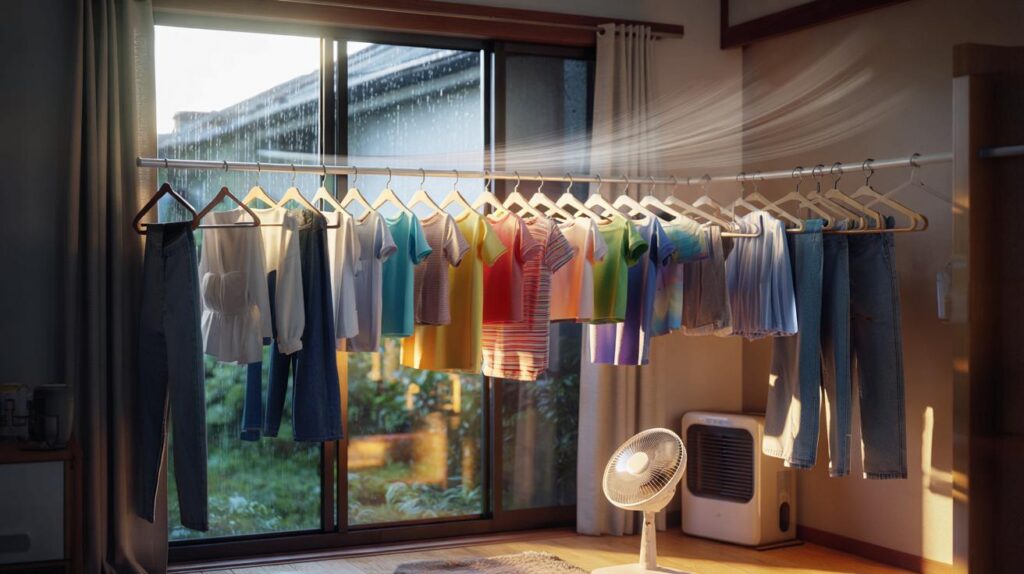
The ‘rainbow’ method uses ordinary hangers. You shape your washing rail like an arc. Shorter items sit in the middle. Longer items sit at the ends. The staggered lengths form open channels that let air move easily between garments.
Stagger lengths across a rail to create a curved “rainbow” profile. The gaps act as air lanes that speed evaporation.
It grew out of a simple problem. Clothes bunched together dry slowly and smell musty. When you spread lengths, air stops getting trapped. Moisture leaves the fibres sooner, fabric by fabric.
Why this layout dries faster
Airflow drives drying. Open lanes remove the humid boundary layer around wet fabric. More air passing each surface means more moisture leaves per minute. Sunlight and heat help, but airflow wins most days.
Household trials report 30% to 45% shorter drying times, depending on fabric, spin speed and room humidity. Odours drop because bacteria lack the damp time they need to grow.
Target an 8–10 cm gap between hanger edges. That spacing balances capacity and airflow on most rails.
Set-up: five steps you can use tonight
- Pre-spin at 1200–1400 rpm. The machine removes cheap moisture before you start.
- Use hangers for everything you can. Clip socks and underwear to a small rack.
- Build the arc: short in the centre (tees, baby clothes), medium next, long at each end (jeans, dresses).
- Keep even gaps between hangers. Aim for a finger’s width plus a little light showing between items.
- Place the rail where air moves: near a bright window, in a hallway, or by an open internal door.
Where to hang — and where to avoid
Pick a spot with fresh air. A window with trickle vents open works well. A hallway with a door cracked open draws air from room to room. Cross-breezes help more than heat alone.
Avoid the most humid room, usually the bathroom. Moist air slows drying and raises the risk of condensation and mould on walls.
Good air beats high heat. A small fan or dehumidifier often halves drying time without cooking your clothes.
Do’s and don’ts for tight spaces
- Do run a desk fan on low across the rail. Angle it so air flows along the “lanes”.
- Do crack a window for 15–30 minutes each hour to vent moist air.
- Do rotate the rail every hour if one side faces a window, so all pieces get airflow.
- Don’t press garments against radiators. Heat can scorch fibres and trap moisture behind.
- Don’t dry loads back-to-back without venting the room. Humidity lingers.
How it compares on time, cost and fabric care
| Method | Typical drying time | Energy use | Odour risk | Fabric wear |
|---|---|---|---|---|
| Rainbow method, window + fan | 3–6 hours for mixed 5 kg load | Fan ~0.05–0.1 kWh/h | Low if vented | Very low |
| Flat airer, no fan | 6–12 hours | Near-zero | Medium to high | Very low |
| Tumble dryer | 1–2 hours | 1.5–3 kWh per cycle | Very low | Medium (heat and friction) |
Costs vary by tariff, but a small fan or dehumidifier often costs pennies per hour to run. A condenser dryer costs pounds per cycle. The rainbow layout lets you use the cheaper tools only when the air stalls.
Make it work better for different fabrics
Denim, towels and heavy cotton
Hang these at the far ends where the arc is longest. Clip waistbands and thick seams fully open. Squeeze cuffs to remove trapped water before hanging.
Synthetics and sports kit
Place these near the centre. They hold less water and dry fast. Keeping them central leaves more space for slower items at the edges.
Shirts and dresses
Button the top button and shape collars on the hanger. Air travels inside the garment through the neckline and sleeves. This reduces ironing time later.
Health and home: odours, moisture and mould
Damp piles breed odours and can feed mould spores. That affects indoor air quality. Shorter drying windows help break that cycle. So does ventilation.
Watch windows and external walls for condensation while you dry. If droplets form, vent the room or run a dehumidifier at 50–55% relative humidity. Wipe frames and sills after each session.
Numbers that matter
- Spacing: 8–10 cm between hanger edges improves airflow without wasting rail space.
- Spin: raising spin from 1000 to 1400 rpm can cut water left in fabrics by roughly a third.
- Vent: a 15-minute window crack each hour removes humid air and keeps rooms comfortable.
- Assist: a 10–12 litre/day dehumidifier can pull 0.2–0.5 litres during a single drying session.
Real-life test you can try this week
Wash two similar mixed loads on the same spin speed. Dry one on a flat airer. Dry the other with the rainbow layout and a low fan. Note start and finish times. Smell garments after two hours. Check which load feels clammy. Most homes see the rainbow batch finish 30–45% sooner, with fewer stale notes.
Safety and care notes
Keep rails clear of heaters and hobs. Leave safe walkways in hallways to avoid trips. Use sturdy hangers for heavy items so plastic hooks do not deform. Wood or thick plastic supports collars and seams better than wire.
Frequently asked
Will clothes crease more on hangers?
Not usually. Many items crease less because the fabric hangs in shape. Shake garments before hanging and button collars to set a clean line.
Can I use a radiator with this method?
You can warm the room, but avoid placing fabric on the radiator. Keep 10–15 cm clearance and push warm air across the rail with a fan.
What about bed linen and sheets?
Fold once along the long edge and drape across two or three hangers like a bridge. Keep the sheet at one end of the arc so air can flow through the gap.
Extra pointers for faster, cheaper laundry
Add a microfibre towel to the drum for the first 15 minutes of tumble drying if you must use the machine. It soaks excess moisture and shortens the cycle. For air-drying, blot heavy items in a dry towel before hanging. That small step can lop 30 minutes off thick cottons.
Consider a £10 hygrometer in the drying room. Aim for 45–55% relative humidity. If readings climb, open a window or start a dehumidifier. Your walls and your wardrobe will thank you.



Tried the rainbow arc tonight and my gym kit dried way faster—noticeably. The 8–10 cm spacing plus a small fan did the trick. Clothes smelled fresher too. Thanks for a simple, no-cost hack! 😊
Is that 43% figure from lab tests or just home trials? Sounds a bit optimisitc for a 65% RH flat. Any data comparing fan-only vs fan + dehumidifier?