
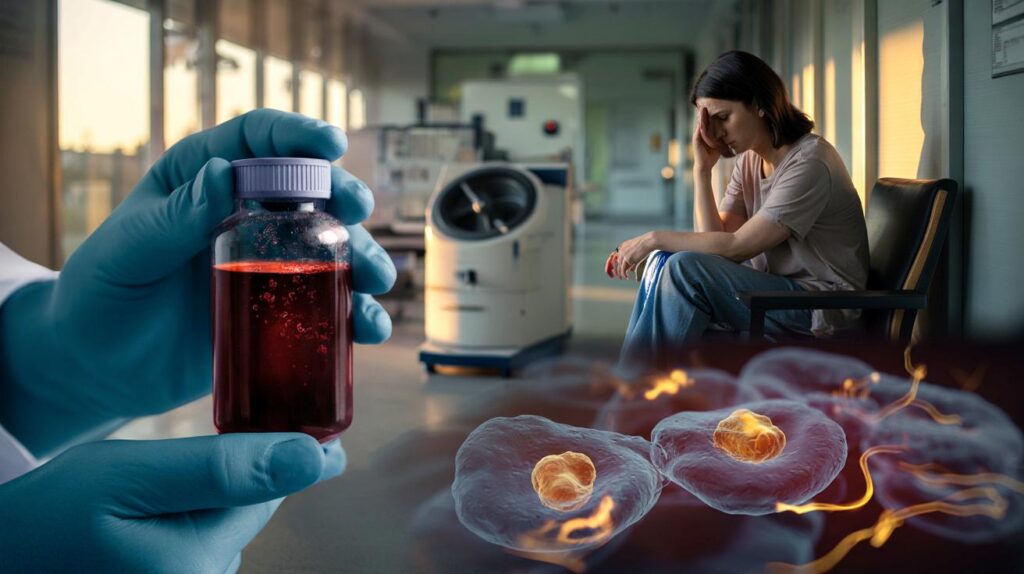
For years, chronic fatigue has been a riddle with moving pieces. People lose jobs, friendships thin, families reshuffle the load — and still there’s no simple answer on a lab report. A new blood test, quietly maturing in UK and international labs, could change that. It hints at a measurable signature of energy failure in the body. Not theory. Not mood. Something you can see.
I’m standing in a hospital corridor where the hum of the centrifuge is louder than the chatter. A nurse labels another vial, a patient rubs their sleeve, and the waiting room clock seems to hold its breath. The woman I’m here to meet tells me she used to run 10Ks, then she couldn’t manage the school run without a nap. People said stress. She said, “It feels cellular.” Her word, not mine. And now researchers think she might be right. What if a blood test could end the doubt?
The test that listens to tired cells
In simple terms, the new research focuses on how our cells use energy under pressure. Scientists put immune cells into a mild stress scenario and watch how they cope. Patterns in those responses appear different in people with long-lasting, debilitating fatigue — including those with ME/CFS and some with Long Covid — compared with healthy controls. It’s like a stress test for your biology, not your willpower.
To picture it, imagine a phone battery that drops from 80% to 20% the moment you open your camera. That cliff-edge drain is what researchers are seeing at a cellular level. One UK team reports changes when a person’s plasma is mixed with healthy cells, as if the “soup” around the cells carries the problem. Another group is training algorithms to spot the signature across dozens of markers. Early, yes. But **the pattern keeps showing up**.
The logic is compelling. Chronic fatigue isn’t just being tired; it’s a system that can’t recover energy in time. These assays measure oxygen use, tiny voltage shifts, and metabolic detours that hint at immune cells running in low gear. That creates a candidate biomarker: a measurable sign that something is off. It won’t replace clinical judgement, nor explain every case, and it still needs larger trials and regulation. *Yet it transforms the question from “Do we believe you?” to “What’s the mechanism?”*
What it means for your next GP appointment
Start with a one-page snapshot. Top line: your main symptom in 10 words, when it started, what changed life-wise. Then three bullet points: activity that triggers a crash, how long the crash lasts, what helps. Bring a two-week energy log with morning/evening ratings out of 10. Ask if your practice is tracking referrals to specialist fatigue clinics or trials exploring metabolic or immune testing. **Small, concrete details make the pattern visible**.
Pacing isn’t fashionable, but it beats boom-and-bust. Work with a “60% rule”: do roughly 60% of what you think you can on a good day, so you don’t pay it back with interest tomorrow. Consider short activity blocks and equal rest blocks. We’ve all had that moment when ambition writes a cheque the body can’t cash. Let your threshold be boringly consistent for a while. Let’s be honest: nobody does this every day.
Your GP may not have the blood test on their system yet — that’s normal. The value today is validation, documentation, and route-mapping while the science lands.
“This won’t be a magic wand on Monday morning, but it could be the map we needed.”
- Ask about a phased return-to-work letter and workplace adjustments.
- Explore referral options: fatigue clinic, pain service, or sleep assessment if indicated.
- Clarify sick note wording: function limits, not just labels.
- Check if you qualify for community rehab or occupational therapy.
- Note red flags that need urgent review: chest pain, fainting, sudden weight loss, persistent high fever.
What we still don’t know — and why that’s okay
The honest bit: no one can promise when a fatigue blood test will reach your local surgery. Diagnostics move at the speed of funding, replication and paperwork. What the new data does give is a direction — from hand-waving to measurable pathways. Expect uneven rollout, debate over which assay works best, and questions about cost, sensitivity and who qualifies. Expect also a shift in tone. The conversation changes when biology shows its hand. And that change trickles into policy, insurance, workplace culture. It means fewer raised eyebrows and more practical help. It means treatment trials can target the right people, not a catch-all “tired” box. That’s not a headline. That’s a lived difference.
| Key points | Details | Interest for reader |
|---|---|---|
| New blood-test approach | Measures how immune cells handle energy under stress; distinct patterns seen in ME/CFS and some Long Covid | Signals a biological footprint, not “just fatigue” |
| Early but promising | Small-to-medium studies; needs larger trials, standardisation, and regulatory approval | Hope with realism on timelines and access |
| Action you can take now | Bring a one-page symptom snapshot; use pacing; ask about referrals and adjustments | Practical steps that help before the test arrives |
FAQ :
- Will this test diagnose ME/CFS or Long Covid right away?Not yet. The current studies are research-grade and need larger validation. The most likely path is a biomarker that supports diagnosis alongside clinical assessment, rather than a single yes/no answer on day one.
- How does the test actually work?Labs expose blood cells to a mild stress and track energy use, oxygen flow, and electrical or metabolic signals. Some teams also look for protein “signatures” or clotting by-products that correlate with symptoms. Different methods, same goal: a repeatable pattern.
- When could my GP order it?Best case, within a couple of years if trials and regulators agree. Realistically, it may appear first in specialist centres or research clinics, then filter into mainstream use. Timelines depend on funding, consensus, and demand.
- What does it change for me right now?It brings validation and a clearer care pathway. You can use a structured symptom snapshot, ask about referrals, adjust work with proper notes, and pace to reduce crashes. **The science backs your experience**, which can shift conversations in appointments and at work.
- Could the test miss people who are ill?Any new biomarker can misclassify some cases until it’s refined. Researchers are working on sensitivity and specificity, and on combining markers to reduce false results. No single test will capture every person’s biology, especially in a complex condition.



As someone with ME/CFS, this feels like real validation. The “stress test for cells” idea makes so much sense, and the practical tips (60% rule, symptom snapshot) are gold. Finaly, a conversation that moves from “is it in your head?” to “what’s the mechanism?” Thank you for laying out what to ask a GP while we wait for wider access. Hope plus realism — I’ll take it 🙂