
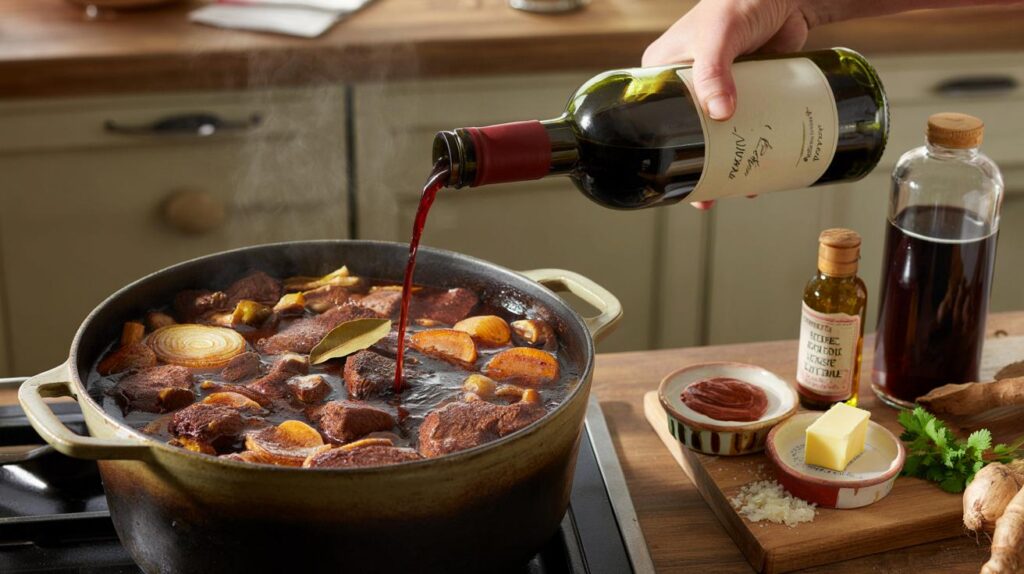
You want the deep, glossy comfort of boeuf bourguignon, but the price of a decent Burgundy makes your eyes water. You’ve got a midweek appetite, a weekend dish, and a supermarket basket that’s already testing your budget. There’s a way to cook the French classic without pouring half your salary into the pot — and it’s more delicious than you think.
Rain dragging on the windows, a cheap red breathing on the counter, the smell of onions hitting hot fat — that’s the instant the kitchen turns into a tiny bistro. I watched a friend hesitate over a £25 bottle, then tuck it back like it was an heirloom. He reached for a £6 blend instead, muttered something about “sacrilege,” and got on with the browning. Thirty minutes later the pan sang with sticky bits, tomato paste looked like jam, and the meat was wearing a crust you could hear. The secret wasn’t the label.
Why the wine matters less than the method
Most of the mystique around boeuf bourguignon is marketing dressed as tradition, and the dish knows it. What you taste isn’t a luxury postcode; it’s reduction, Maillard browning, and a balance of acid, fruit, salt, and umami folded into melting beef. Think of wine as three jobs in one — deglazer, gentle tenderiser, aromatic lift — and you can swap the expensive stuff for craft and a few pantry allies without losing the soul.
I once cooked two pots side by side for a late Sunday crowd: one with a fair Burgundy, the other with a supermarket Spanish red and a splash of cider vinegar. The table went quiet for the cheaper pan, then clattered with spoons. A neighbour who swears by bottle shops asked for the recipe and looked offended when I said “own-brand, 150 ml, and a teaspoon of Marmite.” In blind tastes at pop-ups, the winner is nearly always the one reduced harder and seasoned smarter.
Wine evaporates, tannins soften, and flavours concentrate while the stew rolls low and lazy. The pot needs three pillars: collagen from the beef to become gelatin, enough acidity to keep the sauce bright, and a base of savoury backbone. Stock brings depth, a small pour of any decent red or alcohol-free option brings lift, and umami boosters pull the whole thing into focus. The magic is in the simmer, not the sticker price.
The easy method that nails it every time
Start with 1 kg beef chuck cut into big cubes and season early, so salt has time to travel. Sear in batches in a heavy pot with a splash of neutral oil until the crust is mahogany, not beige — scrape, turn, repeat, then rest the meat. Drop in 150 g lardons, 2 sliced onions, and 2 carrots; cook until sweet and golden, add 2 cloves garlic and 2 tablespoons tomato purée, and fry until it stains the pan brick red. Deglaze with 150 ml cheap red plus 1 tablespoon cider or red wine vinegar, scraping every sticky bit like treasure.
Pour in 600 ml rich beef stock and stir in a teaspoon of Marmite or a dash of soy, a bay leaf, thyme, and a strip of orange peel if you’ve got it. Slip the beef back with any juices, lid on, and move to a 150°C oven for 2 to 2½ hours until a spoon slides through. Finish with sautéed mushrooms, a knob of butter, and a tiny splash more vinegar for sparkle, then reduce on the hob until the sauce is thick enough to cling. **Browning is non‑negotiable.**
Common stumbles are all fixable: crowding the pan, boiling instead of simmering, and being shy about reduction. If the sauce tastes flat, it wants acid; if it’s sharp, it wants time or a splash of stock; if it’s thin, reduce with the lid off until it glosses. A teaspoon of Dijon at the end wakes everything up, and a crumble of gelatin (or a few spoonfuls of collagen-rich stock) adds restaurant body. Let’s be honest: nobody really does that every day.
Spend on decent beef and build flavour like a careful stack, not a rush of ingredients, and you’ll beat most “authentic” versions. **Cheap wine is fine.** If you prefer no alcohol, use 2 tablespoons balsamic plus 750 ml stock and an extra teaspoon of tomato paste; you’ll get brightness without the buzz, depth without the splurge. **Reduce until it shines.**
“Put your money in the meat and the time, not the bottle,” a Burgundian grandmother once told me, pointing at a pot. “Wine is a helper. The pot is the cook.”
- Best cuts: chuck, blade, or shin — you want collagen that melts.
- Budget pour: 100–200 ml any dry red; top up with stock, not more wine.
- No-wine route: 1–2 tbsp vinegar + 1 tsp soy or Marmite + rich stock.
- Umami extras: anchovy, mushroom powder, Worcestershire — small, but mighty.
- Finishers: butter for gloss, Dijon for lift, parsley for freshness.
The bowl that tells a story
This dish is a conversation about care, not cash. It’s the quiet thrill of turning humble things into something that makes a table lean in, the small miracle of patience meeting appetite. We’ve all had that moment when a recipe felt out of reach because of a price tag; then a trick, a swap, a slower flame brings it home. Share what worked, what surprised you, what you’ll tweak next time. A stew like this carries memories just as well as flavours, and both get better when warmed through.
| Key points | Details | Interest for reader |
|---|---|---|
| Method beats money | Hard searing, smart deglazing, and steady reduction do the heavy lifting | Reassurance you can cook a classic without premium wine |
| Build balance | Use stock for depth, a little vinegar for lift, umami boosters for focus | Clear swaps that recreate the “expensive” flavour profile |
| Finish with intention | Reduce uncovered, add butter and Dijon, adjust acid/salt at the end | Simple chef moves for a glossy, restaurant-style sauce |
FAQ :
- Can I make boeuf bourguignon with no wine at all?Yes. Use 750 ml rich beef stock, 1–2 tablespoons balsamic or cider vinegar, and a teaspoon of soy or Marmite for depth. The balance of acid and umami gets you close to the classic profile.
- What cheap wine works best?Any dry, medium-bodied red: own-brand Pinot, Merlot, or Spanish Tempranillo. Avoid heavily oaked, sweet, or very tannic bottles that can turn bitter when reduced.
- How do I stop the sauce tasting bitter?Brown, don’t burn; scrape the fond early with liquid; and reduce gently. If bitterness sneaks in, soften it with a splash of stock, a knob of butter, and time at a low simmer.
- Oven, slow cooker, or pressure cooker?Oven: 150°C for 2–2½ hours, best texture. Slow cooker: 6–8 hours on low, then reduce the sauce on the hob. Pressure cooker: 35–45 minutes at pressure, then reduce uncovered to finish.
- How do I thicken without flour?Reduce uncovered until nappé, mount with cold butter, or add a leaf of gelatin dissolved in hot stock. If you use flour, dust the beef lightly before searing or stir in a spoon of beurre manié at the end.



Tried it tonight with a £5 Tempranillo + a dash of cider vinegar — absolutely banging. “Browning is non‑negotiable” should be on a tea towel. Thanks for the Marmite tip; didn’t think I’d ever say that in a French stew.