
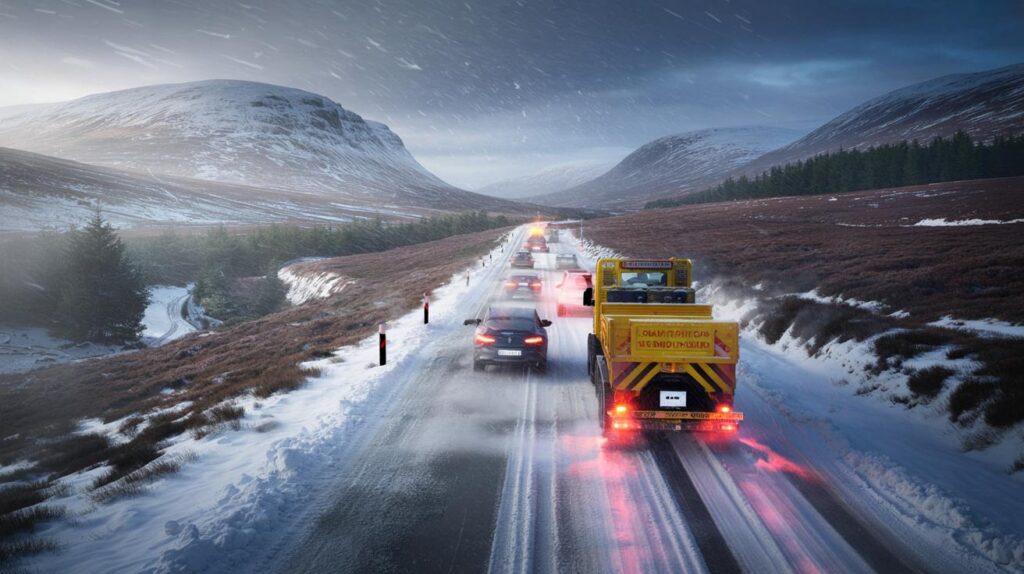
Early autumn turns unsettled as forecasters flag a sharp change in pattern, with upland routes and night-time travel under scrutiny.
Computer models now pick out focused snow bands for mid-October, raising the risk of rapid accumulations on higher Scottish routes. Four counties lie in the firing line, with brief but intense bursts possible as a colder airmass bites.
Where and when the snow bands are most likely
Advanced runs of the Global Forecast System, visualised by WX Charts and cross-checked against Ventusky outputs, spotlight a 24–36 hour window around 18–19 October. The signal favours northern Scotland first, with showers developing into snow across elevated ground. As the air cools and moisture feeds in from the west, snow rates could spike for a time, particularly on exposed hills and passes.
Models show a narrow window around 18–19 October when higher routes could see up to 5 cm of snow per hour.
Early indications focus on the Grampians through to the Northwest Highlands. Timing remains sensitive to the exact track of approaching fronts and the depth of cooler air. Daytime showers may start as sleet at lower levels, then turn more wintry after sunset as road surfaces cool.
Four counties on the front line
The modelling repeatedly highlights parts of Perthshire, Inverness-shire, Ross County and Cromarty. These areas combine higher terrain with frequent exposure to Atlantic moisture.
| County | Key areas flagged | Peak intensity | Most likely timing | Travel risk |
|---|---|---|---|---|
| Perthshire | Perthshire uplands, A9 high-level stretches | Up to 5 cm/hr on high ground | Evening 18 Oct to early 19 Oct | Short-lived but sharp, especially overnight |
| Inverness-shire | Monadhliath and Cairngorm approaches | 2–5 cm/hr above 300–400 m | Late 18 Oct through dawn 19 Oct | Reduced visibility, patchy drifting over tops |
| Ross County | Fannichs and coastal hinterland hills | 1–3 cm/hr, locally higher on passes | Overnight 18–19 Oct | Slick surfaces where sleet freezes |
| Cromarty | Black Isle high spots and inland routes | Bursts 1–2 cm/hr at elevation | Brief pulses 19 Oct morning | Marginal at sea level, trickier aloft |
Low-lying towns may see sleet or wet snow, but the fastest accumulations target elevations above roughly 300–400 metres.
Why models are flagging this now
A shift from a broadly westerly, relatively mild pattern towards a more settled interlude allows colder pockets to establish overnight. Clearer skies raise the risk of fog at first, but as pressure nudges around the UK and fronts return from the Atlantic, colder air can undercut showers over high ground. That mix of moisture and marginal temperatures is classic “first-flurry” territory for Scotland’s uplands.
The Met Office’s medium-range guidance points to a turn towards more changeable conditions later in October, with rain or showers becoming more frequent and winds occasionally strong. Temperatures sit close to seasonal norms overall, which means snow is most viable over the hills rather than the lowlands, especially at night.
What it means for travel and daily life
For most people in northern Scotland, the first event of the season brings short-lived disruption rather than a prolonged spell. The hazard comes from intensity: when showers align into narrow bands, road conditions can deteriorate quickly on higher stretches. A brief 30–60 minute burst can lay several centimetres, especially where road surfaces have cooled.
- Drivers on routes such as the A9, A82 and A835 should watch for rapid changes near summits and exposed passes.
- Early-morning commutes face the greatest risk of ice as overnight slush refreezes on untreated sections.
- Rail services through high cuttings may encounter drifting where gusts funnel spindrift across the line.
- Hillwalkers and stalkers should plan for wind chill, whiteout pockets, and early-season cornices on lee slopes.
How to prepare without overreacting
A few simple steps reduce stress if a band sets up over your route.
- Check multiple sources on the day: radar for live shower tracks, and road authority updates for grit runs.
- Carry a winter kit even in October: scraper, de-icer, torch, warm layer, phone charger, foldable shovel.
- If your timetable is flexible, time journeys to daylight hours to avoid refreezing risk.
- For early starts, park off exposed verges to avoid drift piles forming around wheels.
The science behind “5 cm per hour”
Snow rate is not the same as total accumulation. A shower can deliver 5 cm in a single hour, then clear for several hours, leaving totals that look modest at low levels. On cold, elevated surfaces the accumulation rate is far closer to the rate falling from the cloud, so upland totals climb faster.
A 5 cm/hr rate does not guarantee 10–15 cm totals unless the band persists; duration and surface temperature decide the outcome.
In marginal set-ups near freezing, compaction and partial melting can halve totals within hours at low elevations. Elevated routes hold more because air and surface temperatures run lower, and wind can deepen lee-side drifts despite modest headline totals.
What the latest guidance suggests
Through 8–17 October, guidance has favoured milder nights under a broadly westerly flow, with rain and drizzle most frequent in the north and west and a drier leaning further east. As the weekend around 11–12 October approaches, higher pressure edges in from the west or southwest, calming winds for many and allowing fog patches where skies clear. As the month progresses towards the 18–19 window, the door opens to more unsettled spells again, increasing the odds of frequent showers and stronger winds for a time. Temperatures balance out near average, which aligns with hill snow rather than widespread lowland falls.
Key uncertainties and what to watch next
Small shifts in frontal timing make a big difference. If colder air arrives a few hours later, the first showers fall as rain or sleet even at elevation. If the frontal wave deepens more than expected, the snow band broadens and persists longer. Watch these signals:
- Freezing level trend: a dip to 300–400 m during night hours boosts settling on passes.
- Shower alignment on live radar: a narrow, slow-moving streamer raises local totals quickly.
- Surface temperatures at high sites: values at or below zero favour compacted cover and icy stretches by dawn.
Beyond the first burst
Even if mid-October delivers only transient hill snow, the pattern shift matters for late-month planning. Unsettled periods bring repeating opportunities for wintry showers over Scotland’s high ground. Cyclists, walkers and contractors working above the glens should plan for earlier dusk, variable cloud bases, and a growing risk of rime on exposed kit.
For context, early-season snow can be patchy yet disruptive, especially where traffic compacts slush into ice. A short spell at 5 cm per hour can outpace road treatment on steep gradients. Treat any high-level itinerary around Perthshire, Inverness-shire, Ross and Cromarty as provisional during the 18–19 October window, and keep a plan B ready if bands stall over your route.



Is the A9 likely to be pre-treated overnight along the high-level stretches, or are we looking at reactive gritting only if bands stall? Any updates from BEAR Scotland would be handy.