
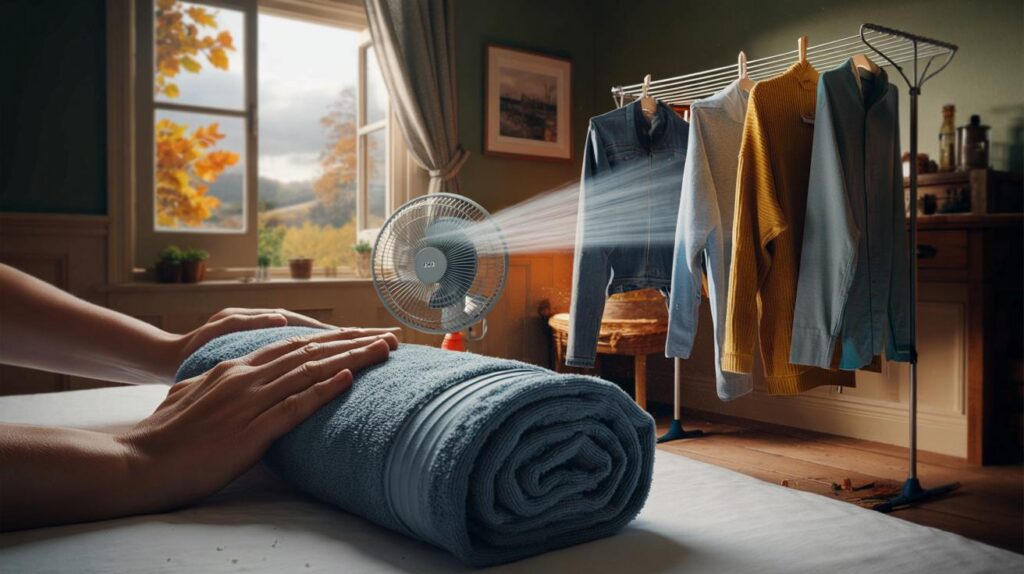
As evenings draw in and radiators stay off, households face the same headache: days of damp laundry draped around rooms.
You can shift that bottleneck without turning on the heating or buying new kit. The fix uses one item already in your bathroom.
How the towel roll method works
The idea is simple. Remove as much water as possible before clothes go on the airer. A dry bath towel acts as a giant sponge.
- Lay a clean, dry towel flat and place one wet garment on top, smoothed out.
- Roll the towel and garment together into a tight sausage from hem to collar.
- Twist or press the roll along its length to squeeze moisture into the towel. Avoid wringing the clothing itself.
- For heavy items, unroll, rotate 90 degrees, and roll again to catch damp pockets.
- Unroll and hang the garment immediately with good airflow on all sides.
Use pressure, not torque. Press down along the roll to draw out water without stretching seams or warping knitwear.
For extra absorption, sandwich a few sheets of kitchen paper between layers of the towel. That can help with cuffs, waistbands and collars where water lingers. Skip paper on dark fabrics if lint transfer bothers you.
Why this speeds up drying
Drying slows dramatically once surface water has gone and moisture is trapped deep in fibres. The towel roll pulls out that hidden water before evaporation has to do all the work. Less water means less time and fewer hours of raised humidity at home.
A high-spin cycle already helps. Yet washing machines struggle with dense areas such as hems, underarm seams and waistbands. Blotting after the spin targets those zones, so airers don’t carry a cold, dripping load into the room.
Remove water first, then move air. That order shortens drying time more than gentle heat alone.
Bedding and bulkier items
Sheets and duvet covers
Large bed sheets benefit from the same approach. Roll one sheet at a time inside a big bath towel, press, unroll, then give the sheet a vigorous shake to separate fibres. Hang it high and wide on an airer or over a banister rail so air can pass freely through both layers. Washing first thing in the morning gives the longest window of natural airflow indoors.
When pollen or rain rules out the line
Allergy sufferers keep bedding off the washing line during peak pollen spells and wet spells. Drying indoors with the towel method reduces the time sheets spend hanging around, which limits musty smells and lowers the chance of trapped moisture in the mattress.
Set up your drying space
The right layout lifts the effect of the towel trick. You don’t need heat, but you do need air movement and room for clothes to breathe.
- Place the airer in a well-ventilated room with a cracked window or open trickle vent.
- Run a small desk fan on a low, cool setting to keep air moving across fabrics.
- Space garments so they do not touch. Double rails cut airflow and add hours.
- Turn items halfway through. Flip jeans and hoodies inside-out to expose damp seams.
- Avoid draping clothes directly on radiators. That traps moisture indoors and can cause condensation on walls.
- Close doors to unused rooms and keep the drying room door ajar to prevent stale air.
Airflow beats heat. A gentle breeze across fabric edges lifts moisture away faster than a warm, still room.
Cost and timing: what to expect
The towel method costs nothing if you own a bath towel. It also reduces the hours your airer needs to sit out, which helps keep humidity under control. Light synthetics and gym wear dry fastest. Thick cottons, denim and towelling still need patience, but the roll step can shave a notable chunk off their drying window.
If you usually put the heating on to push laundry along, this technique offers an alternative on mild days. On colder days, pair the roll method with simple airflow and you still avoid running radiators for hours.
Common mistakes people make
- Using a damp towel. It must start dry to pull water effectively.
- Rolling too many items at once. Work piece by piece for even pressure.
- Twisting delicate fabrics. For wool and silk, press the roll firmly rather than twisting.
- Bunching clothes on the airer. Overlapping slows evaporation and invites musty odours.
- Drying in a windowless bathroom with no fan. Stagnant air keeps moisture trapped.
- Skipping a second spin. Most modern machines allow an extra spin to drop more water before blotting.
Extra ways to cut moisture without heat
Spin smarter before you blot
Run an extra spin at a higher rpm if your fabric care label allows it. Use mesh bags for smaller items so they do not tangle and trap water. Then use a microfibre towel for the roll. Microfibre holds more water by weight than cotton, which helps with hoodies, joggers and towels washed together.
Manage indoor humidity while you dry
A cheap digital hygrometer shows you when humidity creeps above a comfortable range. Aim for roughly 40 to 60 percent. If readings climb, open a window for a short burst of fresh air, or set a fan to push damp air outwards. A compact dehumidifier, if you already own one, can run on a low setting to capture the moisture laundry releases.
One dry towel, five quick steps, no heating: squeeze, shake, space, flip and flow.
When to skip or adapt the towel trick
Some garments prefer gentler handling. Wool jumpers, cashmere, silk and anything with structured interfacing need care. Lay them flat between two towels and press down along the length with your forearms rather than twisting. Reshape knitwear while it’s still damp and dry flat to protect the knit.
Practical add-ons for small homes
If space is tight, rotate pieces through the towel roll in batches and clear the airer as each item dries. Use hangers on door frames to give extra space for shirts and blouses. Pop socks and underwear onto a clip rail so they sit in the strongest airflow. Keep a second towel handy so you can swap when the first becomes saturated, then launder both towels together in the next wash.
Families can turn the method into a quick routine. Assign five minutes after each wash for rolling, then set a reminder to flip items halfway through the day. That rhythm stops damp build-up, keeps rooms fresher, and brings laundry day back under control as autumn sets in.



Tried this tonight and it definately cut my drying time. The towel was surprisingly soaked after the first roll, and my jeans weren’t dripping onto the airer. I still flipped everything after a few hours, but the room didn’t feel as humid. Simple, free, and it works.
Any tips for avoiding lint on dark colours? I worry the towel will shed, and I hate fuzz on black jeans.