
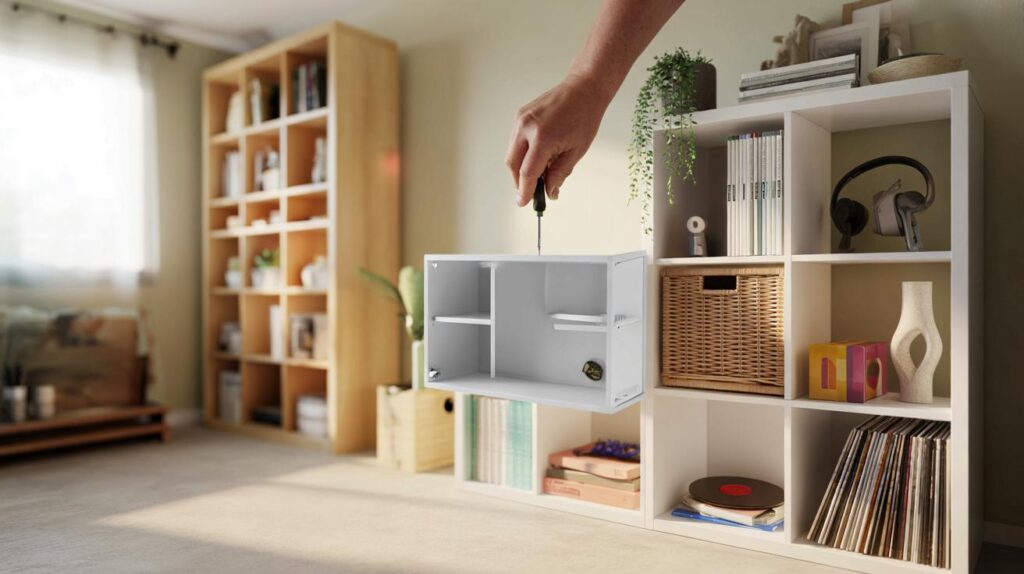
A tiny tweak to your storage can calm the chaos. Parents, renters and home‑workers are making one low‑cost swap fast this autumn.
For years, the Billy bookcase set the tone for budget home libraries. Now a £19 Kallax insert is quietly winning hearts by squeezing more order into the same footprint, and letting people reconfigure their rooms without starting from scratch.
Why people are switching from Billy to Kallax
Billy works best as a traditional book wall. It gives long shelves and a clean, uniform look. Yet many homes need more than rows of spines. They need compartments for papers, tablets, toys, records, homework and shoes. The Kallax insert addresses that need with a simple idea: take one cube and divide it into four.
The insert slots into standard Kallax openings measuring about 33 x 33 cm. You turn one generous void into a grid, then repeat across the unit as your needs grow. One cube becomes a filing hub. The next houses school kit. Another becomes a display for cameras or collectibles. You choose the mix.
One £19 insert turns a single Kallax cube into four tidy compartments in roughly ten minutes with a screwdriver.
This modular approach suits tight hallways, shared bedrooms and small living rooms. You build sideways, not upwards, so the furniture you already own works harder. Families also like that you can remove or reposition inserts when a child’s room becomes a study, or when a rental move forces a quick rethink.
The practical gains you can feel
Assembly feels refreshingly straightforward. The pieces align cleanly, and tool needs are minimal. There is no tall frame to wrangle, no heavy panels to balance, and no wall anchors to find before you can put a single book away.
Each insert creates four cubbies with enough rigidity for paperbacks, A4 files, headphones, craft supplies and board games. Because the grid sits inside the Kallax shell, it does not claim more floor area than the unit you already have. That is where the space saving starts to add up for flats and compact semis.
- Faster organisation: sort by person, purpose or day of the week.
- Less visual noise: doors, baskets and boxes sit neatly around the grid.
- Easy upgrades: add one insert now, another at payday.
- Renter‑friendly: dismantle in minutes and rebuild on the next lease.
Real‑world uses that outshine a tall bookcase
A calmer family hallway
Put one insert at child height for hats, gloves, lunchboxes and permission slips. Keep the next cube free for a basket of shoes. Label the four mini‑shelves by name so the Monday morning hunt ends before it begins.
A compact home office
Rotate the insert so the dividers run vertically, then file ring binders or magazines like a mini‑newsstand. One cube holds current projects, the next keeps tax papers off the dining table, and a third corrals chargers and cords in a lidded box.
A flexible living room wall
Alternate inserts and open cubes across a 2×4 or 4×4 unit. Use gridded sections for books and vinyl, and leave some openings clear for a statement vase or framed photo. The result looks curated without buying a whole new bookcase.
Mix inserts with baskets and doors to shift from Scandi‑calm to family‑proof in minutes, without touching the floor plan.
Billy versus Kallax with inserts: where each still wins
| Feature | Billy bookcase | Kallax + £19 insert |
|---|---|---|
| Best for | Long runs of books, uniform library look | Compartmental storage, mixed media and daily grab‑and‑go |
| Footprint | Tall, slim; needs wall anchoring | Low to mid‑height blocks; stable, modular |
| Flexibility over time | Move shelves up or down | Add or remove inserts per cube; rotate for vertical files |
| Assembly and moves | Full frame build; awkward in tight stairs | Light parts; easy to pack and reconfigure |
| Entry cost | Pay once for a full bookcase | Start with one unit; add £19 inserts as needed |
Money talk: how far £19 can go
The appeal sits in the numbers. One insert immediately quadruples the usefulness of a single cube. Buy two inserts across a 2×2 unit and you create eight small shelves without buying another frame. Spread the cost over months and adapt it to life changes, not the other way around.
Kallax units come in several sizes, from modest single cubes to large room‑dividing grids. Prices vary by finish and dimensions, so many households start small and scale up. The insert keeps that path affordable while improving the day‑to‑day experience.
Add one insert to test the idea; if clutter drops and access improves, repeat the same £19 fix across the wall.
Tips that make the upgrade work first time
- Map the mess: list the four categories that cause the most stress, and assign one to each mini‑shelf.
- Think rotation: turn the insert so the dividers run vertically for binders and music scores.
- Colour‑code: use folders or spine labels so children can put things back unprompted.
- Leave some cubes open: negative space stops the unit looking crammed after a busy week.
- Anchor tall units: always secure tall furniture to the wall in homes with children or pets.
Style notes without the faff
The plain white insert blends with most finishes and lets other pieces carry the personality. Add rattan baskets for warmth, or bright boxes for kids’ rooms. Keep a consistent palette and the grid reads as intentional design rather than a storage stopgap.
Because the cubbies repeat, you get visual rhythm. That structure hides daily life better than one long shelf where objects drift and pile up. It also photographs well, which appeals to anyone selling or letting a home and chasing a tidier listing.
Extra context buyers ask about
Materials usually involve engineered wood products and fibreboard. Surfaces wipe clean and cope well with family life if spills are handled quickly. For heavier loads like hardbacks or records, distribute weight evenly across cubes and keep the insert snug to the frame.
Safety deserves a final word. Shorter, wider units feel planted, but any tall configuration benefits from brackets into solid masonry or proper fixings in plasterboard. Keep cables, cleaning sprays and small items out of toddler reach by placing inserts higher in the layout.
If you’re on the fence
Trial the idea in one hotspot. The hallway where keys vanish. The child’s desk where homework scatters. The dining nook doubling as an office. If a single £19 insert cuts the visual clutter and speeds your routine, you’ve got your answer. If not, move it to another cube and try a new role—no sunk cost, no wasted weekend.
That freedom to adjust is the quiet reason many households are waving off Billy for at least part of their storage. Books still have a place. So do grids, baskets and labelled compartments. The smart money blends the two, spends in stages, and keeps rooms working as life changes around them.



Just tried the £19 insert in my 2×4 Kallax and it really does make the same footprint work harder. One cube became four slots for post, chargers, and kids’ homework—no new furniture, no extra floor spae. If you repeat it across a few cubes you probably do claw back that 0.2 m² in visual calm alone. Definitley beats my wobbley Billy for grab‑and‑go stuff.
Is this actually better than adding an extra Billy shelf? Four small cubbys can look fussy—doesn’t that increase visual noise unless you buy more boxes? Also, what’s the real load rating per divider?