
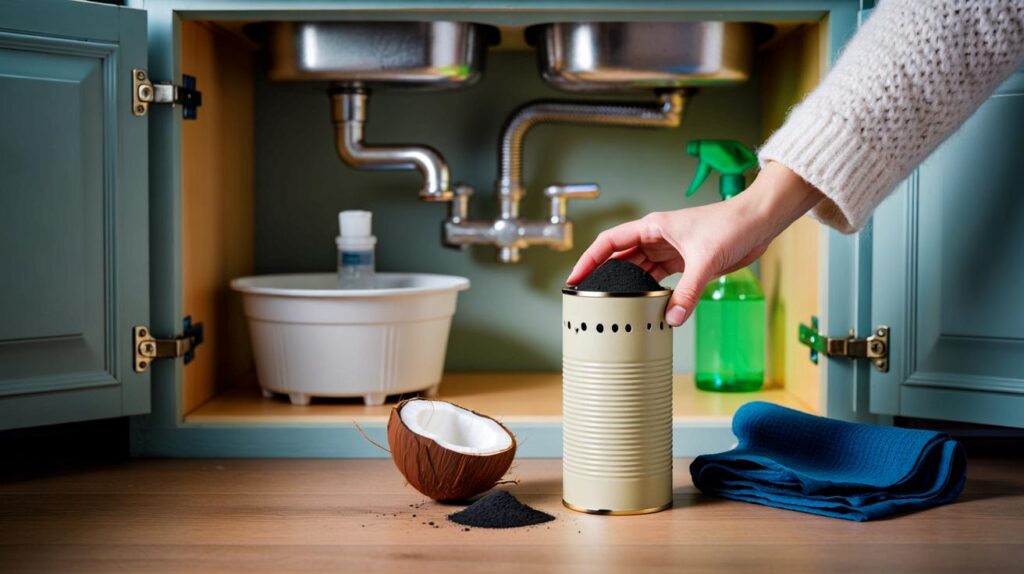
Cupboards smell musty, shoes feel damp, and bills climb. A pocket-sized fix is spreading from kitchens to garages this week.
Households across the UK are trialling tins of activated coconut charcoal as DIY moisture traps, a midwinter revival of a Caribbean practice. The pitch is simple: drier corners without salts, refills or electricity. Here is what sits behind the claim, how to assemble one in minutes, and where it genuinely helps.
Why a coconut shell can dry a cupboard
Activated charcoal is carbon processed to create a network of microscopic pores. Those pores offer an enormous internal surface area. A single gram can expose hundreds of square metres for vapour and odour molecules to stick to. The effect is adsorption rather than absorption, so the charcoal holds moisture and smells on its surface rather than soaking them in.
Coconut husk charcoal is a popular variant because its pore structure suits indoor air. It targets stale, enclosed spaces where air turns humid and odours linger: under-sink cupboards, shoe racks, wardrobes, caravan lockers and boat cabins. In those spots, air movement stays limited and contact time on the charcoal is longer.
Advocates claim that 30 g of activated coconut charcoal can capture moisture weighing up to 20 times its own mass inside confined spaces.
That figure sits far above common desiccants when used in the open. It reflects the huge surface area and the fact that vapour continuously cycles across the charcoal in a tight space. In larger rooms that circulate air freely, the gains drop sharply.
What people are trying at home
Materials
- Activated coconut charcoal, 2 tablespoons (about 30 g)
- A clean 400 ml tin can with its lid removed and edges smoothed
- A hammer and a 3 mm nail for air holes
- Alternative: a small terracotta pot with a saucer and a few drilled holes
- Optional: a teaspoon of used coffee grounds to boost odour control
Step-by-step: build a tin-can absorber
Step 1: Punch 15 to 20 holes of roughly 3 mm around the can at mid-height. Keep holes even so air flows but granules stay put.
Step 2: Pour the charcoal into the base to make a layer about 1 cm deep. Shake gently to level it without packing it down.
Step 3: Place the can inside the target space. Good spots include the back of a shoe cupboard, the high shelf under the sink, or the top corner of a wardrobe.
Step 4: Replace the charcoal every seven days in damp spells. Stir the granules midweek if the cupboard stays shut for long periods. You can scatter spent charcoal thinly around plants as a soil conditioner, away from edible leaves.
Perch the absorber high inside a closed cabinet. Warm, moist air rises and meets the charcoal first.
A fabric pouch looks neat, but it can hold moisture against the granules and slow the job. A rigid container with holes keeps air moving.
Does it really work? Early tests and caveats
The method targets microclimates rather than whole rooms. It shines in musty cupboards, shoe shelves and compact lockers. It will not pull litres of water from a bedroom the way a powered dehumidifier or a calcium chloride trap can. Charcoal excels at reducing stale odours and volatile organic compounds from cleaners and plastics. Its moisture take-up varies with humidity, temperature and surface area exposed.
Users report fresher-smelling cupboards within three days, less condensation on the back of cabinet walls, and fewer white mildew specks on leather. Where a leak or rising damp drives the problem, the effect fades. Fixing the source, improving ventilation and adding door gaps increase the odds of success.
Try this 10-minute kitchen test
Set a small scale to grams. Weigh the empty tin with charcoal and write the total down. Place it on the top shelf of a smelly cupboard and shut the door.
After 72 hours, weigh the tin again. A gain of 2 to 10 g suggests the setup is working in that space. If the gain stays near zero, add a few more 3 mm holes, increase the layer to 1.5 cm, or try a smaller, tighter enclosure.
A budget hygrometer on the same shelf can show relative humidity changes. Expect modest shifts, not dramatic drops. A noticeable fall in odour often arrives before a clear change in humidity readings.
How this compares with common moisture traps
| Material | Typical capacity by weight | Best for | Mess risk | Typical cost per 100 g |
|---|---|---|---|---|
| Activated coconut charcoal | Claimed up to 20x in confined spaces; variable in open areas | Odours, damp cupboards, wardrobes, lockers | Low; dry granules | £3–£8 |
| Silica gel | About 25–40% of its weight | Small boxes, camera bags, tool chests | Low; reusable by oven drying | £2–£5 |
| Calcium chloride | Roughly 200–300% of its weight, forms liquid brine | Very damp rooms, bathrooms, sheds | High; collects salty liquid | £1–£3 |
Where it helps, and where it falls short
Place a charcoal can in an under-sink cabinet, the top of a shoe rack, a wardrobe corner, a caravan locker or a boat storage hatch. Keep doors or hatches closed to concentrate the effect. In a fridge, use a lidded tub with several small holes and position it away from spills; it tackles strong food odours as well as damp corners.
Avoid using it as a substitute for roof, pipe or seal repairs. Where standing water builds up, switch to an absorbent mat or a salt-based trap and address the source. Charcoal will not dry wet laundry or large rooms. Think of it as a low-cost way to sharpen the microclimate in stale spots.
Cost, waste and greener upsides
Charcoal needs no electricity and produces no brine. A 100 g sachet can refill three or four tins. Regular refreshes keep performance steady because saturated pores hold onto water and odours. Spent granules add texture to potting mixes and can improve drainage in houseplant soil. Avoid spreading charcoal dust indoors; pour gently and use a teaspoon to move it.
Compared with disposable salt tubs, you avoid plastic refills and liquid waste. Compared with plug-in dehumidifiers, you avoid a running cost of 75–150 W per hour. On the flip side, charcoal demands a weekly routine and patience for modest, local gains.
Safety and maintenance
- Keep granules away from children and pets; the dust can irritate eyes and lungs.
- Do not place near open flames or hot hobs; a metal can helps contain the media safely.
- Avoid direct food contact in fridges; use a perforated lid or a container with small holes.
- Replace granules every seven days in winter, every two to three weeks in drier months.
- Wipe cabinet walls with a microfibre cloth before first use to remove existing mildew spores.
What experts would measure next
To test the 20x claim rigorously, researchers would control humidity, temperature and air speed inside a sealed cabinet and track mass gain over time. They would also separate moisture uptake from odour adsorption by weighing and then heating the sample to drive off vapour only. A household can approximate this by weighing the can, warming it gently in an airing cupboard for an hour, and weighing it again to see how much moisture leaves.
There is also interest in blends. Some households sprinkle a teaspoon of spent coffee grounds over the charcoal to amplify odour removal. Others mix a few grams of silica gel beads into the layer to steady moisture capture in fluctuating conditions. Small tweaks like these keep the approach low-tech and cheap while nudging performance where you need it most.



20x its weight in moisture sounds… optimistic. In my shed, calcuim chloride tubs pull visible liquid; charcoal never does. Are the “confined space” results only for almost-sealed cabinets? Would love side-by-side data over 72 hours with equal volume and starting RH.
I gave this a go in our under-sink cupboard: 400 ml can, ~30 g coconut charcol, a few nail holes. Three days later the tin was +7 g, and the plasticky cleaner smell was defintely down. Tossed in a pinch of spent coffee too. No mess, unlike salt brine. I’m keeping it.