
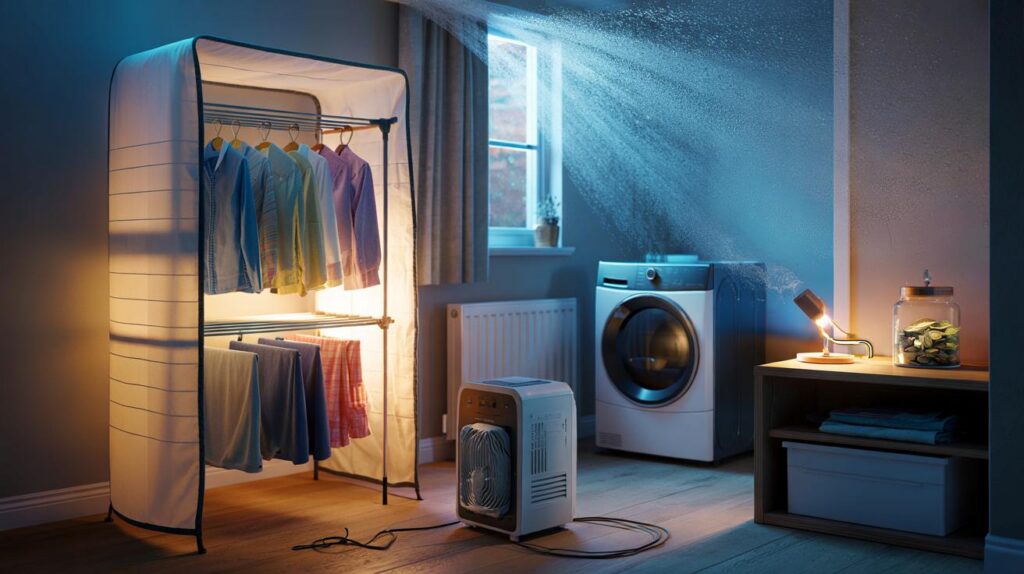
Rain returns, windows mist, and clotheslines sag. Across the country, families juggle damp laundry with rising energy worries again daily.
With autumn closing in, households are reaching for a different kind of “heater” – one that dries clothes and nudges room temperatures up for pennies. Lakeland’s multi-tier heated airer has surged in interest as shoppers hunt for cheaper, tidier ways to get through weekly wash cycles without draping radiators in soggy shirts.
Why people are turning to heated airers
Outdoor drying slows to a crawl as daylight shrinks and showers linger. Indoors, radiators will dry clothes eventually, but they push moisture into the air, fog windows and can feed mould on cold walls. A tumble dryer clears moisture quickly, yet the cost per cycle stings on tighter budgets. Heated airers sit in the middle: low-wattage rails that gently warm fabric, speeding evaporation without blasting through kilowatts.
That balance explains the switch. You keep laundry in one footprint instead of spreading it over every warm surface. You avoid the musty smell of garments left on radiators. And you pay a fraction of a typical tumble-dryer cycle, particularly if you run on off-peak electricity.
Running at around 9p per hour, a three-tier heated airer can turn a family load from wet to wardrobe-ready in a few hours.
What the lakeland model offers
The best-known option on British high streets remains Lakeland’s three-tier heated clothes airer. It is a tall, folding rack with warmed bars and generous capacity. You get up to 21 metres of drying space across multiple levels, and a 15kg load rating, which covers a standard family wash. When you are done, it folds away to around 8cm, so it slides behind a cupboard or under the stairs.
An optional fitted cover traps warm air, acting like a mini airing cupboard and trimming drying times further. The rails apply gentle, consistent heat, kinder to fibres than the scorched blasts some tumble dryers produce on hot settings. Owners also report a small but welcome warming effect in the room, especially in compact spaces such as box bedrooms or utility rooms.
- Drying space: 21m across three tiers.
- Load capacity: up to 15kg of mixed garments.
- Running cost: about 9p per hour, subject to your tariff.
- Storage: folds to roughly 8cm for easy stowing.
- Boost: optional cover concentrates heat and airflow.
The money question: real-world running costs
Costs depend on your tariff and how you use the kit, but the gap with a tumble dryer is clear. A heated airer typically draws around 270–300 watts. At a unit rate near the current price cap, that’s single-digit pence per hour. Many households see a load dry in 4–6 hours, less with the cover or a nearby fan or dehumidifier.
| Method | Typical energy use | Approximate cost per load | Notes |
|---|---|---|---|
| Heated airer (three-tier) | 0.27–0.30 kW for 4–6 hours | £0.30–£0.55 | Gentle on fabrics; adds mild room warmth |
| Tumble dryer (vented/condensing) | 3.0–4.5 kWh per cycle | £0.84–£1.53 | Fast but energy-intensive |
| Radiators with central heating | Heating runs longer to counter moisture | Hard to fix; can be higher overall | Increases condensation risk on cold walls |
| Dehumidifier assist | 0.20–0.30 kW for 2–4 hours | £0.10–£0.35 | Speeds drying and curbs damp |
Could it really save hundreds over the year? Run a quick scenario. Suppose your tumble dryer uses 4.5 kWh per cycle. On a mid-range tariff this comes in around £1.50 a load. A heated airer running at roughly 0.30 kW for five hours uses 1.5 kWh, or about 45p a load. The gap is roughly £1.05. If your household does five loads a week across a year, you reach 260 cycles: that’s around £273 saved. On higher tariffs or with energy-hungry dryers, the difference stretches towards £300–£312. Your figures will vary, but even cautious maths puts noticeable money back in your pocket.
A worked example: five loads a week, difference of £1.20 per load, equals £312 kept over 12 months.
Drying times and how to get the best from it
Performance isn’t magic; good habits speed things up and keep rooms fresh. Spacing garments, spinning laundry hard before you hang it, and controlling humidity all matter.
Simple steps that cut hours off a load
- Maximise your spin: use 1200–1400 rpm to shed water before the rack.
- Use the cover: it traps warmth and airflow close to fabric.
- Keep gaps between items: crowded rails slow evaporation.
- Rotate thicker pieces: turn towels and jeans once mid-way.
- Add movement: a small desk fan on low improves air exchange.
- Pair with a dehumidifier: faster drying, fewer steamy windows.
- Choose the right room: a smaller, ventilated space dries quicker.
- Mind safety clearances: keep cables tidy and avoid tripping hazards.
Can it warm the room?
A three-tier heated airer outputs a few hundred watts of heat, similar to a compact electric panel heater. It won’t replace central heating on a frosty night, but in a snug room it takes the edge off and offsets the chill that evaporating moisture can cause. That extra warmth can reduce the temptation to crank radiators for the sake of one wet load.
There’s another benefit: less condensation. Radiator-dried laundry dumps moisture into the air, which lands on cold glazing and corners. Gentle, concentrated heat plus ventilation or a dehumidifier keeps humidity in check, helping households avoid peeling paint, musty smells and mould growth.
Availability, prices and demand
Retailers have started trimming prices as the wet months roll in, with discounts reaching up to 20% on several heated airers. Demand spikes when the forecast turns soggy, and sell-outs do happen in late autumn. If you need one for school uniform season, shopping early makes sense. Spare covers tend to disappear first.
Who it suits, and when to look elsewhere
- Best for families handling 3–6 loads a week who want to cut running costs and keep radiators clear.
- Good for flats where outdoor drying is rare and condensation needs managing.
- Helpful for delicate fabrics that hate hot tumble cycles.
- Less ideal for king-size duvets or very bulky items that benefit from a large drum.
- Not great if you lack any storage space, as it still needs a corner when folded.
For wet-weather weeks, think of a heated airer as part of a system. A 10–20 minute high-speed spin shortens the job before you even plug in. A dehumidifier set to 50–55% relative humidity protects paintwork and lungs while squeezing hours off drying time. If you use time-of-use tariffs, schedule loads to start before cheaper periods and keep the airer running into off-peak windows.
One last practical note: pick the right room. A small bedroom with the window on vent latch, or a utility with trickle ventilation, will dry faster than an open-plan lounge. Put heavier items on the upper tiers where rising warm air collects, and lighter pieces below. When the rack is hot and the cover is on, you create a tidy, contained drying zone that works with your home rather than against it.



Switched from a creaky condenser dryer to the Lakeland 3-tier last winter; our bill dropped and the kid’s uniforms actually dried overnight with the cover on. I timed a mixed 5kg load: about 5 hours at ~300W, so roughly 1.5 kWh — way cheaper than our old 4.2 kWh cycles. Room felt a tad warmer too. Not magic, but defnitely kinder on fabrics.
So it’s basically a warm clothes tent for 9p an hour? Sign me up as Chief Peg Officer 🙂