
Most of us juggle clutter, stale rooms and tight budgets; multifunctional kit now promises to tidy up both space and air.
A flat-pack twist is turning heads: a compact side table that doubles as an air purifier and talks to your smart home. The idea targets tight urban rooms, allergy flare-ups and families who want fewer boxes humming in the corner.
What you need to know
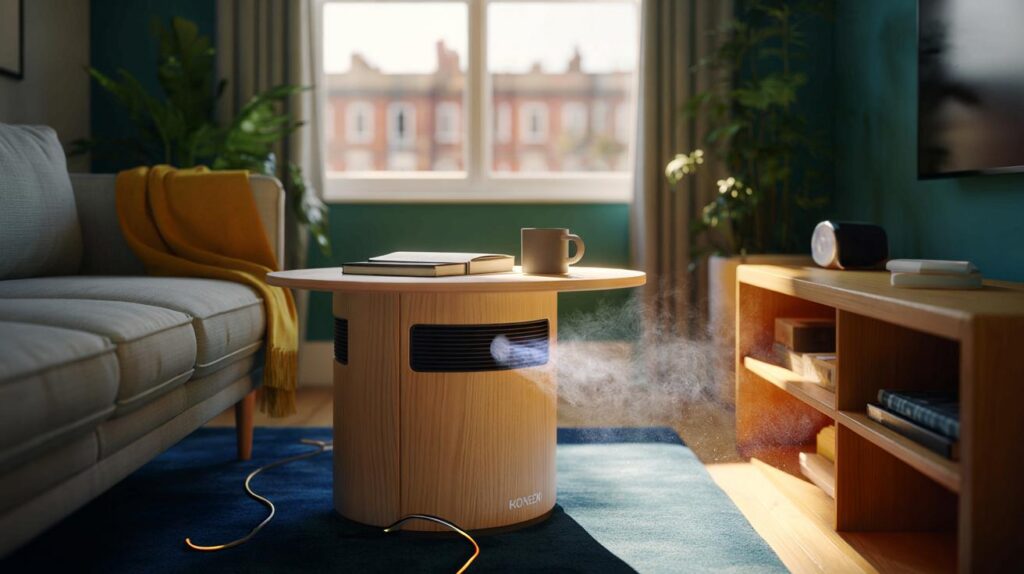
IKEA’s STARKVIND is a circular side table finished in oak veneer (light or dark) with an air purifier concealed in its belly. The unit ships with a particle filter designed to capture smaller airborne particles—think dust, pet dander and pollen—with an advertised efficiency of around 99.5%. You can run it manually from the dial, or put it in auto mode so a sensor adjusts the fan when it detects more particles.
£165 buys a table that filters the air while holding your mug and book—no extra appliance footprint required.
You can also bring it into a smart setup. Pairing with the DIRIGERA hub lets you control it from IKEA Home smart; it works with Amazon Alexa, Google Assistant and Apple HomeKit routines. If you don’t fancy a hub, you can still use the on-device controls.
How it works
The table hides a layered intake and a discreet outlet beneath the top. Air passes through a pre-filter to trap hair and larger dust before the finer particle filter does the heavy lifting. In auto mode, the onboard sensor reads particle levels and nudges the fan up or down so you don’t have to think about it.
Smart control without the jargon
- Use the dial to set five fan speeds or auto mode.
- Add the DIRIGERA hub to schedule overnight runs or trigger clean-up after cooking.
- Voice prompts can start or stop the fan while your hands are full.
- Routines can cut noise in the evening and step up airflow on weekday mornings.
Filters and airflow
The supplied particle filter targets fine matter often labelled PM2.5. A separate gas filter is available if you want more help with odours and certain volatile compounds from paints, cleaners or new furnishings. Expect to replace filters periodically; frequency depends on pollution levels and daily runtime.
The pre-filter catches the fluff; the main filter tackles the tiny stuff most likely to aggravate hay fever and dust allergies.
Where it fits in your home
The footprint suits small living rooms, city flats and bedrooms where every square centimetre counts. A tidy cable run down a table leg keeps the look clean. Place it where you sit, sleep or play—close to the source of emissions or to the people who need the benefit. Keep a little clearance so the vents can breathe.
- By the sofa: cuts pet dander and everyday dust where you spend hours.
- In a child’s room: low visual clutter and a night-friendly profile on gentle speeds.
- Beside the bed: doubles as a nightstand, moving air past the breathing zone.
- Near the kitchen door: helps with lingering cooking particles once you’ve aired the room.
Price, upkeep and what to budget
The sticker price sits at £165. Factor in running and filter costs when you compare it with a standard purifier and separate table.
| Item | Typical cost/interval | What to plan |
|---|---|---|
| Replacement particle filter | Every 6–12 months (usage dependent) | Budget for regular swaps, more often in dusty homes or during pollen season. |
| Optional gas filter | As needed if odours persist | Useful after decorating or if you’re sensitive to smells. |
| Electricity | Varies by speed and hours | Auto mode reduces draw when the air is cleaner. |
Want a quick running-cost sense check? Assume an average draw of 10W in auto over a day. That’s roughly 0.24 kWh per 24 hours, or about 7 kWh a month. At a unit rate near 28p/kWh, you’re looking at around £2 a month. If you often run higher speeds, add a little.
What about cooling and odours
This isn’t an air conditioner. It doesn’t lower air temperature, but moving air across your skin can feel cooler, especially at higher fan settings. If odours bother you, pair the table with the gas filter and open windows after cooking or cleaning to vent the source.
Think of the airflow as a gentle desk fan effect with filtration layered on; comfort plus cleaner air in the spots you use most.
How this compares to a standard purifier
Standalone purifiers often sit in the way or get tucked behind a chair where they work less effectively. Folding the function into a table solves two problems—surface and filtration—in one footprint. You’ll still want to treat it like a working appliance: don’t block the intake with boxes, avoid heavy table lamps that cover vents, and give it a quick wipe when dust builds.
Who stands to gain
- Allergy-prone households: supports hay fever and dust sensitivity alongside routine cleaning.
- Pet owners: reduces airborne dander near pet beds and favourite nap spots.
- Renters: improves air without wall drilling or bulky appliances eating floor space.
- Remote workers: tidier desk area, less visual noise on video calls.
Placement ideas that work
| Use case | Setting to try | Where to place |
|---|---|---|
| Hay fever season | Auto by day, low at night | Next to your pillow height for direct benefit. |
| Pet-heavy lounge | Medium in the evening | Beside the sofa, away from curtains. |
| Post-paint odours | Higher setting for short bursts | Near the doorway, with windows cracked open. |
| Cooking haze | Medium for an hour after meals | At the edge of the kitchen-diner, not right by the hob. |
Tips for cleaner indoor air
Ventilate after showers and cooking. Vacuum with a HEPA-equipped machine once or twice a week. Damp dust rather than flicking particles back into the room. Keep candles and incense occasional; they add fine particles quickly. If you dry clothes indoors, crack a window to shed moisture and reduce musty smells.
Risks and limitations
Filters saturate; neglect reduces performance. Set a reminder to check the pre-filter and replace the main filter on time. Don’t cover the tabletop with a cloth that blocks vents. Keep small fingers away from intakes; it’s furniture, but it still houses a motor. If you rely on voice control, remember that internet outages won’t stop the table—manual controls still work, but routines will pause. Data stays within your smart-home ecosystem; review privacy settings if that matters to you.
The big pitch is simple: fewer boxes on the floor, cleaner air where you live, and a price under £200 that folds form and function into one.
A few extras to consider
If you suffer from seasonal pollen spikes, start running the table on auto two weeks before peak season so it keeps on top of incoming particles. For new-build or freshly furnished rooms, the optional gas filter may help with that “new furniture” smell during the first months. If you host often, set a routine to ramp the fan 30 minutes before guests arrive to keep the room fresher without draughts.
Want a quick rule of thumb for any purifier, table or not? Put it where you are, not where the socket is. Give it 10–20 cm of breathing space, keep doors ajar to share clean air between rooms, and remember: source control plus filtration beats either alone.



“99.5% cleaner air” sounds great, but what’s the CADR and the recommended room size? Lab numbers don’t always translate to real homes. Also, how much are replacement particle and gas filters, and how long do they last in a dusty flat?
So it’s a table that hoovers the air? Definately sci‑fi vibes.