
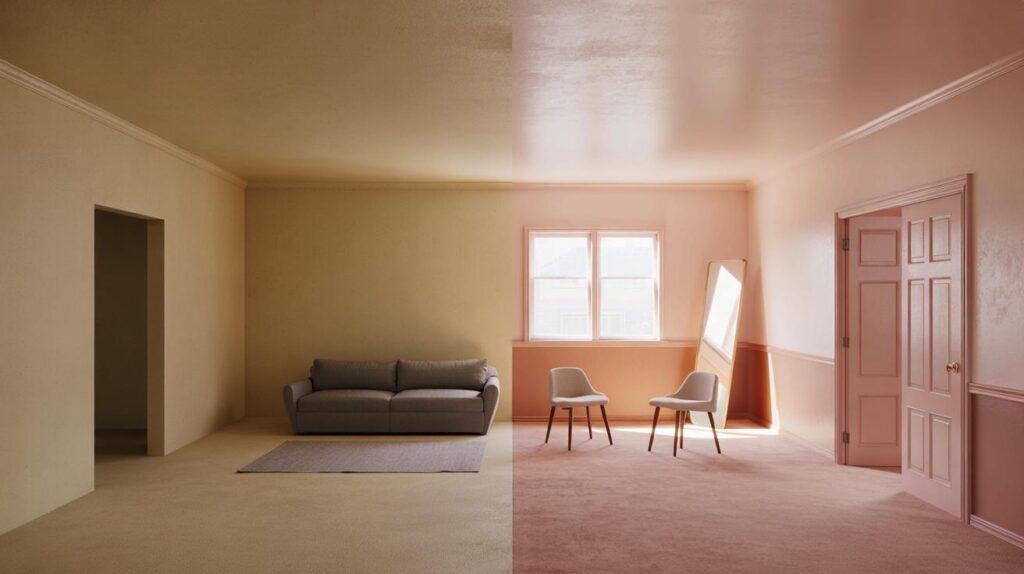
Your place looks tired, but the budget is spoken for. Paint prices nibble at paycheques, furniture costs bite, and the chaos of a full renovation feels like a marathon you didn’t train for. You want a lift, not a life upheaval.
The flat was quiet except for the radio and the soft thud of a roller hitting its tray. Sunday light slid across the wall, and in that tilted afternoon glow the beige looked even more beige. We’d stared at it for months, as if it might brighten out of guilt. The funny thing is, most rooms don’t need a makeover, they need a moment of clarity — a nudge to the eye, a shift in how the space is read. We pulled the rug under the sofa instead of in front, rolled a thin stripe of clay-pink along the skirting, and angled a mirror at the darkest corner. The air changed. The room felt taller, looser, almost like it shrugged. The smallest decisions did the heavy lifting. One detail caught us by surprise.
How paint and placement trick the eye — and wake a tired room
Rooms read like sentences; a pause in the wrong place, and the meaning sags. Paint is punctuation that costs less than a takeaway and lasts longer than a trend. Use it to shorten a wall, lift a ceiling, or stretch a hallway without touching a single brick. A two-litre tin, a decent brush, and a Saturday give you more “architecture” than a new sideboard ever will. **Colour is less about taste than direction.** Tell the eye where to travel and your square metres start to behave themselves.
I saw it in a renter’s terrace in Leeds. She painted just the doors and skirting a muted sage, left the walls off-white, then swapped her big grey sofa for two slim chairs she already owned. The rug slid sideways so its long edge lined up with the window. Nothing new was bought except a £22 tin and a pair of brass handles. The effect was immediate: the room gained a calm axis, the window became the star, and the draughty corner stopped looking apologetic. Two evenings, one bin bag of clutter, and the space felt £1,000 lighter.
There’s a bit of brain science at play. Our eyes anchor to contrast and edges, so where you put the darkest tone becomes your “frame”. Paint the skirting and door the same shade as the walls and the outline disappears, which makes the room read larger. Run colour up and over the ceiling — a light wash rather than pure white — and the “horizon line” jumps, which tricks height. Keep furniture legs showing and the brain registers flow, not blockage. It’s choreography, not shopping.
Fast paint moves and rearrangements that deliver in a weekend
Try a half-height wall: tape a crisp line at roughly two-thirds up, roll a grounded colour on the lower section, and keep the top pale. It steadies a busy room and gives art a clean runway. Or go the other way and colour-drench a small study — walls, skirting, doors, even the radiator in one tone — so clutter visually melts. A soft tint on the ceiling — think quarter-strength of your wall colour — removes the white “cap” that bathrooms and bedrooms often wear. It’s quick, it’s oddly satisfying, and your corners suddenly look intentional.
Common slip-ups happen at 9pm when you’re tired and the tape is crooked. Sample big, and on more than one wall, because north light bruises colour while south light warms it. Don’t collect thirteen testers and create a patchwork purgatory. Pick three, live with them for a day, then commit. Keep finishes consistent: eggshell on woodwork, matte on walls, satin on radiators. And please move the furniture first. We’ve all tried painting around a bookcase, telling ourselves we’ll shift it later. Let’s be honest: no one actually does that every day.
A decorator once told me that rooms don’t need more things; they need clearer stories. Here’s the line I wrote down and never forgot.
“Paint is the cheapest architecture you can buy.”
- Angle the sofa by 10 degrees to point at the view, not the TV.
- Centre the rug under the front legs of seating to anchor the zone.
- Paint interior doors the wall colour to make corridors feel calmer.
- Use a single bold stripe behind shelves to fake depth and order.
- Swap bedside tables with living room stools for lighter proportions.
The small, brave changes that spark bigger ones
Rooms feel stuck when stories loop. A fresh line of colour, a lamp moved off the chest of drawers and onto the floor, a chair turned to greet the morning — these are tiny acts of optimism. *Paint is permission to start over without starting over.* You read your home differently when the light catches a new edge, and that shift can ripple into how you use Sunday mornings or where you sit to call your mum. The fresh-looking corner becomes the one you keep tidy. The switch in layout makes a chat last longer. We crave small wins because they’re doable today.
| Point clé | Détail | Intérêt pour le lecteur |
|---|---|---|
| Colour as direction | Use contrast to frame views, soften edges to enlarge space | Instant visual order without buying furniture |
| Ceiling matters | Tint the “fifth wall” or drench small rooms | Cheat height and add calm in hours |
| Rearrange before you repaint | Anchor rugs, show furniture legs, set a focal axis | Free transformation and better flow |
FAQ :
- What’s the quickest paint trick for a rental?Paint the doors and skirting to match the walls in a wipeable eggshell. It feels custom, yet it’s easy to reverse.
- Should I paint the ceiling white?White can chop a room. A light tint of your wall colour softens the line and makes the room feel taller.
- How many colours is too many in one room?Pick one hero, one support, and one accent. That trio covers walls, woodwork, and a pop on a lamp or chair.
- Can rearranging really make a small room feel bigger?Yes. Expose furniture legs, align the rug with the longest wall, and aim seating at a view or doorway for flow.
- What if my paint choice looks wrong at night?Warm it up with lamp light. Swap cool bulbs for warm white and add a shaded floor lamp to mellow the tone.



Tried painting the doors and skirting to match our walls this weekend — corridor instantly calmer. Also pulled the rug under the sofa like you said; the room legit feels taller. Defintely didn’t expect a £25 tin to beat a new console.