
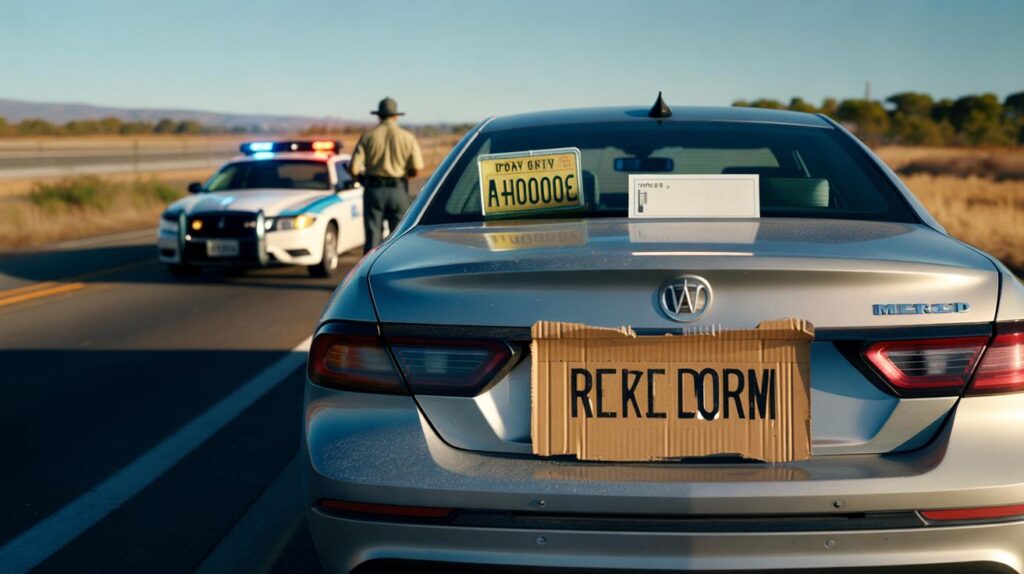
A roadside stop in California has stirred debate about number plates, improvisation and the thin line between compliance and creativity.
In Merced, a California Highway Patrol officer pulled over a motorist after spotting a hand-crafted rear plate in place of a state-issued one. The driver, who appeared to be trying to stay road legal after losing the original, was acknowledged for effort but reminded that only official plates count.
A stop that raises wider questions
The incident unfolded on a routine patrol. An officer noticed that the rear plate wasn’t standard issue, prompting a stop. Local officers later said the handiwork showed initiative, yet the message was clear: there’s no substitute for a plate produced and registered through the state.
California requires vehicles to display state-issued registration plates. Homemade or improvised plates aren’t valid on public roads.
That single rule underpins automated tolling, camera-based enforcement and insurance checks. A plate is not just a number; it’s a regulated identifier with specific fonts, reflectivity and security features that homemade versions simply lack.
What the officer saw
From a distance, a drawn or printed plate can look persuasive. Up close, the deviations stand out: non-reflective material, incorrect typeface, missing validation stickers or the wrong mounting. Those cues are enough to trigger a stop. In this case, officers signalled appreciation for the ingenuity, while reinforcing the legal bottom line.
What California law actually says
- Most vehicles must display two plates: one front, one rear, securely fastened and clearly visible.
- Plates must be unaltered, unobstructed and readable by day and night; frames cannot cover characters or stickers.
- Only plates issued by the Department of Motor Vehicles are lawful. Substitutes, drawings or 3D-printed replicas are not.
- If plates are missing, drivers must carry current registration and seek replacements rather than fabricate a stand-in.
- Using a false or altered plate can escalate an infraction into a more serious offence.
Making your own plate may feel practical after a loss or theft, but it invites a stop, a citation and fresh costs.
Lost or stolen plates: your legal options
There are legitimate routes that keep you on the right side of the law and reduce hassle later.
- Report theft promptly to local law enforcement. A report helps if your old number gets used on another vehicle.
- Apply to the DMV for replacement plates. The standard path uses a replacement application with a fee.
- If only one of a two-plate set is gone, expect a new pair with a fresh number rather than a single plate.
- Ask about a temporary operating permit if you cannot mount plates while waiting. Eligibility varies by case.
- Once received, mount plates with secure, tamper-resistant screws and ensure stickers sit in the correct positions.
How long does it take?
Processing times can run from several days to a few weeks, depending on demand and postage. If you rely on a camera-based toll road or a workplace car park that scans plates, contact the operator and update your account to avoid misreads while you wait.
Why DIY plates cause more trouble than they solve
| Aspect | DIY plate | State-issued replacement |
|---|---|---|
| Legality | Unlawful, risks citation | Fully compliant |
| Readability and reflectivity | Inconsistent, fails standards | Meets regulated specs |
| Automated cameras | Prone to misreads or non-reads | Designed for reliable capture |
| Enforcement risk | High likelihood of a stop | Low if properly mounted |
| Insurance and tolling | Potential disputes, charges reversed slowly | Smoother verification and billing |
What penalties are likely?
Officers often treat missing or improper plates as a correctable equipment issue. That can mean a citation that is cleared after you fix the problem and show proof. Persisting with an invalid plate, using a number that isn’t yours, or altering a plate can draw heavier penalties. In some scenarios the vehicle could be impounded if officers cannot verify registration on the spot.
Beyond fines, there is a paper trail hazard. If your original plate was stolen and you keep driving with a copy, traffic cameras could attribute another person’s offences to your vehicle, creating administrative knots that take time to untangle.
Practical tips to protect your plates
- Use anti-theft screws or locking fasteners; they deter casual theft.
- Avoid tinted covers and bulky frames; they can obscure characters and attract attention.
- Check plates monthly for loosened screws, damaged stickers or grime that reduces readability.
- Keep a photo of your plate and current registration on your phone for reference if something goes missing.
- If a plate disappears, act the same day: report, apply, and ask about temporary options.
A note for UK readers and other jurisdictions
While this stop happened in California, the principle travels. In the UK, number plates must be made by a registered supplier, use the mandated font and spacing, and display the correct identifiers. Hand-drawn or 3D-printed substitutes are unlawful. If your plates are stolen, notify the police, inform your insurer and order replacements with the required identity checks and documents.
The bigger picture: why standards matter
Modern plates are engineered objects. They use reflective sheeting and specific character spacing to improve recognition by humans and machines. Traffic systems, from average-speed cameras to car park barriers, rely on those standards. A homemade plate may look neat in daylight, but it tends to fail at night, in rain, or under infrared illumination.
If you lose your plates, here’s a simple plan
- Step 1: Photograph the mounting area and remaining plate or sticker, if any.
- Step 2: File a theft report if you suspect criminal loss; otherwise note where and when it went missing.
- Step 3: Start a replacement request with the DMV and ask about a temporary operating permit while you wait.
- Step 4: Update toll accounts and workplace parking with your vehicle details to minimise billing errors.
- Step 5: Fit replacements with secure fixings and verify stickers are positioned correctly.
There are lawful, straightforward ways to replace missing plates. Shortcuts on the back of an envelope almost always cost more.
Context from local authorities
According to the local CHP office, the driver’s resourcefulness was noted, but the advice was firm: replacements should come through the DMV. The message was directed at everyone who thinks a neat printout will tide them over after a loss. It won’t—and it could snowball into fines, wasted time and administrative headaches.
What this means for you
If you’re tempted to sketch a plate to keep moving, resist it. A brief wait for official replacements beats repeated stops, citations and the risk of someone else exploiting your old number. Treat plates like identity documents for your car: once compromised, replace them properly and lock the new set down.



DIY plate? Bold move in California. Just get a temp permit and avoid the drama 🙂
Interesting read. But how long do DMV replacements actuallly take in Merced right now? My neigbhor waited 4 weeks and got ticketed twice in the meantime—seems like the “legal path” can still cost you.