
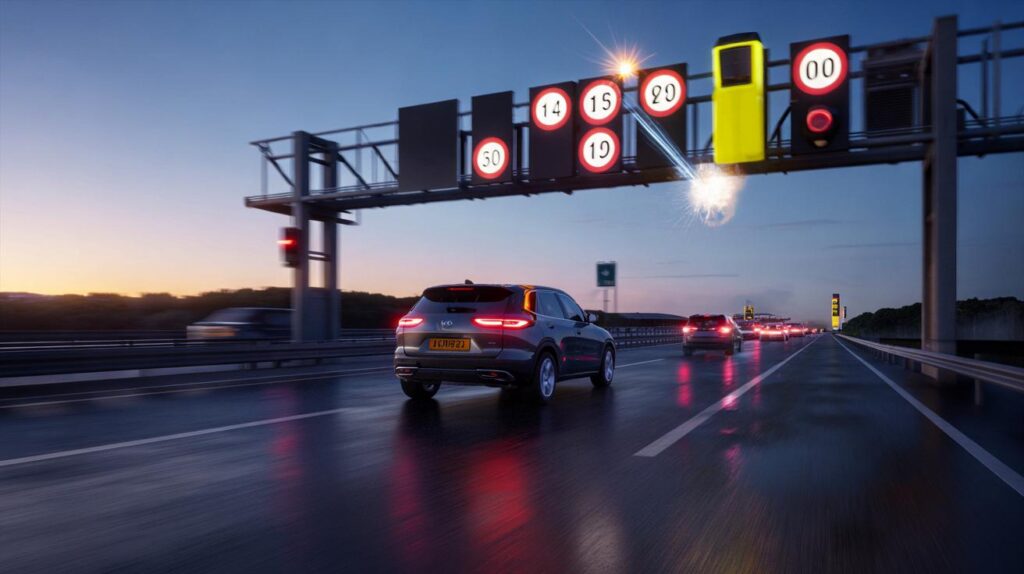
Flashing gantry signs on the M4 and M5 keep changing, and thousands wonder what one brisk squeeze of the throttle costs.
That question landed back in the spotlight after a Swindon driver faced magistrates for speeding through a variable limit near the Almondsbury interchange. The case shows how easily a brief lapse meets a camera’s gaze, and how quickly a modest mistake drains time, money and licence points.
What the court heard
Kelly Stubbs, 43, of Mill Lane, Swindon, drove a Vauxhall Mokka Ultimate Turbo along the M5 northbound between junctions 17 and 16, and on the M4 between junctions 19 and 20, on 31 August 2024. Variable limits were active across the corridor that day. Cameras recorded her travelling at 72mph when a signed 60mph restriction applied.
She appeared at Bath Law Courts on Tuesday, 26 August, nearly a year after the offence, and admitted exceeding a variable speed limit. Magistrates imposed a £146 fine and three penalty points. Stubbs must also pay a £58 surcharge and £110 in prosecution costs.
72mph in a 60mph variable limit led to three penalty points, a £146 fine, plus £168 in surcharge and costs.
Another driver, another camera
She is not alone. In a separate case, Rei Diko, 28, of Pen Y Lan Road, Roath, Cardiff, drove a BMW 420 eastbound on the M4 between junctions 20 and 19 and across the M5 between junctions 15 and 17. Cameras caught him at 58mph while a 50mph limit was in force.
Diko received three penalty points, a £220 fine, an £88 surcharge and £110 in costs. His total court bill reached £418.
58mph in a 50mph variable limit near the M4/M5 interchange brought three points and a £418 total penalty.
Variable limits on the M4 and M5
Those stretches form one of the busiest smart motorway zones in the West Country, where overhead gantries set temporary limits to manage congestion, incidents and roadworks. Enforcement cameras monitor each lane. When a lower limit shows above your lane, that limit applies until a national speed limit sign appears or a different limit replaces it.
Police forces often begin action at the threshold of limit plus ten per cent plus 2mph. On a 60mph limit, that means 68mph or above may trigger enforcement; on a 50mph limit, 57mph or above may do the same. Both recent cases sit above those thresholds.
Where and when the cameras trigger
- Each lane can be enforced separately under the displayed gantry limit.
- Limits can change quickly; keep scanning ahead for fresh signs.
- Red X signals mean the lane is closed and carry separate penalties.
- Average speed systems may operate through longer work zones.
How the penalties stack up
Many motorists expect a fixed penalty of £100 and three points for straightforward speeding. Court cases can cost more, because fines are based on income bands and include a surcharge and costs. Both drivers above left court with three points. Their fines differed because each case went before magistrates, who assessed means and circumstances.
| Driver | Road segment | Recorded speed | Limit | Penalty points | Fine | Surcharge | Costs | Total |
|---|---|---|---|---|---|---|---|---|
| Kelly Stubbs, 43 | M5 J17–16; M4 J19–20 | 72mph | 60mph | 3 | £146 | £58 | £110 | £314 |
| Rei Diko, 28 | M4 J20–19; M5 J15–17 | 58mph | 50mph | 3 | £220 | £88 | £110 | £418 |
Would you risk it for three points?
Three points might sound manageable. They still hurt. Insurers often nudge premiums up for a single speeding endorsement, and sharper rises can follow for repeat offences. Twelve points within three years can trigger a totting-up disqualification. New drivers face licence revocation at six points within two years of passing their test.
A quick cost check
- Fine, surcharge and costs: £314–£418 in these two cases.
- Insurance increase: varies by insurer, often £30–£150 per year for three points.
- Time spent: court appearance, paperwork and potential day off work.
A speed awareness course sometimes replaces points for lower-level speeds, at police discretion, when the driver has not taken a course in the previous three years. For a 60mph limit, eligibility usually ends above 75mph. For a 50mph limit, it usually ends above 64mph. That may explain why one lapse becomes an afternoon in court while another results in an offer of a course. Neither of the cases here ended with a course.
How to stay ahead of changing limits
Variable limits shift as quickly as traffic conditions. Treat the gantry as the final word for your lane. Ease off early the moment you see a lower limit two or three gantries ahead. Use engine braking where possible. Keep space in front so you can slow smoothly without heavy braking.
- Scan two gantries ahead to anticipate a change.
- Lift off the throttle early; let speed fall naturally.
- Hold a steady gap; leave at least two seconds in dry weather.
- Watch for the national speed limit sign before speeding up.
What the technology does
Modern motorway enforcement relies on high-definition, lane-specific cameras mounted near gantries. They read number plates, cross-reference the displayed limit and store secure evidence packs for prosecution. Systems also enforce red X lane closures, which carry higher penalties because they protect broken-down vehicles and road workers.
Why limits drop when traffic looks clear
Control rooms lower limits pre-emptively to smooth traffic flow around pinch points. A lower limit can raise overall throughput by reducing stop-start waves and rear-end collisions. Roadworks, debris, weather and incidents trigger further reductions. If a limit feels harsh on a clear road, it may be protecting a hazard just beyond the next bend or crest.
What this means for your next trip
Think about the numbers. On a 60mph limit, adding 12mph saves seconds per mile yet risks three points and a few hundred pounds if a camera spots you. On a 50mph limit, an extra 8mph feels modest but crosses common enforcement thresholds. The margin looks small; the consequence does not.
If you already hold points, consider the cumulative risk. Two modest offences can put you halfway to a court summons for totting up. For young or newly qualified drivers, one variable-limit mistake can count for the majority of your allowance. A calm right foot and early anticipation keep you clear of fines and keep traffic flowing for everyone.



Given the thresholds (60 + 10% + 2 = 68mph), 72mph is clearly over. Three points on your licence can sting at renewal; some insurers load for 3–5 years. Not worth the gamble for a minute saved.
Why did this end up in court rather than a speed awareness course? She was below 75 in a 60—was it timing, prior course, or just bad luck with the proccess?