
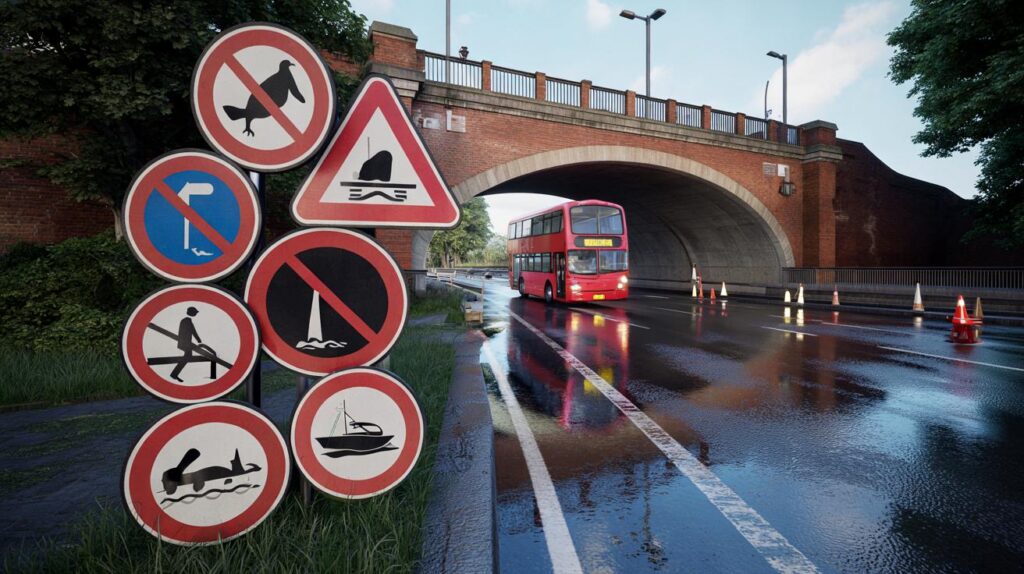
Playful signs have cropped up across Chelmsford, turning heads and camera phones, and raising a bigger question about safety and trust.
What began as a bit of local mischief has ballooned into a citywide guessing game. Now Essex Highways has stepped in, asking the mystery maker to call time on the pranks before someone takes a wrong turn.
Humour meets highways
Over the past 18 months, several unofficial signs have appeared in locations that matter: near the railway station, in the city centre, and by busy retail routes. They look convincing. They borrow the colours, symbols and fonts of real traffic signs. They appear overnight. And they speak directly to Chelmsford’s daily frustrations, from flooding to bridge strikes.
Essex Highways says unofficial signs risk misleading people and causing confusion, and has urged the creator to stop.
Officials say the joke has gone far enough. While many residents enjoy the wit, the road network depends on instant recognition and compliance. Once that certainty blurs, mistakes follow.
The six spoofs everyone is talking about
Shoppers, commuters and bus passengers have spotted a string of lookalike signs and logos in busy spots, often tied to a topical incident.
- August 2025: after a double decker became wedged under the bridge by the railway station, a tongue-in-cheek sign appeared at the scene.
- Recent weeks: a notice near Chelmsford Market seemed to ban pigeons from gathering or landing.
- January 2025: mock “boat restrictions” were posted on a railway viaduct, riffing on viral images of a £1m yacht appearing to get stuck while creeping through.
- November 2024: a Woolworths logo materialised at the entrance to Chelmer Village Retail Park, sparking nostalgia and confusion in equal measure.
- Early 2024: a flooded underpass sprouted a sign suggesting the council would provide snorkels, masks and flippers.
- Two months later: nearby, signs claimed rowing through another flood-prone underpass was forbidden.
Some of these installations have been removed; others still sit in plain view. Not all residents can spot the difference at a glance, especially when driving.
Why officials worry
Road signs are a safety language, governed by the Traffic Signs Regulations and General Directions. Drivers learn to obey them without hesitation. Fake signs that look official break that contract.
At least six spoof notices in 18 months, some mirroring official fonts and colours, have appeared across the city.
One wrong arrow could send a vehicle into a dead end or a weight-restricted street. A fake prohibition could push cyclists into faster traffic. A jokey warning might dilute attention when a real risk sits nearby. Network Rail has previously reported more than a thousand bridge strikes a year across Britain; Chelmsford’s bus incident shows how quickly mistakes can escalate.
There is a legal edge, too. Section 132 of the Highways Act 1980 makes it an offence to affix unauthorised signs to highway furniture. Fines can reach the level-3 maximum. If a collision follows misleading signage, civil liability may also arise. Removing a sign is not free either: crews, traffic management and inspections often run to several hundred pounds per visit.
City hall response
Chelmsford City Council’s leader, Stephen Robinson, has acknowledged the creativity on display but doesn’t back the practice. He characterises it as light-hearted criticism of county-level services while stressing that people should not put up unofficial signage. Essex Highways’ message is firmer: please stop.
How to tell a spoof from the real thing
Spot the small giveaways
Some look uncannily real. Still, a few checks can help.
- Look for placement: official signs sit on standard posts, at standard heights and positions, not odd angles.
- Check reflectivity: genuine signs use high-grade reflective faces; home-made boards often glare unevenly.
- Scan the edges: authentic plates have neat borders, rounded corners and consistent fixings.
- Read the wording: clunky phrasing, jokes, or eccentric icons signal a spoof.
- Context test: if a sign appears after a viral incident and you’ve never seen it before, be sceptical.
What to do if you spot one
Do not tamper with it. Make a quick note of the location, take a photo if safe to do so, and report it to Essex Highways or the city council. Crews can verify legitimacy and remove fakes without creating fresh hazards.
The line between satire and safety
Part of the appeal lies in how these signs talk to local life. Flooded underpasses, busy bridges and nostalgia for lost brands all resonate. Satire lands because it feels true. But the transport network runs on clarity. If the same fonts and arrows can also flag a joke, drivers lose the split-second certainty that prevents crashes.
There is also the issue of trust. Once people question a sign’s authority, they may start second-guessing the real thing. That hesitation can cascade at a junction or crossing, especially at night or in heavy rain.
What happens next
With more than a year of pranks and rising attention, the novelty is wearing thin for those tasked with keeping the roads safe. Essex Highways wants the creator to down tools. The council points to proper channels for raising concerns about road layouts, bridge warnings and flood responses. Those processes take longer than a vinyl sticker, but they lead to authorised changes that carry legal weight.
Practical takeaways for residents
If in doubt, prioritise Highway Code principles over any odd-looking sign, and report the location.
Residents who want better flood signage can ask for assessments of underpasses and culverts. Bus operators can review approach speeds and clearances near the station bridge, using data from recent strikes to shape driver briefings. Retail parks can tighten brand approvals on their entrances to prevent unauthorised logos. These steps sound dull next to a witty placard, but they stick—and they keep people moving.
For anyone tempted to join the joke, consider a safer outlet. Local art trails, temporary exhibitions and sanctioned street graphics all invite creativity without compromising road users. A well-aimed cartoon in a gallery won’t send a family car down a restricted route. A fake road sign might.



I chuckled at the ‘no rowing’ and the £1m yacht gag, but I get the point: roads rely on instant trust. If a spoof makes a cyclist swerve or a bus clip the bridge again, it’s not clever anymore. Maybe host a sanctioned art trail instead? The signs look a bit too real—reflectivity and fonts fool tired eyes at night, becuase who has time to double-check?