
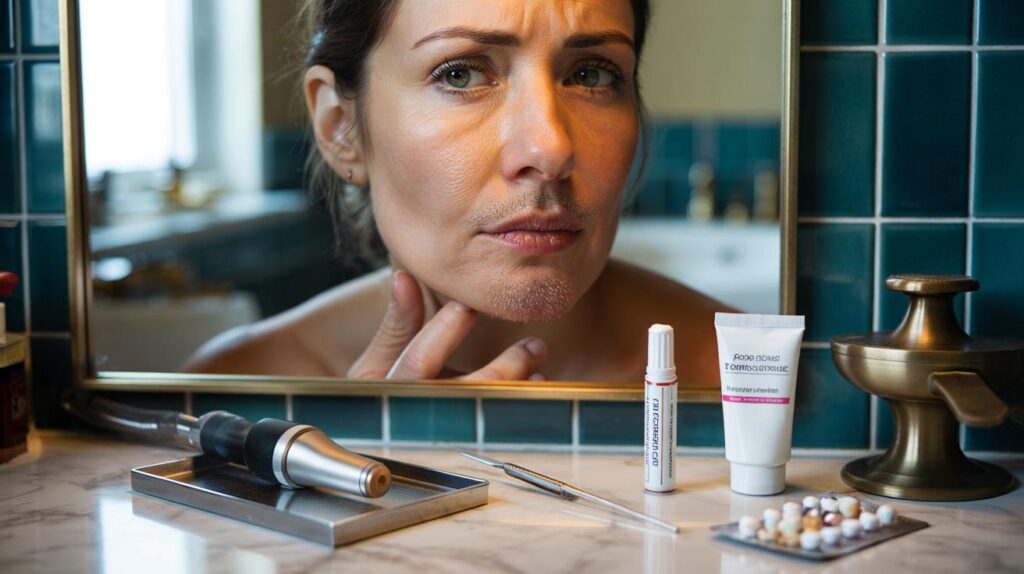
You spot the same wiry chin hair again. It returns quickly, raising awkward questions about timing, stress, age and hormones.
That stubborn hair is common, yet its speed and texture can shift with life stages. For many women, the pattern intensifies after 35, post‑pregnancy, or when stopping contraception. For some, it is a local follicle quirk. For others, it signals hormone changes that deserve attention.
What turns a lone chin hair into a pattern
Oestrogen falls and androgens gain relative influence around the menopause transition. That shift can nudge dormant facial follicles into producing thicker, darker terminal hairs. Similar changes may follow pregnancy, weight gain, or stopping a combined pill that previously suppressed androgens.
Polycystic ovary syndrome (PCOS) sits in the frame too. It affects roughly 8–13% of women of reproductive age and can raise androgen activity. Hirsutism, the medical term for excess coarse hair in a male‑pattern distribution, affects about 5–10% of women. Genetics matters as well: family patterns, hair density and ethnicity shape how visible facial hair becomes. Darker hair on light skin stands out more, even when counts are low.
Fast change beats frequency: if coarse chin hairs multiply over weeks, think less about tweezers and more about testing.
Signals you should not ignore
- New coarse hairs appearing every few days after years of stability.
- Rapid darkening or thickening of existing hairs within one to two cycles.
- Spread from a single spot to the jawline, upper lip or sideburns.
- Irregular periods, difficulty conceiving, or bleeding that becomes very light or very heavy.
- Acne that persists beyond 6–8 weeks of over‑the‑counter care.
- Unexplained weight gain, especially around the waist, or new scalp thinning.
- Deepening voice or clitoral enlargement, which requires urgent medical assessment.
Book a GP or dermatology appointment if several points apply. Early assessment can separate a benign local issue from a hormone‑driven pattern that responds better to medical treatment than repeated plucking.
Smart fixes you can start this week
Short‑term methods manage appearance while you work out the cause. Pick based on skin sensitivity, hair colour and time.
- Tweezing: precise for one to five hairs, but can trigger ingrowns if the hair snaps below the surface.
- Threading: fast for small clusters; less risk of product reactions; may irritate sensitive skin.
- Waxing or sugaring: clears a wider zone for one to three weeks; patch test if you have rosacea or use retinoids.
- Depilatory creams (thioglycolate): painless for many; do a 48‑hour patch test to avoid burns.
- Shaving: safe and quick; does not thicken hair or speed growth; use a sharp single‑blade and a gentle gel.
Shaving changes the bluntness of the tip, not the follicle. The hair looks thicker because the cut edge is flat.
Longer‑term options that change the regrowth curve
For durable reduction, energy‑based devices and targeted creams outperform endless epilation.
- Laser hair removal: best on dark hair and light to medium skin tones. Expect 6–8 sessions, 4–6 weeks apart, with 60–90% reduction on responsive hair. For darker skin, a 1064 nm Nd:YAG laser lowers burn and pigment risks.
- Electrolysis: works on any hair colour, including grey or very fair. Treats each follicle with an ultrafine probe. Suited to tiny areas like the chin; requires multiple sessions because hairs cycle.
- Eflornithine 11.5% facial cream: slows hair growth by inhibiting follicle enzyme activity. Results build over 8–12 weeks and pair well with laser. Availability varies across the UK.
| Method | Best for | Sessions | Typical cost (UK) | Pros | Cons |
|---|---|---|---|---|---|
| Laser | Dark, coarse hair | 6–8 | £40–£120 per small area | Fast, wide coverage | Less effective on light/grey hair |
| Electrolysis | Any hair colour | Multiple | £30–£80 per 15–30 min | Permanent per follicle | Time‑intensive; discomfort |
| Eflornithine cream | Facial hair | Ongoing | Prescription pricing varies | Non‑procedural | Slow onset; must continue |
Aftercare matters. Cleanse with a mild, fragrance‑free wash. Use a bland moisturiser and broad‑spectrum SPF 30+. Pause retinoids and acids for 48–72 hours around energy treatments to reduce irritation and pigmentation risk.
When hormones drive the hair: testing and treatments
If the pattern suggests a systemic driver, your GP may arrange targeted blood tests. Useful panels often include total testosterone, sex hormone‑binding globulin (to calculate the free androgen index), DHEA‑S, prolactin, TSH and, when indicated, 17‑hydroxyprogesterone. Morning sampling and day 3–5 of a natural cycle improve consistency.
Results guide care. Combined oral contraceptives can lower ovarian androgen production and raise SHBG, reducing free testosterone. In selected cases, anti‑androgens such as spironolactone are used off‑label in the UK; effective doses typically range from 50–100 mg daily. Reliable contraception is mandatory during treatment. Flutamide is rarely used due to liver risk. Metformin may help where insulin resistance underpins PCOS features.
Do not use anti‑androgens during pregnancy or if trying to conceive. Combine with dependable contraception.
Weight management can help in PCOS. A 5–10% weight reduction often improves cycle regularity and lowers androgen levels, which can ease facial hair over months. Pair lifestyle efforts with cosmetic methods early; waiting for lab shifts alone can feel demoralising.
Why one spot grows fast: local factors
Some follicles carry more androgen receptors or local enzyme activity, so a tiny patch outpaces neighbours. Repeated trauma, micro‑inflammation or ingrowns can alter how a hair emerges, making it seem thicker. Plucking does not increase follicle number, but snapping hairs below the surface raises the chance of bumps and uneven regrowth.
Skin care that prevents bumps and marks
- Use a salicylic acid 0.5–2% liquid two to three times a week to keep pores clear.
- Try lactic acid 5–10% if your skin is dry or reactive to salicylic acid.
- Soothe post‑treatment with aloe vera gel or a ceramide‑rich moisturiser.
- Limit hydrocortisone 1% to very short bursts for severe irritation under medical advice.
- Protect daily with SPF to avoid post‑inflammatory pigmentation on the chin.
Your practical next steps this month
Week 1: keep a simple log. Count visible coarse chin hairs every three to four days, note cycle day, stress, sleep and medications. A jump from 2–3 to 10+ coarse hairs within a month, or spread to new areas, justifies GP testing.
Week 2: choose a management pairing. For a few dark hairs, combine tweezing with eflornithine if prescribed. For clusters, schedule a laser patch test or book electrolysis for fair/grey hairs.
Week 3–6: space sessions correctly. Laser works best when you return as new hairs surface, usually at 4–6 weeks for the face. Avoid sun exposure and self‑tanners before appointments.
When to seek urgent care
- Sudden virilisation signs such as deepened voice, increased muscle bulk or clitoral enlargement.
- Very high, rapidly rising hair counts over weeks in combination with new severe acne.
- Systemic features such as easy bruising, purple stretch marks and high blood pressure suggesting cortisol excess.
If in doubt, ask your GP for a hormone panel and a review of medicines that can trigger facial hair, such as some progestins or steroids.
Two helpful additions: if you have darker skin, confirm your clinic offers Nd:YAG laser and shows healed results on similar skin types. If you are perimenopausal and stopping the pill, plan ahead with your GP to set expectations about hair, skin and cycle changes as oestrogen declines.
Finally, set a budget and timeline. Many women reach their “public‑facing” goal after three to four laser sessions, then need one or two top‑ups a year. Electrolysis often clears isolated grey stragglers in 10–30 minutes per visit. Combining methods gives the most predictable control without over‑treating your skin.



Loved the clarity here—especially “fast change beats frequency.” I’ve been logging for two months and it definitley highlighted a post‑pill shift I missed. Also, thanks for busting the shaving myth; my aunt still swears it makes hair “thicker.”
Good overview, but recommending spironolactone needs more nuance: potassium labs, BP checks, and drug interactions (e.g., ACE inhibitors). Also, note it’s off‑label in the UK—GPs vary widely. Any guidance on typical monitoring schedules?