
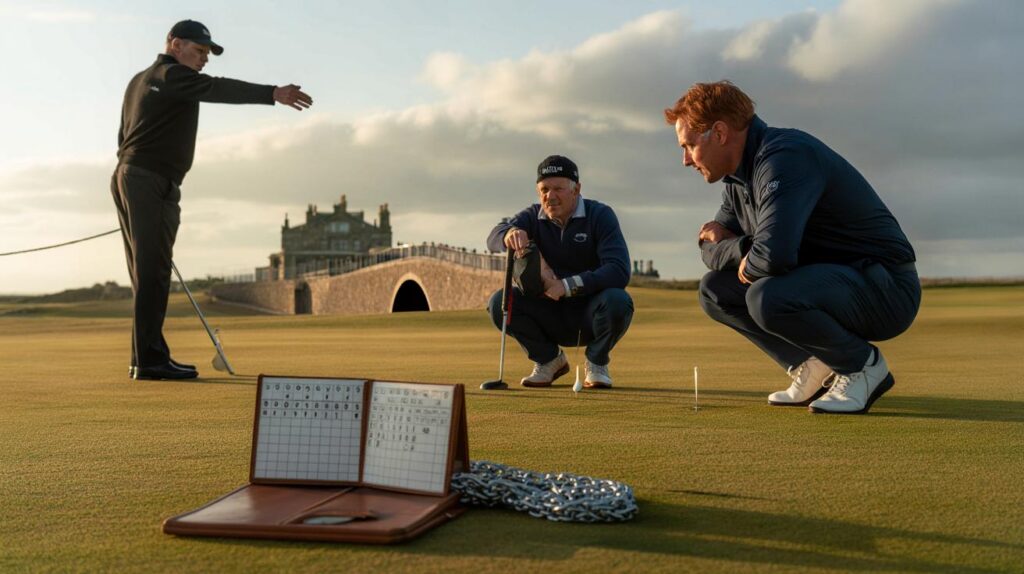
Whispers of scorecards and handicaps return to St Andrews as fans look back at a stunning pro‑am triumph and its fallout.
The Alfred Dunhill Links Championship is back across Scotland’s storied coastal courses, with Andy Murray among the famous amateurs. Yet a decade-old row involving broadcaster Chris Evans still echoes round the tees, bunkers and clubhouses.
What happened at the Dunhill Links
In 2011, Chris Evans partnered professional Nick Dougherty and posted a breathtaking team total of 40 under par at the Alfred Dunhill Links. The celebrity-pro pairing topped a field packed with big names from sport and film. The score set tongues wagging. Attention quickly focused on one line of the entry form: Evans’ declared 10 handicap.
By the following year, Evans said he had been told he could not return. He had cleared time away from his radio programme to defend the title, but he was, by his own account, barred from competing. He described the decision as a lifetime ban. Event officials did not publicly spell out the reasons at the time, and the question of whether the exclusion remains in force still lingers.
After a record 40-under team tally in 2011, Evans said he was banned for life from returning to the Dunhill Links.
He also joked about staging a spoof “Dung Hill Cup” on the same dates. Behind the barbed humour sat an obvious frustration: congratulations mingled with muttering that his handicap was set too high for his ability.
Why a 10 handicap caused a storm
Handicaps exist to level the playing field. In a pro‑am, the professional’s gross score is combined with the amateur’s net score after applying a handicap allowance. The Dunhill Links uses a best‑ball team format across three courses before a cut for the final round. A well‑syndicated discussion among players and fans argued that a 10 marker receiving shots at strategic holes can unlock very low team numbers, especially alongside a tour‑level partner.
Questions emerged because 40 under par is an outlier, even in pro‑ams famous for low totals. That does not prove wrongdoing. It does show how sensitive handicapping can be when high-profile prizes and televised leaderboards enter the picture.
The row was never just about one number; it was about trust in the fairness of a format that relies on handicaps.
How the team scoring works
The team event runs alongside the professional strokeplay. Each hole, the lower score of the two partners counts for the team. The amateur receives a percentage of their course handicap as strokes. On links courses with wind, firm turf and sprawling greens, those extra shots can translate into birdie or par saves that a pro can’t always make from awkward lies.
- Team score in question: 40 under par (2011)
- Amateur handicap declared: 10
- Courses used: three (rotating before the cut)
- Reported sanction: lifetime ban asserted by Evans in 2012
- Time elapsed: more than 10 years
This year’s cast and storylines
Evans is not in the field, but the star wattage remains bright. Andy Murray, who has spoken about one day trying to qualify for The Open, tees it up again in the amateur ranks. The roll call stretches from Hollywood to the Hall of Fame. Michael Douglas and Catherine Zeta‑Jones return to Scotland’s east coast. Comedy icon Bill Murray, a favourite with galleries, provides the laughs. From music, Huey Lewis and Keane frontman Tom Chaplin bring rhythm to the fairways.
Sporting greats pepper the tee sheet. Five‑time Olympic champion Sir Steve Redgrave is back with the long irons. Ashes winners Kevin Pietersen and Michael Vaughan swap slips for sand saves. Former South Africa rugby skipper Morne du Plessis adds Springbok muscle to the draw. Dustin Johnson appears, and he’s joined for the week by his father‑in‑law, NHL legend Wayne Gretzky.
On the pure golf side, Ryder Cup star Tyrrell Hatton plays the team event with his father Jeff, while 2023 champion Matt Fitzpatrick partners his dad Russell. Both pairings tend to attract packed ropes and a healthy quotient of birdies.
| Name | Why they matter this week |
|---|---|
| Andy Murray | Grand Slam tennis champion with ambitions in elite golf qualifying |
| Tyrrell Hatton | Ryder Cup stand‑out, defending his reputation on links he loves |
| Matt Fitzpatrick | Recent champion who thrives on fast, firm coastal setups |
| Michael Douglas | Hollywood presence helping draw global attention |
| Bill Murray | Fans’ favourite whose antics lighten the wind and weather |
What Evans said and what organisers did
In 2012, Evans told listeners he would not be allowed to defend his pro‑am title. He described the sanction as a lifetime ban and suggested organisers reacted badly to a celebrity team winning by such a margin. At the time, reports noted that officials did not publicly confirm specifics, and attempts to clarify the current status of his exclusion continue.
Evans framed the decision as the owner of the ball taking it home because his team lost — a sharp metaphor for a bruising dispute.
The episode still divides opinion. Some point to the transparency of handicaps and the controls that events apply. Others argue that a marquee pro and a mid‑handicap amateur, under best‑ball, can overwhelm the system unless allowances are finely tuned. Both positions meet at the same demand: a level game and clear rules.
The courses and what makes them tricky
The Dunhill rotates across three championship venues that punish loose swings and shaky putting.
| Course | Character | Typical par |
|---|---|---|
| St Andrews Old Course | Vast double greens, shared fairways, devilish angles in the wind | 72 |
| Carnoustie | Narrower targets, penal rough, the Barry Burn looming on closing holes | 72 |
| Kingsbarns | Clifftop visuals, exposed breezes, modern links contours | 72 |
Variability across three sites can magnify handicap effects. A 10 playing well at Kingsbarns in a light breeze may post a run of net birdies. The same player at Carnoustie in a squall can look like a different golfer. That swing fuels debate when leaderboards merge numbers from differing tests.
For amateur golfers: keeping handicaps credible
The World Handicap System adjusts scores based on course rating and slope, but tournament allowances vary. In celebrity pro‑ams, organisers often apply a percentage reduction to amateur handicaps to protect the field from outlier totals. If you’re entering a high‑profile event, prepare like a pro and document your form.
- Keep scorecards and track differential averages over your last 20 rounds.
- Play competition tees on links and parkland to understand how your index travels.
- Practise pressure golf: set targets, play for a card, and note misses under stress.
- Check the event’s handicap allowance and how strokes fall on the card.
- Be ready to accept an adjusted allowance; it protects the field and your reputation.
Want a feel for impact? A 10 index given 75% allowance becomes a 7 or 8 for the week. On a par‑72 with stroke holes on four par fives and long par fours, that can still mean several net birdie looks — especially alongside a tour player who attacks flags you avoid. The format rewards teamwork, course management and honest numbers.
For fans, the Evans saga is a reminder that pro‑ams sit at the edge of entertainment and elite sport. They showcase famous faces, raise money and profile the host courses. They also test the integrity of handicapping under cameras and commentary. The best fix is sunlight: clear rules before the first tee shot and transparent communication when controversies arise.



As a tournament format nerd, I don’t think a 10 handciap in best‑ball automatically screams foul, but 40‑under is a wild outlier. If the allowance was, say, 75% with stroke caps on par 5s, you’d still get fireworks without breaking the field. Did the event use reductions back then, and are they stricter now? Consistent pre‑published rules would stop this from feeling… murky.