
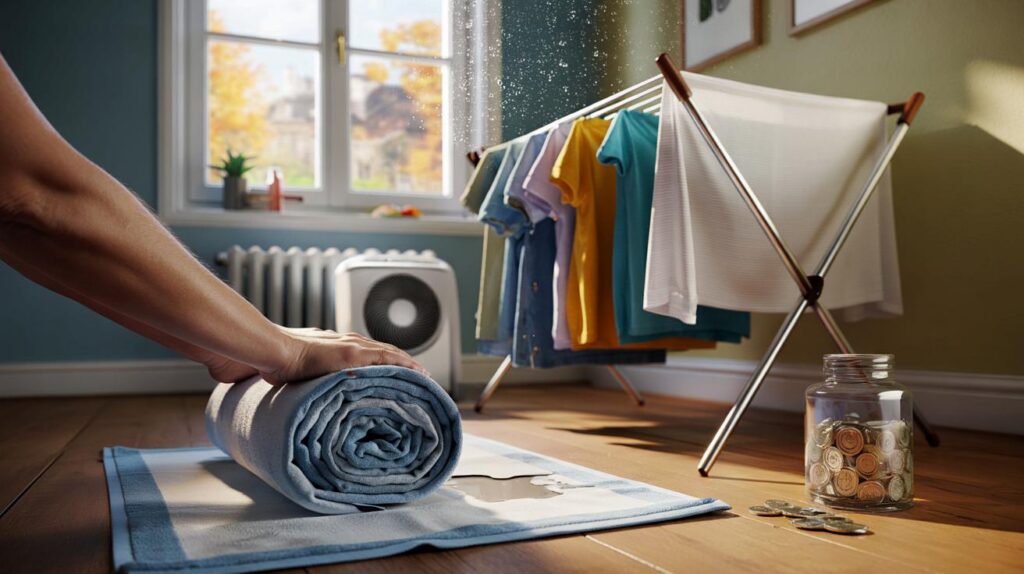
With bills still biting and radiators idle, damp laundry lingers. A simple pre-drying step could change your autumn routine.
As cooler air creeps in and daylight shortens, many households keep the heating off to protect budgets. That choice often leaves shirts and bedding hanging for days, inviting condensation and musty odours. A no-cost trick using a single everyday item promises faster results without touching the thermostat.
Why washing stalls indoors
Indoor air in autumn holds less moisture, yet rooms are often shut tight, which slows evaporation. Water leaves fabric quickly at first, then lingers deep in fibres. Without airflow or a warm gradient, that last phase can take hours.
Humidity, airflow and fabric weight
- High indoor humidity above 60% traps moisture in cotton and terry fabrics.
- Poor airflow around garments reduces the boundary layer where evaporation happens.
- Heavy items like jeans and towels carry more water per square inch, so they bog down drying racks.
Reduce the water in the cloth before you hang it, and the room does far less work. That’s the whole game.
The 0p towel roll method
Before you reach for a heater, reach for a clean dry bath towel. By compressing damp garments inside an absorbent roll, you transfer a sizeable share of moisture to the towel, which is then aired separately. This pre-drying step can bring a noticeable time saving for T‑shirts, school uniforms and even sheets.
Step-by-step
Households report cuts of 25–40% in indoor drying times using a single dry towel and a firm press, with zero energy spend.
This technique works because towels offer huge surface area and capillary action. When you compress a garment in contact with terry loops, water migrates into the towel without aggressive wringing that can distort knitwear. It is especially effective after high-speed spins, which leave clothing uniformly damp rather than dripping.
Make it work for bedding
Sheets often overwhelm airers and doors because they clump and block airflow. You can adapt the same method to speed the first stage for double and king sizes.
Bedding tactics for a fast dry
- Wash in the morning to use the day’s natural temperature and ventilation.
- Lay the damp sheet on a large, dry towel or two lightweight towels edge to edge.
- Roll and press as above, then shake the sheet vigorously to lift and separate fibres.
- Hang in a tent shape over multiple bars or a banister to keep air moving through the middle.
If hay fever is a concern or the weather is foul, drying indoors keeps pollen off bedding. Aim for steady airflow rather than heat. A quiet desk fan on low, angled across the room rather than at the sheet, helps carry moisture towards an open window.
Speed boosters that cost pennies
Pair the towel roll with low-wattage helpers. You can add flow and remove moisture without running radiators.
| Helper | Typical power | Estimated cost per hour (at ~28p/kWh) | Notes |
|---|---|---|---|
| Desk fan on low | 30–45W | £0.01 | Pushes moist air off fabric; open a window a crack. |
| Dehumidifier (efficient) | 150–250W | £0.04–£0.07 | Pulls moisture from room air; reduces condensation and smells. |
| Heated airer (typical) | 200–300W | £0.06–£0.08 | Use with a cover for best results; still cheaper than a tumble dryer. |
| 2kW fan heater | 2000W | £0.56 | Dries quickly but drives up costs and humidity if ventilation is poor. |
By comparison, a vented tumble dryer can draw 2–3kW; a 60‑minute cycle could cost around £0.56–£0.84 at current tariffs. The towel method removes much of that need, particularly for light loads.
Prevent damp and mould while you dry
Mist on windows and a musty edge to rooms are warnings. Aim for indoor humidity between 40% and 60% while laundry dries. Simple steps help.
- Crack a window for 10–15 minutes to vent moist air, even on cool days.
- Run an extractor fan in the kitchen or bathroom while the airer is in use.
- Leave gaps between garments; avoid double‑layering on rails.
- Rotate items after an hour so thicker seams face the airflow.
- Keep the airer away from outside walls where condensation forms first.
Dry laundry in a single room with a door and a small window opening. You localise moisture and control it.
Common mistakes to avoid
- Overloading the towel roll. One garment per bath towel works best for consistent pressure.
- Wringing knitwear hard. Press, don’t twist, to protect shape.
- Leaving the towel damp on the airer under clothes. Dry towels separately so they don’t slow everything down.
- Hanging clothes directly over radiators. This traps moisture on cold walls and can lead to mould growth.
- Skipping the spin. Use the machine’s highest safe spin for each fabric to start drier.
A quick routine you can repeat after every wash
Think of drying as two phases: remove water mechanically, then let air do the rest. Here is a simple cycle to follow.
- Select a high spin speed suited to the fabric label.
- Towel roll the heaviest pieces first to cut the bulk of moisture.
- Arrange garments on the airer with at least a hand’s width between items.
- Set a fan to skim across the rack; crack a window if possible.
- After 60–90 minutes, flip and rotate items; check cuffs and waistbands last.
What kind of towel works best
A thick cotton bath towel is ideal. Dark garments can transfer dye onto pale towels the first few washes, so pair colours sensibly. Microfibre towels absorb quickly but can leave light static on synthetics; cotton remains the safest all‑rounder. For bulky hoodies and jeans, two thinner towels rolled together give wide pressure without a hard crease.
How to tell when clothes are ready
Rather than guessing, check the weight and feel. A T‑shirt that started at 150g and left the washer at 300g should return close to its original weight when dry. If you have a small scale, note a few typical items once, then use touch and timing thereafter. A cheap humidity monitor near the airer helps too; when the room dips back below 60% after a peak, most pieces are done.
When to skip the trick
Silk, heavily embellished garments, and loosely knitted wool can crease or deform under pressure. For those, use a mesh flat rack and airflow only. If a label says reshape while damp, lay the item flat and pat it into form, then dry away from direct heat.
The bottom line for busy households
One dry towel, a firm press and smarter airflow can shave meaningful time off indoor drying and keep energy use low. On an autumn week with three loads, replacing an hour of heater time with the towel method and a fan could keep over £1 in your pocket while reducing condensation risks. Small changes, repeated, add up to warmer, drier rooms and laundry that smells fresh rather than stalled.



Tried the towel roll methd on T‑shirts and bed sheets—went from all day on the airer to about 2.5 hours with a cheap desk fan. Deffo saved me putting the heater on. Thanks for the step-by-step, esp. the flip-after-90-min tip!
£1.20 a day saving sounds great, but can you show the maths? If a 2kW heater is ~£0.56/hr and a fan is ~£0.01/hr, is the claim assuming two hours avoided? And how many loads per day are you basing it on?