
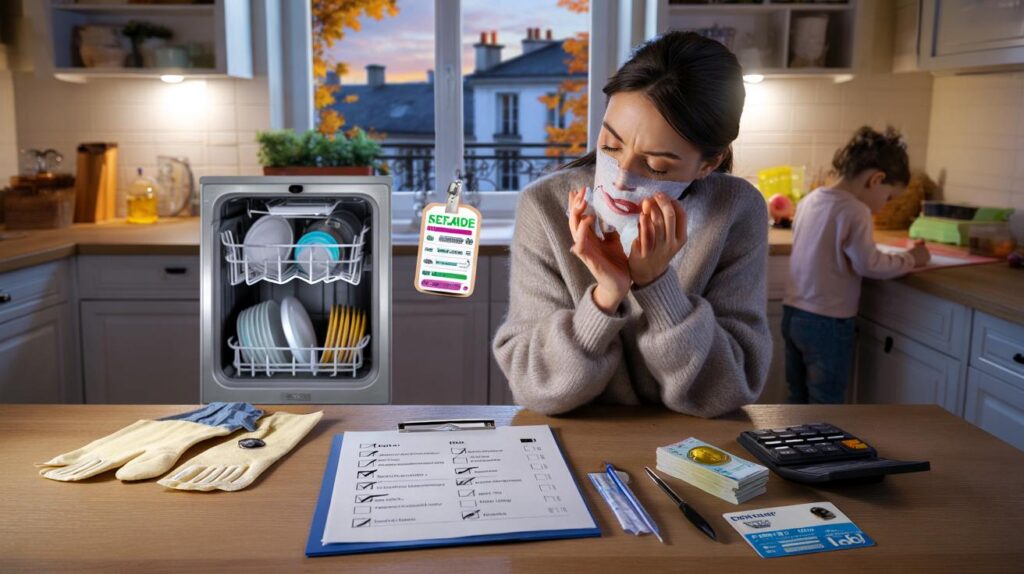
Sore hands, dark evenings and a sink that never empties. The daily grind bites harder as temperatures drop and dinners grow heartier.
Across France, a little-known route inside the benefits system can turn that grind into minutes of calm. It is not automatic, and it is not identical everywhere. Yet for many low-income households, it can make a dishwasher realistic right now.
A quiet lifeline inside the CAF system
The CAF (Caisse d’Allocations familiales) does more than pay child benefits. In specific cases, local CAF offices may support the purchase of essential household equipment, including a dishwasher. This support exists to stabilise family life, protect health and keep homes functional. The catch is that it is local, conditional and based on a file that stands up to scrutiny.
A local decision, not a national hand‑out
There is no national form that guarantees a dishwasher. Each département sets its own rules, budgets and priorities. Decisions weigh your household income, composition, current equipment, health constraints and the urgency of the need.
There is no single application form. You must build a case for your local CAF, and you should wait for written approval before buying.
Where the need is documented—new baby, disability, long illness, housing newly equipped, or a burst budget after a breakdown—your chances rise. The strongest files show why the appliance is necessary, not just nice to have.
Who stands a real chance of approval
Local guidance varies, but the following profiles often receive a hearing:
- Families with two or more children juggling school, childcare and shift work.
- Households with a medical or disability reason that makes manual washing difficult or risky.
- Parents rehoused after separation, domestic violence or poor housing conditions, with no basic equipment.
- Low-income households facing a sudden expense after an appliance failure.
- New tenants moving into unfurnished social housing where a first set of essentials is required.
Evidence wins. A medical note, a landlord’s attestation of missing equipment, and a recent quote for a modest machine can tip the balance.
How much and in what form
Amounts and formats change by département. Some offices offer one‑off grants; others lean on zero‑interest loans or mixed packages. The figures below reflect common ranges reported by local CAFs and social services. Your branch may differ.
| type of help | typical range | how it is paid |
|---|---|---|
| Exceptional grant | €100–€500 | Reimbursement on invoice or payment direct to the retailer |
| Zero‑interest equipment loan | €200–€1,000 | Repaid over 12–36 months via CAF deductions |
| Mixed grant + loan | Case by case | Part paid by CAF, part repaid monthly |
Most decisions require a modestly priced, energy‑efficient model. Think €300–€450 for entry models and €500–€800 for mid‑range machines with A to C ratings. Keep your quote realistic to avoid refusal.
The step‑by‑step playbook that gets results
These five checks mirror what local advisors often expect to see:
- Contact your local CAF first and ask which exceptional schemes or equipment loans are open this month.
- Gather proofs: ID, household composition, last three income statements, proof of no current dishwasher, and—if relevant—a medical note.
- Request a written quote showing the model, energy rating, price and retailer details. One clear quote is better than three vague ones.
- Explain the impact on daily life: number of meals, health limits, shift schedules, and the risks of manual washing in your situation.
- Wait for written approval. Do not order the appliance before the green light, or you may lose eligibility.
Written approval first, purchase second. Some CAFs pay the retailer directly, others reimburse against the invoice, and a few combine both with a small loan.
Evidence that moves the dial
Social workers and CAF advisors look for concrete signals of need. Build your file around them.
- A note from a GP or occupational therapist confirming pain, dermatitis or mobility issues aggravated by manual washing.
- A landlord’s or social worker’s attestation that the home lacks essential appliances.
- A breakdown report for a dead machine if you are replacing one crucial to family routines.
- A realistic model choice with a low energy label and a quiet cycle, showing long‑term savings.
- A monthly budget showing loan affordability if a zero‑interest option is proposed.
Costs and savings you can quote
Water and electricity in 2025 numbers
Modern dishwashers typically use 9–12 litres per eco cycle and around 0.6–1.0 kWh. Handwashing varies wildly with running taps, often 30–100 litres per load. Using common 2025 household prices—about €4 per m³ of water and €0.25 per kWh—the arithmetic helps your case.
| method | water used | electricity used | estimated cost per load |
|---|---|---|---|
| Handwashing (running tap) | 40–80 L | Gas or electric for hot water | €0.20–€0.60 water + energy |
| Dishwasher (eco 50–55°C) | 9–12 L | 0.6–1.0 kWh | €0.15–€0.35 water + electricity |
Run four eco cycles a week and you might see annual running costs of roughly €30–€70, with less water waste and less skin irritation. These numbers strengthen arguments around health and budget stability.
If the answer is no: other doors to knock on
Rejections happen when budgets are tight or the need looks secondary. There are adjacent paths worth trying:
- Ask about a CAF equipment loan if a grant is unavailable this quarter.
- Check your mairie’s social action centre (CCAS) for emergency help on first equipment.
- Look for departmental funds for disability or family hardship.
- Compare retailer options: trade‑in deals, cashback periods, and starter bundles with tablets and salt.
- Consider a quality refurbished model with a 12‑month guarantee; some CAFs accept second‑hand if it is invoiced and warranted.
Refurbished with a proper invoice can cut the purchase price by 30–50% and still meet CAF documentation rules.
Practical extras to think about
Keep your choice modest and durable: standard width, energy class A to C, eco cycles, and a noise level under 46 dB for flats. Plan the installation: a short inlet hose, a leak‑stop valve, and a drain point that does not pinch. Factor salt and rinse‑aid into monthly running costs. If a loan is offered, model repayments against your CAF benefits calendar to avoid cash squeezes.
Timing matters. Files can take two to six weeks depending on the département and the season. Your case moves faster when every document is complete, contact details are current, and the quote stays valid. If you face a health risk or a newborn deadline, flag it early and get a social worker to endorse your timeline.
You can strengthen your pitch with a quick savings snapshot. Compare your current washing routine—minutes per day, dermatitis flare‑ups, hot water litres—with a dishwasher on eco mode. Attach this one‑page note to your file. It shows foresight, it quantifies benefits, and it answers the unasked question: why now, and why this model.
Families who do qualify often combine a small grant with a short zero‑interest loan. That mix keeps the upfront cost near zero and spreads the rest over a year or two. If you also receive the chèque énergie, schedule eco cycles during cheaper tariffs where possible and keep temperatures low. Small tactics, steady gains and a case built on evidence—that is how the sink stops dictating your evenings.



Super clear guide — thanks! I didn’t know CAF could pay the retailer directly. Quick Q: do refurbished machines with a 12‑month invoice actually get accepted often, or is that rare across departements? Is mid‑range definately too much?