
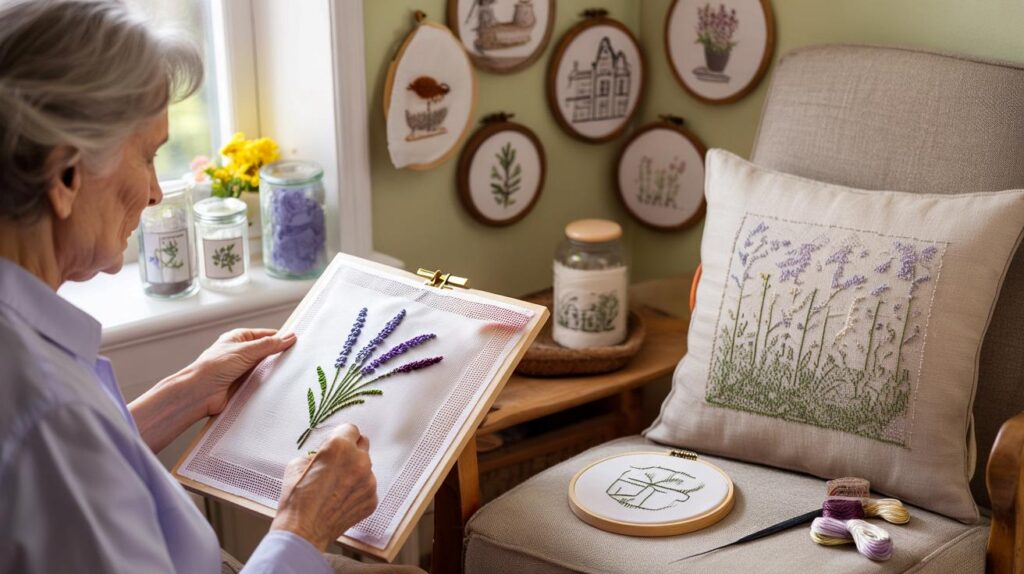
Older rooms don’t need grand renovations to feel alive again. They need stories. A tiny square of colour on the armchair, a stitched word above the kettle, a border of flowers that whispers: someone lives here and loves this place.
The Tuesday group meets where the light is generous — near the conservatory, beside a sagging fern and a well-behaved kettle. Hoops click softly as mugs are set down, the conversation moving as steadily as the needle through cloth. You notice how the room changes as finished pieces arrive: a sprig of rosemary stitched in sage, a soft alphabet on a cushion, a bird perched above a doorway as if it belongs. The house feels like it’s exhaling. What if the walls could stitch back?
Stitches that change a room
Cross-stitch delights because it is small and truthful. Each tiny cross builds a picture that can settle anywhere: on a shelf, on a cushion, tucked into a frame that leans against a lamp. We’ve all had that moment when a corner looks tired and you can’t bear another catalogue lamp; a stitched motif slips in like a friend. It doesn’t shout. It sits there and warms the air.
Take Margaret, 79, who turned a cold hallway into a cheerful welcome using three hoops and leftover threads. She stitched a teacup, a terraced house, and a tiny robin — each hoop in a different size — and hung them in a playful cluster by the door. People smile before they’ve taken off their coats. Small motifs create big feelings when they’re grouped with care. No decorator needed, just an afternoon, a bit of patience, and a wall that says thank you.
There’s a quiet logic to why it works. The grid keeps your hands steady and your head clear; patterns are broken into digestible blocks, so confidence grows with every row. Motifs are modular: a sprig of lavender can live on a bookmark, repeat across a runner, or anchor the corner of a pillow. With 11-count or 14-count Aida, stitches are larger, visibility kinder, and the finish still crisp. The home gets personal, room by room, square by square.
From idea to object — gentle methods that shine
Start with a room, not a pattern. Stand in it for a minute and listen: the mantle might want a circular hoop with a botanical alphabet, the guest chair might crave a small cushion with a single word — “Rest”, “Welcome”, “Tea?”. Choose 11–14 count fabric for comfort, a tapestry needle, and a hoop that sits nicely in the hand. When you finish, rinse, pat flat, and stretch on a foam board or tuck into a hoop with a felt backing for a neat, modern look.
Common snags happen when symbols blur or thread tails wander. Use a simple magnetic board or a highlighter to mark each area and park threads on bobbins with labels. Pause more than you think: wrists like kindness, eyes like good light, and breaks prevent cross-stitch from becoming a chore. Let’s be honest: nobody really does that every day. It’s only fabric and thread; you can always try again. If a mistake slips in and it still makes you smile, that might be the point.
A little courage turns into style when you repeat a motif across objects — coasters, jar toppers, a ribbon of bunting above the sink. It’s the rhythm that makes a home hum rather than the price tag. Match colours to what you already own, not what a leaflet says you should buy. Balance intricate charts with gentle, one-evening projects so momentum never fades.
“I stitch in odd moments — while the toast browns, between the news and the weather — and suddenly a week later I’ve got a meadow,” says Lena, 83, grinning at a cushion that looks like spring stayed for tea.
- Use larger-count Aida (11 or 14) for kinder visibility and tidy texture.
- Magnetic needle minders stop the dreaded sofa search.
- Clip-on lamp or daylight bulb changes everything after dusk.
- Back your hoop with felt for a polished, gift-ready finish.
- Repeat a motif across three items to create instant harmony.
Decor ideas that carry memory
Kitchen stories: stitch herbs on jar toppers and a short phrase above the cooker — “Slow down” or “Stir with love”. Lounge calm: a trio of cushions with one motif each — leaf, bird, wildflower — in the colours already in your rug. Hall nudge: a slim vertical sampler to pull the eye upward, making the space feel taller. Bedroom comfort: lavender sprigs on sachets tucked into drawers, or a tiny constellation on a navy bookmark for bedtime reads. **One design, repeated differently, ties the whole house together.**
Memory projects gently place the past where it can be seen. A grandchild’s drawing becomes a chart for a small hoop beside the photo frame. Holiday fragments show up as seaside shells on a door hanger or a lighthouse on a key rack. On a rainy afternoon, pick a letter from your initials and stitch it on a linen napkin; three more weekends and you’ve got a set for Sunday. The point is not perfect stitches. The point is a table that recognises you.
For hands that tire, tools are quiet allies. A lap stand holds the hoop so shoulders can drop; a needle threader makes the fiddly bit a breeze; pre-sorted threads remove the decision fatigue that steals joy. If colour matching feels heavy, try monochrome — indigo on oatmeal fabric, charcoal on cream — handsome in any light and forgiving of pauses. *A simple border, a neat back, and you’ve got heirloom energy without the theatre.*
There’s also a playful route that rarely fails: seasonal swaps. Keep one frame on a shelf and switch the insert — autumn leaves, winter berries, spring blossom, a bold sun for July — so the room follows the calendar. If you love plants, stitch labels for pots, each with a tiny icon: basil leaf, tomato vine, a stubborn chilli. Work in short bursts and let patterns sit open on a bookstand. You’ll wander back and put in ten more stitches before you notice the time.
Gifting multiplies the charm. Door signs for friends, bookmark bundles for a book club, a stitched recipe title for the person who always brings cake. Ask for stories while you stitch: the exact green of a grandad’s allotment shed, the navy of a favourite cardigan, the pale pink that used to be on a front door. These choices don’t live on a chart; they live in a life. The house is just where they land.
And when threads tangle or a chart feels like a forest, walk away and put the kettle on. Threads forgive. Patterns will still be there. Your room will wait, and when you return, the next little cross will know exactly where to go.
Some days the idea comes first — a word to hang by the bed, a sprig for the guest towel — and the pattern follows. Other days, a forgotten skein of moss green sparks a rolling rush of leaves that ends up as a table runner beneath a bowl of apples. **Every home has one neglected spot that’s begging for a stitched heartbeat.** Look for it. Then give it two colours and a square of fabric, and watch it soften.
There’s a quiet bravery in making things visible. You begin with a hoop and end with a small altar to the present tense — the chair you read in, the corner where the radio sits, the shelf that now has a bird. A guest will notice and ask what it means; you’ll find yourself telling a story you didn’t realise you still carried. The house will listen, the way houses do, and keep it safe.
Some rooms brighten with just one line of backstitch around a simple floral. Others want abundance — a cluster of hoops, a cascade of stars across a cushion, a border along a curtain edge that no one expects but everyone loves. Start small, repeat what works, change what doesn’t. The only rule worth keeping is the one that lets you keep going.
There’s no rush. Cross-stitch is patient by design. It meets you where you are — ten minutes before the post arrives, a Sunday that stretches kindly, a winter afternoon that needs light. Work with what your hands like today, and let tomorrow decide its own colour.
Then there’s the thing no glossy catalogue can sell: your touch. It settles into fabric, softens sharp corners, and tells the room who it belongs to. Make one tiny cross, then another. The rest is just time, laughter, and a few good cups of tea.
When you look up one ordinary morning and see lavender dancing on a cushion, or a plucky robin winking from the hallway, it won’t feel like a project. It will feel like your home remembering you back. That’s the magic worth chasing.
Pick a doorway, a chair, a shelf, and begin there. The house will tell you the rest.
| Key points | Details | Interest for reader |
|---|---|---|
| Small motifs, big impact | Clustered hoops, single-word cushions, repeatable herbs and florals | Quick wins that change a room without renovation |
| Gentle methods for comfort | 11–14 count fabric, good light, lap stands, magnetic boards | Less strain, more joy, longer stitching sessions |
| Finish like a pro at home | Rinse, block, felt-backed hoops, foam board stretching | Gift-worthy results with everyday tools |
FAQ :
- What fabric count is easiest on ageing eyes?11–14 count Aida is a sweet spot: holes are larger, stitches still look tidy, and progress feels brisk.
- How can I keep track of where I am on a pattern?Use a magnetic board or printout and mark finished areas with a highlighter; park active threads on labelled bobbins.
- What are simple decor pieces to start with?Jar toppers, small hoops, bookmarks, and sachets. They finish fast and slot naturally into daily life.
- How do I make my pieces look “finished” without a framer?Rinse, dry flat, lightly press from the back, then mount on foam board or finish in a hoop with a felt back.
- My hands tire quickly. Any tips?Use a lap or floor stand, take short breaks, switch to larger needles, and stitch in daylight or with a daylight bulb.



Absolutely loved the focus on small motifs with big feelings. Margaret’s trio by the door is such a gentle masterclass in scale and clustering. Starting with the room rather than a pattern is the advice I didn’t know I needed, and the 11–14 count tip makes it feel doable for my mum (and honestly, me after 8pm). Also: “match colours to what you already own” — finally someone says it! Definately trying lavender sachets for the bedroom and a vertical hallway sampler.
Looks lovely, but be honest: don’t hoop clusters start to feel a bit kitchy after a year? How do you keep it fresh?