
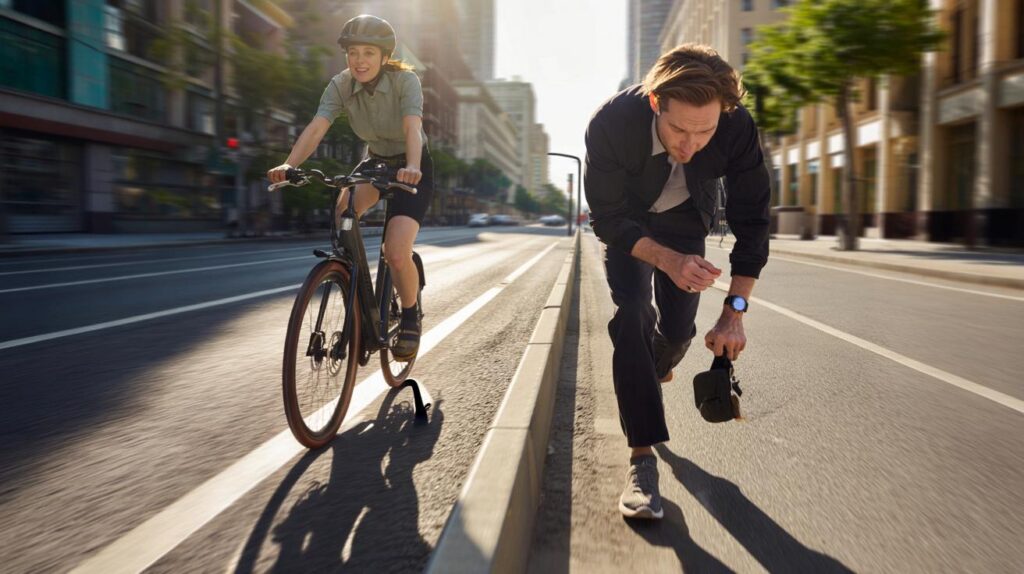
Morning miles feel different depending on your choice of wheels or heels, but the energy maths may surprise you.
Your body tells you a story every time you travel. On two feet you work hard for each step. On two wheels you glide.
A machine that suits the body
More than a billion people own a bicycle, and for good reason. Pedalling uses compact, circular movements rather than heavy leg swings. That simple change saves effort on every metre you cover.
Walking and running load your limbs with repeated lift-and-swing. Each stride fights gravity and momentum. The work soon adds up. On a bike your hips, knees and ankles turn smoothly, so muscles do less wasteful work and joints absorb fewer jolts.
Cycling can be at least four times more energy‑efficient than walking, and roughly eight times more efficient than running.
Time tells the same tale. A typical city speed of 15–20km/h on a bike shrinks a 5km journey to around 15–20 minutes. At 5km/h on foot, you can spend an hour on the same route.
Why wheels matter
Feet collide with the ground; tyres roll. That one difference changes everything. Each footstrike wastes energy as sound, heat and vibration. It also creates a tiny braking force as your foot lands ahead of your centre of mass. You then spend energy to overcome your own micro‑brake.
A rotating wheel avoids that stop–start. The tyre makes gentle, rolling contact with the road and lifts away without impact. Your pedalling force points in a clean direction, and more of it turns into forward motion rather than noise and shake.
Rolling contact turns muscle effort into movement with minimal loss; impacts do the opposite.
Gears keep muscles in their sweet spot
Muscles lose force and burn more energy when they contract too quickly. That is why sprinting feels so punishing compared with jogging. Bicycle gears solve this. As speed rises you shift up, keeping your legs turning at a comfortable cadence while the bike accelerates. The machine matches your physiology rather than forcing it.
- Use low gears to climb while keeping a steady cadence and reducing knee strain.
- Shift up on flats to maintain speed without spinning out or fatiguing fast‑twitch fibres.
- Aim for 70–90 revolutions per minute for most commutes; it balances comfort and power.
When walking still wins
There are gradients where legs beat gears. On very steep slopes around 15 per cent and above, straight‑line pushing with your legs can feel easier than trying to drive the pedals. You and the bike are heavy; torque demands grow quickly. Dismounting and walking preserves energy and confidence.
The downhill story flips. Beyond roughly a 10 per cent descent, every step hits hard. Your muscles act like brakes to control your drop, which costs energy and jars joints. Bicycles roll downhill efficiently, and gravity becomes your helper.
Steep uphills favour walking above about a 15 per cent gradient; steep downhills punish it beyond about 10 per cent.
What this means for your commute
For everyday journeys on typical urban gradients, bikes deliver more distance, less time and less metabolic cost per kilometre. The numbers below illustrate a 5km trip for an average adult.
| Mode | Typical time | Estimated energy used | Notes |
|---|---|---|---|
| Walking (5km/h) | ~60 minutes | ~250–300 kcal | Higher limb swing cost and repeated impacts |
| Cycling (15–20km/h) | ~15–20 minutes | ~90–150 kcal | Rolling contact and gearing improve efficiency |
| Running (10km/h) | ~30 minutes | ~500–700 kcal | Fast contractions drive energy cost up |
Figures vary with mass, wind, tyres and surfaces, but the gap remains clear: the bike takes less energy per kilometre and slashes time on most routes.
Practical ways to bank the gains
- Choose forgiving tyres: slightly wider, properly inflated tyres roll fast and cushion bumps.
- Plan gradients: if your route includes a brutal 15 per cent pinch, consider a short walk or a detour.
- Sit and spin: keep a smooth cadence rather than grinding heavy gears.
- Brake early, lightly: smooth braking avoids energy‑sapping surges back to speed.
Health, joints and everyday risks
Lower impact helps knees, hips and ankles, especially if you carry a backpack. Cycling loads the joints less at commuting speeds, while still training the heart and lungs. For many riders, a daily 20–30 minute pedal fits the activity guidelines without leaving them wrung out.
Road risks exist, so stack odds in your favour. Fit bright lights front and rear, even in daylight. Use a bell. Position yourself where drivers can see you, and make eye contact at junctions. A well‑adjusted helmet reduces head injury risk, though visibility and road position matter just as much. Regular checks on brakes, chain and tyre pressure keep stopping distances short and handling predictable.
E‑bikes extend the advantage
Pedal‑assist bikes keep the biomechanics and add a small motor that supports your effort. You still move your legs and raise your heart rate, yet you crest hills without spiking breathing or heart load. That keeps older riders and those with joint niggles in the saddle. It also extends realistic commuting range from 5–10km to 15–25km for many people.
Money, carbon and noise
Energy efficiency shows up in your wallet. A short urban return trip on a bike costs pennies in wear and charging if electric, versus fuel and fares that climb quickly. Tyres and chains are cheap to maintain; your car stays at home for short hops that damage engines and wallets. One more bonus: bikes make little noise, and quieter streets feel safer and calmer for everyone.
A quick planning exercise for you
Think about your most common weekday journey. If it is 4–6km, cycling at an easy 16km/h trims 30–45 minutes off a round trip. Do that four days a week and you buy back two to three hours. Over a year that is roughly 100–150 hours you can spend sleeping, reading or with family. At the same time you reduce repetitive impact on joints and keep your heart working most days.
If hills worry you, test the route on a weekend. Note any section that nudges past that 15 per cent feel. Walk the steep pinch, then remount; your total time still beats a full walk by a long way. If traffic feels hostile, select a parallel quietway even if it adds 500 metres; the extra distance barely dents the time advantage when you roll at cycling speed.
For the typical city dweller, two wheels turn daily effort into distance, time and comfort you notice.
Extra angles to try next
Track cadence for a week and adjust gearing to stay near your comfort zone; many riders find they arrive calmer and less sweaty. Swap a backpack for a pannier to cut back strain on your shoulders. On rainy days, full‑length mudguards and a light waterproof keep clothing clean so you can ride year‑round. If you prefer indoors, a 20‑minute turbo trainer session after work gives similar leg mechanics and cardiovascular benefits with zero traffic risk.
The big idea to keep in mind: rolling wheels, smooth gearing and compact leg motion convert your effort far more cleanly than footsteps do. That is why a bicycle often feels easier, faster and kinder to your body on the journeys you make most.



I switched to cycling last month and the 4-5km commute now takes 18 minutes instead of almost an hour. The cadence tip (around 80 rpm) was gold—arrive less sweaty and my knees feel calmer. Thanks for laying out the numbers.