
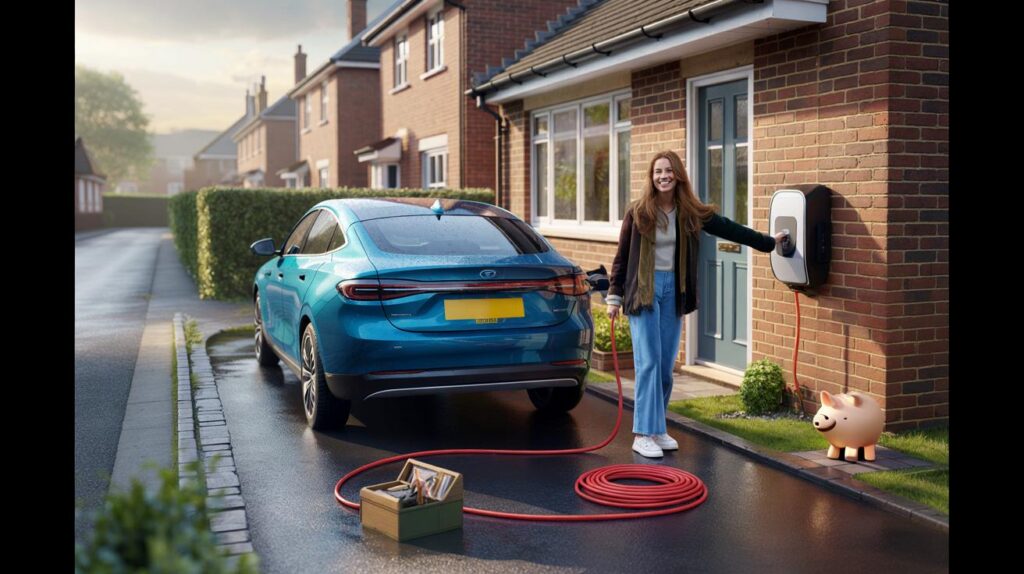
Homeowners and tenants across England woke today to a quiet shake-up that could slash delays, costs and charging headaches.
The Government has brought in a rule that removes the need for planning permission for most domestic electric vehicle charge points in England, alongside simpler approvals for many workplace and street installations. It’s designed to speed up the switch to electric, cut red tape and, for thousands, move a charger from “someday” to “this month”.
What has changed
Until now, installing public and workplace charging often meant a tangle of forms, drawings and an uncertain wait. In some areas, projects stalled for up to nine months while planners worked through applications. Those queues are being cleared. Most home chargers on private driveways now count as permitted development, and key pieces of kit that power rapid hubs — such as substations on suitable sites — can proceed without a full planning application.
From today in England, most driveway EV charge points no longer need planning permission, removing months of delay for many households.
Officials say cutting paperwork will increase the number of places to plug in, which is vital for drivers who cannot charge at home. The policy dovetails with longer-term goals: the Department for Transport expects at least 300,000 public charge points to be needed by 2030, and the sale of new petrol and diesel cars is still due to end that year.
Who benefits right away
Homeowners and renters with a driveway
If you have off-street parking in England, the path to a home charger just got shorter. You can commission an approved installer, choose a compliant smart unit and proceed without planning permission in the majority of cases.
People without a driveway
Streamlined approvals are aimed at councils and private operators too, supporting more on-street posts and rapid hubs at retail parks and service areas. Faster delivery should narrow the gap between those with private parking and the many relying on public charging.
Quicker delivery of kerbside and rapid sites matters for millions who park on-street and cannot charge at home.
Limits still in place
This change does not mean a free-for-all. Certain locations remain sensitive. If your property is listed, within the curtilage of a listed building, or in a conservation area, you may still need consent. Installations must also respect highway safety and sit wholly within your land unless specific permission has been granted.
Trailing cables across pavements are risky and can attract fines. Some councils allow cable gullies recessed into the pavement, but these usually require consent and must be installed to precise standards. Always check before cutting a channel or running a cable mat to the kerb.
What it could save you
| Step | Before the rule change | From now |
|---|---|---|
| Home driveway charger | Often permitted, but some areas sought applications; uncertainty and occasional delays | Broadly permitted development in England; no planning application in most cases |
| Public rapid hub equipment | Full planning for many components, including electrical infrastructure | Simpler route for essentials like substations on suitable sites |
| Typical wait for public projects | Weeks to nine months, depending on council | Shorter timelines where planning no longer applies |
| Upfront paperwork and fees | Application fees, drawings, consultancy time | £0 planning fee for most home chargers; streamlined approvals elsewhere |
Costs, grants and technical rules
A standard smart home charger typically costs £800–£1,500 including installation, depending on cabling runs and whether your consumer unit needs an upgrade. Many households can avoid a dedicated new supply; installers will test your existing capacity and advise.
Grants are still available in targeted cases. Flat owners and renters may qualify for up to £350 off a charge point through the EV Chargepoint Grant. Businesses can use the Workplace Charging Scheme for up to £350 per socket, capped at 40 sockets per applicant.
All new domestic units must be “smart” under UK regulations, with features such as off-peak scheduling and power balancing. Installations must comply with BS 7671 wiring standards and Building Regulations Part P. Always use a competent installer who can notify the work.
The grid: the sticking point
While planning is now simpler, connecting new public sites to the electricity network can still take time. Larger rapid hubs often require reinforcement and may wait months for a slot. Rural areas and edge-of-town locations can be particularly challenging, which is why industry groups keep pushing for faster grid connections and clearer timelines.
Permits are simpler, but the grid connection queue remains the bottleneck for rapid and ultra-rapid charging sites.
For households, grid issues are far rarer. Most domestic chargers can be fitted after a simple notification to your distribution network operator, although a minority of properties will need upgrades.
Why this matters for your wallet
Charging at home is usually cheaper than public rapid charging, especially if you switch to an off-peak tariff. Many suppliers now offer night rates between 5p and 10p per kWh for a set window, which can cut your “fuel” bill to a fraction of petrol. Public pricing has eased from last winter’s highs but still costs more than home energy, so bringing a charger to your driveway can pay back quickly if you drive regular mileage.
What you can do this week
- Check your property: confirm you have off-street parking entirely within your boundary.
- Speak to your freeholder or landlord if you rent or live in a flat; written consent is usually required.
- Get three quotes from OZEV-approved installers; ask about cable runs, load management and smart features.
- Ask your supplier about off-peak EV tariffs and whether a smart meter upgrade is needed.
- If you live in a conservation area or listed property, email the planning team for written confirmation before work.
How this fits the bigger picture
Ministers are betting that trimming process will unlock thousands of new sockets quickly, alongside the Government’s £2.3 billion funding pledge for charging and manufacturing. The target of 300,000 public chargers by 2030 remains a tall order, but the direction is clear: fewer barriers for installers, more choice for drivers, and a stronger push toward cleaner fleets before the petrol and diesel sales ban arrives.
What about new-builds and renovations
New homes and major non-residential developments in England already require EV charging provision under building rules introduced in 2022. If you’re planning an extension or converting a garage, ask your designer to include a cable route and charger point now; it is much cheaper to fit during works than later.
Two quick scenarios to consider
A family with a driveway in a suburban semi can now book an approved installer without planning paperwork, fit a 7 kW smart unit for around £1,000 and switch to a night tariff. At 8p per kWh off-peak, a 60 kWh charge costs under £5, covering roughly 180–220 miles depending on the car.
A small employer with a car park can move faster on staff charging. With simpler approvals and the Workplace Charging Scheme, four 7 kW sockets can be installed at lower up-front cost, improving staff retention and helping the firm meet sustainability targets.
Key takeaways
Most driveway chargers in England no longer need planning permission. Grants exist, smart features are mandatory, and home charging paired with off-peak tariffs remains the cheapest way to run an EV.
If you have a driveway, the practical route is now: confirm any local constraints, get quotes, pick a smart unit, schedule installation, and set your tariff. For those relying on the public network, watch for faster rollout of kerbside posts and rapid hubs as the planning queue shrinks.



Finally! No more planning limbo for a simple 7 kW box. This could shave months and real money off installs for families like mine. Now, can suppliers stop hiding the best off‑peak EV tariffs behind smart meter queues?
Cutting red tape is great, but if the DNO says “wait 6 months for a connection,” aren’t we back to square one? The grid is the bottleneck, not the paperwrk. Show me connection timelines improving and I’ll believe the rollout projections.