
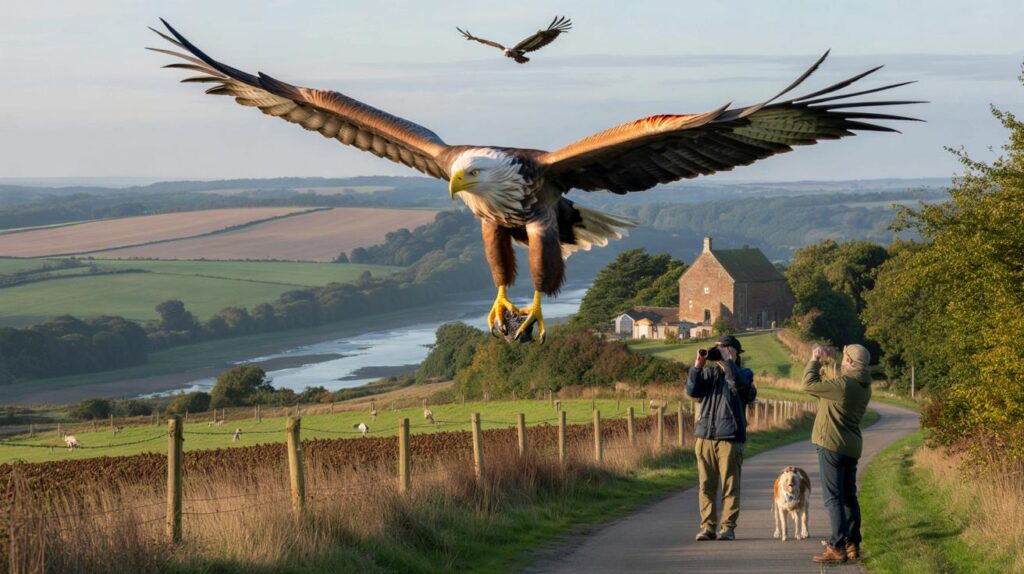
Above hedges and hop fields, an immense silhouette slipped across the Wealden sky, lifting binoculars and eyebrows in equal measure.
On 22 September at around 4pm, a white-tailed eagle passed over farmland near Robertsbridge in East Sussex, giving locals a rare close look at Britain’s biggest raptor and stirring talk of how far these birds now roam.
A giant over Robertsbridge
Landowner Will Hoad reported the eagle coursing over his fields in late afternoon light. The bird held long, plank-like wings flat as it drifted, then pushed forward with slow, powerful wingbeats. The encounter lasted minutes, long enough for photographs and for that unmistakable sense of scale to register.
The sighting sits within a growing pattern. Since reintroduction began on the Isle of Wight in 2019, young sea eagles have ranged widely over southern England. East Sussex has seen scattered reports, but an individual over inland farmland remains a headline moment for local wildlife watchers.
At up to 2.5 metres across, the white-tailed eagle is the largest bird of prey in the UK, dwarfing buzzards and kites.
Where did this bird come from?
Hoad suspects the eagle travelled from the Isle of Wight cohort. That is plausible. Satellite tags have shown reintroduced birds exploring coastlines, estuaries and river valleys before settling into seasonal routines. The Robertsbridge area, with the River Rother, stored lakes and well-stocked ponds, offers ample feeding opportunities during a roaming phase.
White-tailed eagles carry a pragmatic diet. They scavenge readily, take fish from open water, and lift waterbirds from the surface. Rabbits and hares feature when available. Their ability to exploit many habitats increases the likelihood of occasional appearances far from the sea.
Released in 2019 after an absence of about 240 years from southern England, these eagles are part of a long-term programme led by Forestry England and the Roy Dennis Wildlife Foundation.
What the sighting means for East Sussex
An eagle overhead signals healthy, connected landscapes. Large raptors need space, food and clean water. The High Weald’s mosaic of woodland, pasture, rivers and reservoirs supplies that mix. Occasional visits also highlight how restored species can create new points of local pride and wildlife interest, from school projects to weekend walks that double as wildlife surveys.
Concerns surface as well. Anglers worry about impacts on stocked waters. Farmers ask about lamb safety. Evidence from northern Britain and continental Europe shows the species relies largely on fish, waterbirds and carrion. It takes weak or dead livestock in rare instances. Good carcass management and swift reporting of problem behaviour reduce conflicts.
How to identify a white-tailed eagle
Size, shape and behaviour
- Wingspan: about 2.1–2.5 m; body length: roughly 70–90 cm; females are heavier than males.
- Wing shape: long, broad and almost rectangular, with a straight trailing edge; flight looks steady and deliberate.
- Tail: adults show a pale, wedge-shaped tail; young birds have a dark tail and gradually pale with age.
- Head and bill: pale head on adults, with a heavy, powerful bill that looks prominent in profile.
- Flight style: soaring on thermals with minimal wing flex; will quarter lakes and estuaries and drop to the surface to lift fish.
From a distance, the best clue is sheer size. If a bird makes gulls look small and puts buzzards to shame, you may well be watching an eagle.
Key figures at a glance
| Measure | Typical value |
|---|---|
| Wingspan | 2.1–2.5 m (6.9–8.2 ft) |
| Body length | 70–90 cm |
| Adult weight | Approx. 4–6.5 kg (females heavier) |
| Nesting sites | Cliff ledges or large trees |
| Diet | Fish, waterbirds, small mammals, carrion |
| Pair bond | Long-term; often mate for life |
A species brought back from the brink
Sea eagles vanished from England in the late 18th century after centuries of persecution. The last known pair nested on the Isle of Wight in 1780. That same island now anchors their return. The structured programme began with six juveniles released in 2019, with further releases scheduled over several years to build a small but viable population.
Survival in the early years depends on finding food and avoiding hazards such as illegal poisoning, collisions and disturbance. Public awareness helps. So does a landscape that tolerates apex predators and benefits from the cleanup service they provide by removing carrion.
If you saw the eagle, what should you do?
Collect the details
- Note the exact time and date, and mark the spot on a map or phone.
- Record the direction of travel and any behaviour, such as circling, diving or perching.
- Estimate size by comparison: nearby gulls, herons or buzzards make useful yardsticks.
- Take photographs if safe to do so; even distant images can confirm features.
- Share your record with a local bird group or a national recording scheme.
Give the bird space. Keep dogs under close control around waterbirds and livestock. Do not approach potential roosts or tall trees if a large raptor is present.
This bird was reported at about 4pm near Robertsbridge on 22 September. Clear details like these turn a lucky sighting into valuable data.
Why East Sussex suits a sea eagle on the move
The county’s rivers, reservoirs and gravel pits act as service stations for travelling birds. The Rother and its floodplain host fish and waterbirds. Coastal marshes sit within easy reach. Winter brings higher numbers of gulls and duck on inland waters. All of this gives a juvenile eagle room to learn, fail safely and improve its hunting technique.
When these birds find a reliable food source, they may linger for days. Anglers sometimes report a bird standing on the bank, scanning the shallows. Farmers see one riding low over pastures. Most encounters pass quietly, with the bird drifting on to the next valley by evening.
What about pets and livestock?
Healthy dogs and cats are not typical prey. Adult eagles aim for efficient meals and avoid risky fights. They target fish, waterfowl and carcasses. Lambs can be vulnerable in specific situations, especially near the coast or on islands, but evidence from the species’ wider range indicates incidents remain infrequent. Clear communication between farmers, local raptor workers and project teams reduces fear and speeds up solutions if a pattern emerges.
What to look for next
If East Sussex continues to host occasional visitors, spring and early summer could bring more sightings as young birds disperse from wintering areas. Watch reservoirs, large lakes and estuaries on bright, breezy days. Thermals after late morning make life easy for big wings. A pale tail and creamy head signal an adult. A darker bird points to a younger age class.
These eagles build loyalty to breeding areas as they mature. They prefer cliff ledges or massive trees with open views. If a pair decides the south coast suits them, future headlines may feature nest building and territorial displays over the Weald.
Further context for readers
Reintroduction programmes rely on patient timelines. Young raptors often wander for several years before breeding. That delay can feel frustrating locally, yet it gives the public time to adapt to a large predator’s return. Schools develop lesson plans. Visitor centres add identification guides. Land managers trial measures that protect both wildlife and livelihoods.
If you want to build your field skills, practise estimating wingspans against known objects. A standard telegraph pole crossarm or a five-bar gate offers a rough yardstick. Then test yourself on common raptors first. Once you can separate a buzzard at a glance, a sea eagle becomes unmistakable the moment those vast, steady wings slide across the sky.



Saw it from the footpath by the Rother at about 4:10 — biggest bird I’ve ever seen, like a kite on steriods. Got a blurry pic if anyone wants to compare?
So the “flying barn door” finally paid East Sussex a visit — next stop, landing on my allotment and judging my scarecrow’s performance 🙂