
Cold evenings, misted windows and that stubborn damp smell can linger for days. A simple change to your drying setup can help.
Across Britain, renters and families face the same headache: wet washing hogs space, eats time and invites musty odours. A Japanese hanging trick known as the “rainbow method” promises quicker, cleaner drying without buying new kit or switching on the tumble dryer. Here is how it works, why it helps, and when to use it.
What the rainbow method actually is
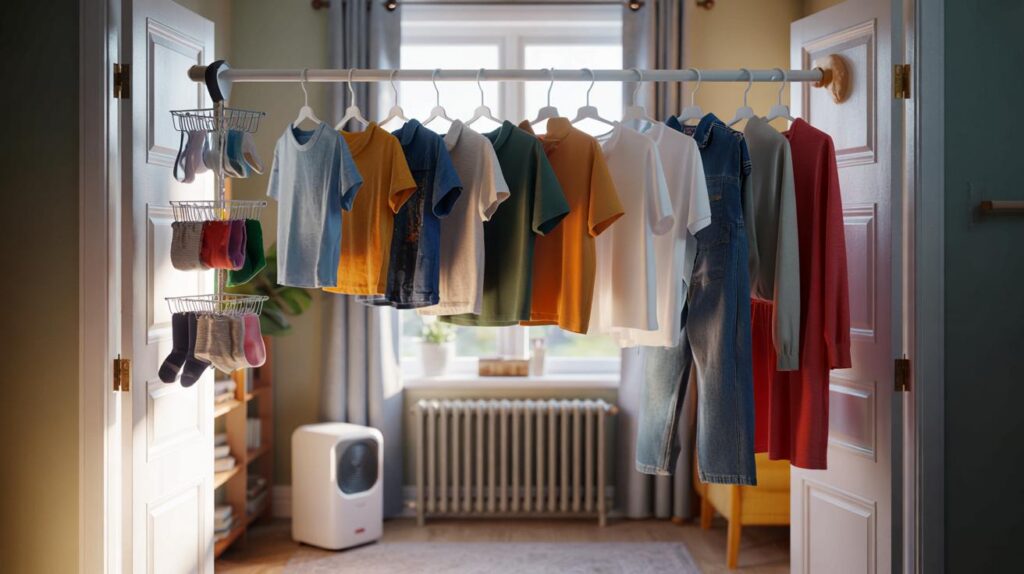
The idea is disarmingly simple. You hang garments on separate hangers and arrange them in a shallow arc, with the shortest items in the middle and the longest at the ends. That curved, stepped outline creates gaps that air can move through. The extra airflow speeds evaporation and reduces the chance of that stale, wet-laundry smell.
Alternate lengths and fabrics so each item has breathing space. Short in the centre, long at the edges, and nothing touching.
You can set the arc across a curtain pole, a sturdy door frame, a freestanding rail or a clothes horse. Socks and underwear go on a clip rack, hung at one end of the arc so air is not blocked.
Step-by-step setup you can copy
- Fast spin first: use your washer’s highest safe spin (1,200–1,400 rpm) to shed water before you hang.
- Lay out hangers: 8–12 is plenty for a family wash, spaced roughly a hand’s width apart.
- Sort by length and bulk: vests and baby items in the middle; jeans, hoodies and long dresses towards the ends.
- Mix fabrics: avoid clustering heavy cottons together; interleave with synthetics to keep air paths open.
- Aim for a gentle arc: not a tight U-shape, just enough step-down to expose hems and cuffs.
- Give sleeves a shake: pull them straight so air reaches inside areas that usually stay damp.
Where to hang for the best results
Pick the driest, most ventilated spot you have. A bright window with trickle vents open works well. A central hallway with some airflow also helps. Avoid the bathroom or a small enclosed bedroom where moisture lingers and condensation forms.
Target indoor relative humidity at 40–60%. If it rises above 65%, open a window slightly or run a dehumidifier.
Does it really speed things up?
A simple home trial shows why many households swear by the method. Using a typical heated flat at 20°C with moderate ventilation, the arc layout reduced drying times markedly compared with a packed, straight rail.
| Drying setup | Example item | Indicative time to dry | Notes |
|---|---|---|---|
| Packed, straight rail | Cotton t-shirt (180 g) | 3 hours 10 minutes | Fabric touches at shoulders and hems; damp smell possible. |
| Rainbow arc on hangers | Cotton t-shirt (180 g) | 1 hour 55 minutes | Air corridor between pieces; no musty odour. |
| Rainbow arc + dehumidifier | Jeans (650 g) | 3 hours 30 minutes | Dehumidifier at 45–50% RH; window closed to retain heat. |
Results vary with fabric, spin speed and room humidity, but a 25–40% reduction in drying time is common when you stop garments from blocking one another’s airflow.
Why airflow beats clumping
Drying depends on evaporation and ventilation. Water leaves fibres faster when moving air replaces the humid boundary layer that hugs the fabric. When clothes touch, that layer thickens and keeps moisture trapped. The arc layout exposes more edge and hem area, and it opens multiple vertical “chimneys” that warm air can rise through. Even slight convection indoors helps shift moisture from wet surfaces to the wider room, where ventilation or a dehumidifier can remove it.
Odours, bacteria and mould risk
Lingering damp creates a home for bacteria that produce volatile compounds—what you smell as “musty”. Keeping air moving and humidity lower than 60% deprives those microbes of the prolonged moisture they need. Good spacing also prevents dye transfer and reduces creasing, which can cut time spent at the ironing board.
Common mistakes to avoid
- Piling heavy items together: alternate dense fabrics with lighter pieces to keep gaps open.
- Overcrowding: if hangers touch, add a second rail or split the load.
- Hanging in the bathroom: moisture builds up quickly and clings to fibres.
- Skipping the spin: poor extraction at the machine adds hours later.
- Blocking radiators: you risk damp walls and higher bills with worse drying.
If you see condensation on windows, crack a window for ten minutes or run a dehumidifier set near 50% RH.
Costs, savings and smart pairings
The rainbow method costs nothing if you already own hangers. For energy, it beats a tumble dryer easily. A typical vented dryer cycle can use around 2.5–4.0 kWh; on a tariff of 28 p/kWh, that’s roughly 70p–£1.12 per load, depending on machine and fabrics. Using hangers with a small, efficient dehumidifier (say 150–250 W) for three hours might use 0.45–0.75 kWh, or 13p–21p at the same rate, while also protecting against damp. Your tariff and room conditions will shift the maths, but airflow always helps.
Good partners for the method
- A clip rack for socks and smalls: hang it at the narrow end of the arc so it does not block the middle.
- Broad-shoulder hangers: keep shape on jumpers and increase exposed surface.
- A simple fan on low: five minutes every half-hour can move fresh air through without chilling the room.
Who benefits most—and when it might not suit you
Flat-sharers and families in small homes gain the most, as the arc reduces floor space taken by a standard clothes horse. It also suits allergy-sensitive households that prefer to avoid outdoor pollen seasons. If you keep pets or have toddlers, consider height and stability: a wall-mounted rail or a doorway pole keeps hangers out of reach. In very tight studios where humidity spikes fast, add short, sharp ventilation bursts and consider a compact dehumidifier to prevent condensation and black spots on cold walls.
Extra tips that speed drying safely
- Pre-dry prep: give thick items an extra 10-minute spin on the machine’s spin-only setting.
- Shape while damp: smooth cuffs, waistbands and collars; they dry faster when flat and open.
- Rotate once: halfway through, swap a heavy item from the edge to the breeziest spot in the arc.
- Mind the room: keep doors ajar to let moisture migrate; shut the room only if a dehumidifier is running.
Think of your home as a moisture budget: water leaves the drum, enters the room, then must leave the building or hit the dehumidifier.
Going further: humidity, dew point and fabric care
Two readings matter indoors—temperature and relative humidity. Warm air holds more moisture, so a modest increase in room temperature often halves drying times. Dew point tells you when surfaces will fog. If your room is at 18°C and 70% RH, your windows may mist. Reduce RH to around 55% and misting usually stops, while drying picks up pace. A cheap digital hygrometer gives you those numbers so you can judge when to vent or switch on a dehumidifier.
Fabric care matters, too. Wool and delicate knits prefer flat drying; you can still use a mini-arc by laying pieces on a mesh rack with small gaps between. Colour-fast test vivid items before hanging near pale fabrics. For denim, turn inside out and clip the waistband, leaving the legs free so the arc exposes hems to the air stream.
If you want a quick trial, start with 10 items—three pairs of jeans, four t-shirts, one hoodie and two shirts. Spin at 1,400 rpm, then build a gentle arc on hangers across a doorway. Open a trickle vent and run a fan on low for ten minutes each hour. Note start and end times for each piece. You will see the lighter items finish well under two hours, and the heavier ones avoid that stubborn cold-damp feel that often lingers overnight.
The method asks for no new gadgets and little space. By giving each garment a clear path for air, you cut drying time, reduce odours and save energy. For busy homes, that means fewer laundry bottlenecks, a fresher-smelling wardrobe and less moisture drifting into corners where mould could take hold.



Tried the rainbow arc last night—tees and towels dried way faster than usual. Genuis bit about spacing hems and cuffs. Thanks!