
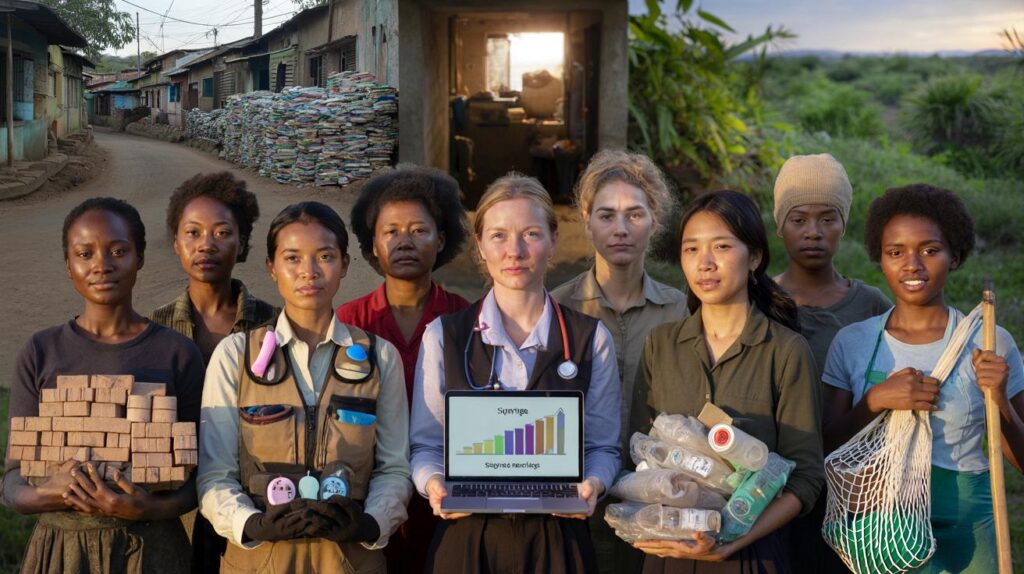
Some women are quietly reinventing the way we live: turning rubbish into homes, reimagining healthcare with a cardboard box, teaching code to those shut out of the room. They don’t trend on your feed. They trend in real life.
I met them first in fragments. A WhatsApp video from Nairobi, plastic shavings falling like confetti as a brick presses into shape. A damp clinic corridor in Rajasthan, a midwife tearing open a pink kit that could stop an infection before it starts. A makeshift classroom in Lima, laptops rescued from office clear-outs glowing on young faces at dusk.
We’ve all had that moment when the world feels too big to fix, and the news too loud to hear anything human. Then someone shows you a small, stubborn solution that works Tuesday after Tuesday. You feel the grip of cynicism loosen, just a touch. Then a woman you’ve never heard of changes your idea of what’s possible.
It wasn’t on TV.
The changemakers hiding in plain sight
First, the women turning waste into worth. In Nairobi, engineer Nzambi Matee built Gjenge Makers, compressing discarded plastic into paving blocks tough enough for roads. These aren’t prototypes; they’re under people’s feet. In the Bahamas, educator Kristal Ambrose took teenagers kayaking through slicks of rubbish until they became lawmakers-in-waiting, pushing her country towards a real single-use plastics ban. In Jakarta, lawyer-activist Tiza Mafira treated plastic bags like cigarettes: a habit that needed rules and a cultural shift. The city banned them in major stores in 2020. One theme runs through their work: rubbish is a design flaw, not destiny.
Health, too, is being re-engineered in the margins. In India, social entrepreneur Zubaida Bai created affordable clean birth kits—sterile tools in a simple pouch—that midwives can carry on a motorcycle. Infection drops. Babies breathe. In London, researcher-inventor Hadeel Ayoub built the BrightSign glove, translating hand movements into text and speech for sign language users. It’s hardware you can hold, not a promise on a slide. Small changes that cut through the noise tend to look like this: specific, portable, owned by the people who need them most.
And in Uganda’s forests, conservation refuses to stand apart from community. Veterinarian Dr Gladys Kalema-Zikusoka treated mountain gorillas, then realised that sick people living nearby were spreading diseases to the apes. She founded Conservation Through Public Health to link clinics, livelihoods and wildlife protection. Masks and handwashing weren’t just for pandemics; they were for primates too. Mountain gorilla numbers have climbed past 1,000 worldwide, thanks to efforts like hers and decades of cross-border cooperation. The insight is simple enough to fit on a poster: when people thrive, nature has a chance.
New power in code, cash and classrooms
Here’s a method you can steal today: the 1–2–3 rule for backing hidden leaders. One: follow three of them in your feed—read their project updates before the headlines. Two: fund a micro-pledge each month, even £3, to a specific tool they use (kits, scholarships, lab time). Three: forward their work to one person who might actually act on it. Ten minutes, set as a recurring calendar nudge, builds real momentum over a year.
There’s another lever: everyday infrastructure. In Lagos, fintech builder Odunayo Eweniyi turned tiny decisions into power with PiggyVest, helping millions of Nigerians save automatically, round-up by round-up. She also co-founded Feminist Coalition, which mobilised emergency support during #EndSARS—courage at speed, with receipts. In Addis Ababa, coder Betelhem Dessie mentors girls who’ve never touched a Raspberry Pi until they build out their first bot. In Lima and beyond, Mariana Costa Checa’s Laboratoria trains women in UX and web development, then walks them straight into jobs. Let’s be honest: nobody changes the world alone on weekends. People change when the rails they run on change.
Progress stalls when we overcomplicate support. You don’t need to write a manifesto; you need to show up consistently.
Change compounds when it feels local, doable and ours.
Build a micro-portfolio of women-led projects just like you’d build a savings habit. Start with these simple actions:
- Swap doomscrolling for “discover scrolling”: search the names Nzambi Matee, Kristal Ambrose, and Tiza Mafira, then hit follow.
- Buy once from a social enterprise this month: a clean birth kit donation via Ayzh, or a BrightSign device fundraiser.
- Join a skills circle: mentor one learner from Laboratoria or iCog-ACC, monthly, for 30 minutes.
- Share a field story, not a hot take: Dr Gladys’s clinic-forest model is a better argument than any thread.
The signal that cuts through
Some names travel less because they spend more time doing than debuting. Rumaitha Al Busaidi in Oman works across climate science and food security, bringing women into fisheries and resilience planning in a region where they were rarely at the table. That quiet, practical expansion of who gets to shape the future is the story. **This is not a movement built around one face; it’s a network of competence.** The more we circulate their work, the less novelty we attach to women leading at scale. *Familiarity is a kind of power in public life.* When these leaders feel familiar, their budgets grow, their copycats multiply, and the next girl sees a path that isn’t labelled “exceptional.”
These ten women point to a pattern worth sharing. Solutions that last tend to be rooted, iterative and boring on purpose: bricks that don’t crumble, code that keeps running, clinics that never close. There’s nothing soft about it. **The real revolution is administrative: who gets resources, who is in the room, whose design wins by Wednesday.** The big story is already happening in Nairobi side streets, Ugandan health posts, Peruvian bootcamps, Omani labs and Caribbean shorelines. The only question is whether we choose to amplify what’s working, or scroll past it and wait for the next headline to tell us what matters.
| Point clé | Détail | Intérêt pour le lecteur |
|---|---|---|
| 10 hidden innovators | From Nzambi Matee to Rumaitha Al Busaidi, leaders across waste, health, tech and climate | Discover practical solutions you can back today |
| The 1–2–3 support rule | Follow, fund, forward—10 minutes a month | Easy habit to convert admiration into impact |
| Design over drama | Local, repeatable fixes beat viral moments | Guides smarter choices about what to amplify |
FAQ :
- Who are the ten women mentioned?Nzambi Matee, Kristal Ambrose, Tiza Mafira, Zubaida Bai, Hadeel Ayoub, Dr Gladys Kalema-Zikusoka, Odunayo Eweniyi, Betelhem Dessie, Mariana Costa Checa and Rumaitha Al Busaidi.
- Why haven’t I heard of them?They prioritise building over branding, and their work is often local or technical—high impact, low hype.
- How can I support them from the UK?Use the 1–2–3 rule: follow their channels, set a small recurring donation where possible, and share a specific story with someone who can act.
- Is this only about charity?No. Many run businesses or training programmes—think purchases, partnerships, internships and policy support, not just donations.
- What should I look for to spot similar leaders?Clear problem statements, simple tools in real use, measurable outcomes, and communities that vouch for them.



Loved the 1–2–3 rule—set a calendar nudge today and followed Matee, Ambrose, and Mafira. Quick question: are there beginner-friendly funds or platforms that bundle micro-pledges to these specific tools, so we don’t each reinvent the wheel?
This is inspiring, but how are you verifying impact beyond anecdotes? For example, do you have longitudinal data on infection reductions from Ayzh kits or job placement/retention metrics from Laboratoria cohorts? Selection bias is real; links to open datasets or evaluations would be great.